
AR▼

هذا المنتج متوافق مع المعدات والتطبيقات الخاصة بالعلامات التجارية التالية أو مناسب لها، وذلك للاسترشاد به عند الاختيار فقط. تعود العلامات التجارية إلى أصحابها كل على حدة، ولا تمثل أي شراكة أو تأييد.
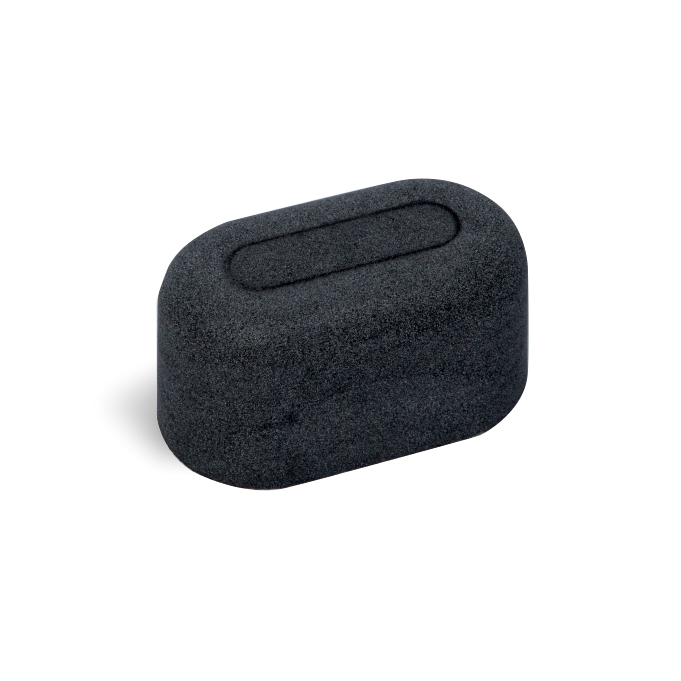
This is a Ranveth water pitcher filter cartridge built around a food-grade PP housing, high-iodine coconut-shell granular activated carbon and ion-exchange resin. It is made to reduce residual chlorine, colour and odour, soften water by cutting calcium and magnesium scale, and hold back heavy metals such as lead and copper, along with sediment and rust. It suits household water pitchers, portable sports bottles, desktop instant-heating dispensers and the internal tank filters of capsule coffee machines. The design logic is simple to state and worth understanding before you buy: the carbon and resin are paired in a set ratio, and that pairing sets the efficiency, the gravity flow rate and the service life you get.
In a gravity-fed pitcher cartridge, the media do not work as a list of separate features. They work as a ratio. Coconut-shell activated carbon carries a high iodine value, which gives it the pore volume to pull residual chlorine and odour compounds out of tap water quickly. Ion-exchange resin handles a different job: it exchanges calcium and magnesium ions to soften the water and helps capture dissolved heavy metals. Change the proportion of one to the other and three things move together.
Push the carbon share up and dechlorination and taste improvement come faster, but softening capacity drops. Push the resin share up and scale control and lead and copper reduction improve, but the carbon has less contact volume and odour removal weakens. The ratio also changes how long water takes to pass through the bed, because each medium packs and wets differently. That is why we treat the blend as a specification, not a commodity fill.
The food-grade PP shell is precision injection moulded, and the internal mesh is dimensioned to keep a steady gravity down-flow while holding the carbon fines inside. This is the part buyers notice first in use: a well-matched mesh and media bed gives clear water, with no black flush at first use and no carbon dust carried into the jug. The housing also protects the bed from channelling, so water passes through the media rather than around it. If the mesh is too coarse, fines escape; too fine, and the flow slows to a trickle. The mesh, the media grade and the blend ratio are therefore engineered as one set of choices, and each affects the other two.
For buyers, the practical consequence is that a cartridge should be specified against the water it will treat. A market with hard water needs more resin; a market where chlorine taste is the main complaint may favour a carbon-forward blend. Ranveth adjusts the activated carbon to resin ratio for the target duty, whether that is lead reduction, scale control or general dechlorination, and we can mould a housing to your own outer shape. Because the media pairing is test-backed in our own laboratory, the blend you approve is the blend we can document.
| Item | Detail |
|---|---|
| Product name | Dechlorination water pitcher filter cartridge / drinking bottle filter cartridge |
| Core filtration materials | Food-grade PP housing, high-efficiency coconut-shell granular activated carbon, selected ion-exchange resin |
| Core purification functions | Strong adsorption of residual chlorine, colour and odour; water softening (removal of calcium and magnesium scale); interception of harmful heavy metals such as lead and copper; filtration of sediment, rust and suspended solids |
| Flow and filtration characteristics | Precision injection-moulded mesh designed to maintain an excellent gravity down-flow rate while preventing internal carbon fines from leaking, so no black water appears in use |
| Main end applications | Household water pitchers, portable sports water bottles, filter components for desktop instant-heating dispensers, internal tank filter cartridges for capsule coffee machines |
| Media ratio and tooling customisation | 100% OEM flexible contract manufacturing. The activated carbon to resin mixing ratio can be adjusted for target lead-reduction or descaling requirements; the housing shape and structure can be injection moulded with customer-specific tooling |
| Quality certification and safety systems | Produced in the company's 20,000 m² cleanroom area, in line with international potable-water and food-contact safety standards. The company holds ISO 9001 and ISO 14001 system certification and IATF 16949 certification |
The cartridge is sized for gravity-fed and low-pressure drinking applications. The most common use is the household water pitcher, where the cartridge sits in the upper reservoir and water passes through by gravity. The same construction fits portable sports water bottles, where the filter is built into the bottle or cap assembly. We also supply filter components for desktop instant-heating dispensers and internal tank filter cartridges for capsule coffee machines, both of which benefit from chlorine and odour reduction before the water is heated or brewed.
Because the blend ratio can be tuned, the same platform can serve different market positions: a dechlorination-led cartridge for taste, a resin-rich cartridge for hard-water regions, or a balanced blend for general household use. If your device has its own housing, we can mould to your drawing; if you are developing a new pitcher or bottle, we can start from the media specification and work outward to the shell.
A custom build starts from your application, not from a catalogue number. To quote accurately and to choose the media ratio with you, we ask for the following:
With those details we can propose a carbon-to-resin ratio, confirm the mesh and housing options, and return a quotation with sample timing.
Media choices are only as good as the evidence behind them, so we put testing first. Our in-house laboratory holds CNAS accreditation, the China National Accreditation Service for Conformity Assessment, and can issue test reports covering filtration efficiency, dust-holding capacity and resistance. That is how a blend ratio becomes a documented specification rather than an assumption.
Production runs in a 50,000 m² plant in Zhongshan, Guangdong, China, which includes six cleanrooms totalling 20,000 m². Cartridge filling and sealing take place in that controlled environment. The company holds IATF 16949, awarded in 2024, together with ISO 9001, ISO 14001 and ISO 45001 system certification, and products meet REACH and RoHS requirements with compliance documents available. With more than 20 years of filtration development and manufacturing and over 20 years of continuous export to Europe, the United States, Japan and Korea, we have built more than 1,000 filtration solutions and run IQC, IPQC and OQC checks through the whole process.
If you are evaluating a pitcher, bottle or dispenser filter, tell us the model, size or drawing, the flow your system needs, your operating conditions and your quantity. We will come back with a proposed media pairing, sample arrangements and a quotation. You can reach the team through the contact page.
The cartridge uses high-iodine coconut-shell granular activated carbon paired with ion-exchange resin in a food-grade PP housing. The carbon-to-resin ratio is set against the target duty: more carbon favours dechlorination and odour removal, while more resin favours softening and lead and copper reduction. We adjust the ratio for each customer's water conditions and performance goal.
The coconut-shell activated carbon removes over 95% of residual chlorine from tap water and also adsorbs colour, odour and some organic pollutants. Under standard household use of roughly 2–4 L per day, a single cartridge lasts up to 150 L or about one to two months. These figures are verified by testing in our CNAS-accredited laboratory.
Yes. We support full OEM and ODM work: the activated carbon to resin ratio can be adjusted for lead reduction or descaling, and the outer housing can be injection moulded with your own tooling, including colour and logo printing. We have developed more than 1,000 filtration solutions, so we can start from your drawing or from an existing pitcher or bottle model.
For B2B buyers with a clear purchase intent we can supply standard samples free of charge, with freight usually paid by the customer. For custom samples our engineering team builds to your drawing or sample and can provide a CNAS laboratory test report. Send the device model, size or drawing, flow requirement, operating conditions and quantity for a quotation.
The MOQ is usually 1,000–2,000 pieces depending on specification and packaging, and 5,000 pieces for customised models. Standard items ship in about 7–15 days; OEM production runs typically take 25–35 days. Our own factory in Zhongshan, Guangdong, allows flexible scheduling, and long-term customers can arrange scheduled or split deliveries.
Replace it when it reaches about 150 L of treated water or after one to two months of typical household use, whichever comes first, and sooner if the water is hard or heavily chlorinated. A slower gravity flow or a return of chlorine taste are practical signs that the bed is spent. Consistent replacement keeps the dechlorination and softening performance within the tested range.
Cartridge filling and sealing take place in cleanrooms, and each batch passes IQC incoming inspection, IPQC in-process checks and OQC outgoing inspection. Our CNAS-accredited laboratory can test chlorine removal, flow rate, particle release and heavy-metal leaching. The plant holds IATF 16949, ISO 9001, ISO 14001 and ISO 45001 certification.
We have exported for over 20 years to Europe, the United States, Japan and Korea and hold REACH and RoHS compliance documentation. Packaging can be customised with your printed carton, multi-language instructions and label information for the destination market. For a tailored proposal, contact us with your model and quantity.