
CS-CZ▼

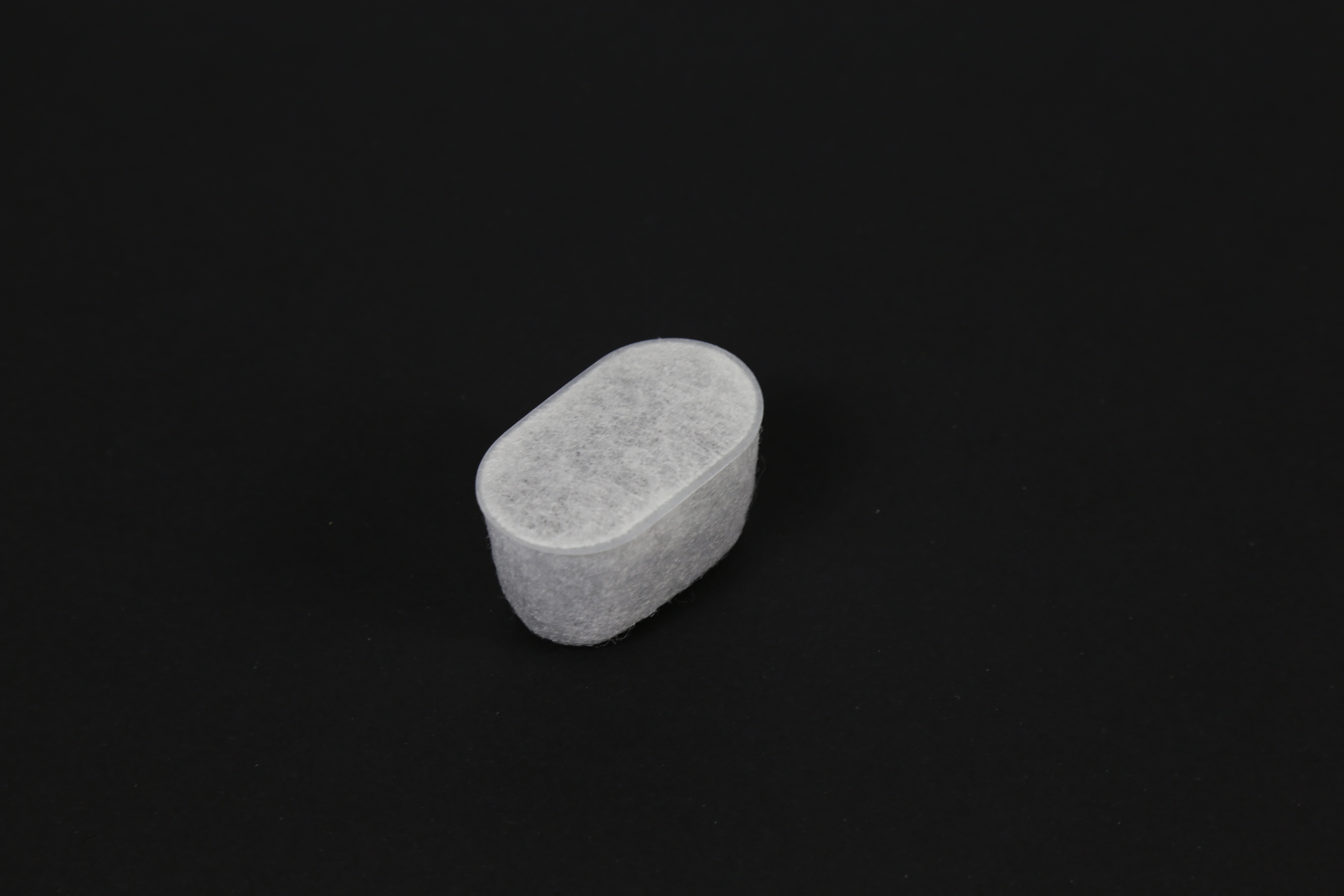
This is a coffee machine water filter compatible with KEURIG brewers, built around a paired bed of coconut-shell activated carbon and food-grade ion exchange resin. It filters cold water to reduce chlorine, off-tastes, odours, scale-forming calcium and magnesium, and larger particles such as sediment and rust before they reach the brew path. It is made by Ranveth for coffee equipment brands, service operators and OEM buyers who want a predictable drop-in cartridge.
The performance of a coffee water filter is decided less by any single material than by how its media are paired and layered. Here, two media do different jobs in the same cartridge. Coconut-shell activated carbon is a hard, microporous carbon with a high surface area, chosen to adsorb chlorine, chloramine by-products and the organic compounds that flatten coffee aroma. Food-grade ion exchange resin works by exchanging calcium and magnesium ions for sodium or hydrogen ions, which lowers the hardness that forms limescale on heating elements and shower screens.
Because the carbon handles taste and odour while the resin handles hardness, neither medium has to be overdosed to compensate for the other. That balance matters for airflow resistance: a tightly packed carbon bed alone would raise pressure drop, but pairing it with resin beads of controlled size keeps the flow path open within the 20–120 psi operating range. Lower resistance is not only easier on the pump; it also lets the media be used more evenly, so capacity is spent across the whole bed rather than at the inlet face. The result is a filter that holds its flow and its taste performance through its rated life rather than fading early.
Construction follows the same logic. The media are held in a compact cartridge sized for the KEURIG filter slot, so replacement is a direct swap. The micron rating is deliberately fine enough to intercept sediment and rust before they reach the resin, protecting the exchange sites and extending useful life. Every choice in the build — carbon grade, resin type, bed depth, compaction — is made together, because changing one alters efficiency, pressure drop and service life at the same time.
| Item | Detail |
|---|---|
| Filtration media | Quality coconut-shell activated carbon plus food-grade ion exchange resin |
| Micron rating | Fine microporous interception; captures sediment, rust and other large particles |
| Filter life | Approximately 250 litres or 2–3 months, depending on local water quality and usage frequency |
| Operating pressure | 20–120 psi (approximately 1.4–8.3 bar) |
| Operating temperature | 2°C–38°C (cold water filtration only) |
| Applications | Automatic coffee machines, semi-automatic espresso machines, commercial coffee machine water softening, OEM water filter cartridge customisation |
| Quality systems | Production follows ISO 9001/14001, IATF 16949, medical supplies GMP standard, and CNAS national-level testing certification |
The filter is designed for the water side of coffee brewing, where small changes in water chemistry show up directly in the cup. In automatic coffee machines and semi-automatic espresso machines, it protects boilers and thermoblocks from the scale that builds when hard water is heated, while the carbon keeps chlorine from masking the aromatics of the coffee. In commercial settings, the same cartridge is used for coffee machine water softening, where consistent water quality across many brew cycles matters more than any single feature.
Because the cartridge is a compact, self-contained unit, it also suits OEM water filter cartridge programmes. Coffee equipment brands and distributors can adopt the standard KEURIG-compatible format or ask for a build matched to a different machine. The filter is intended for cold water lines only and should not be exposed to temperatures above 38°C.
Custom builds start from the machine, not the cartridge. To quote accurately, we ask for the device or vehicle model the filter will serve, so we can match the housing and connection. If the cartridge is not a standard shape, send a dimensioned drawing or a physical sample; size and drawing are the fastest way to confirm fit.
Next, tell us the flow requirement: the water flow rate your machine expects, or for air-side variants the airflow. Operating conditions come next — inlet pressure within the 20–120 psi range, water temperature, typical hardness, chlorine level and any sediment load. Finally, give us the quantity you expect for the first order and for the year, and we will recommend the media pairing and advise on MOQ. If you have a target shelf life or a preferred cartridge colour and logo treatment, include that too. Our team in Zhongshan reviews each request and replies with a proposal rather than a catalogue page.
Ranveth is a filter manufacturer based in Zhongshan, Guangdong, China, with more than 20 years of experience in filtration research and manufacturing and continuous export to Europe, the United States, Japan and South Korea. Media choices are backed by our own laboratory, which holds CNAS (China National Accreditation Service for Conformity Assessment) accreditation and can issue test reports on filtration efficiency, dust holding capacity and resistance. That means the carbon and resin pairing in this cartridge is supported by measured data, not by assumption.
Production runs in a 50,000 m² plant that includes six cleanrooms totalling 20,000 m². The factory operates under ISO 9001, ISO 14001 and ISO 45001, and in 2024 added IATF 16949 automotive quality management certification. Products meet REACH and RoHS requirements, with compliance documents available on request. Quality control covers IQC, IPQC and OQC through the process, and multiple automated lines support monthly capacity in the millions of pieces. For buyers who need a specific fit, media grade, logo or packaging, our team has developed more than 1,000 filtration solutions and offers OEM/ODM support across size, structure, media grade, frame material, logo and packaging.
If you are evaluating this filter for a coffee machine line or an OEM programme, the practical next step is a sample and a quote based on your own water conditions. Tell us the device or vehicle model, the size or drawing, the airflow or water flow, the operating conditions, and the quantity you have in mind. With those details we can confirm the media pairing, propose a specification and set out MOQ and lead time. To start the conversation, contact our team.
It uses quality coconut-shell activated carbon paired with food-grade ion exchange resin. The carbon adsorbs chlorine, off-tastes and odours, while the resin reduces calcium and magnesium hardness that causes scale. Pairing them keeps pressure drop balanced within the 20–120 psi operating range.
The ion exchange resin lowers hardness to limit limescale on heating elements, and the carbon reduces chlorine and organic compounds that affect coffee flavour. The micron rating also intercepts sediment and rust before they reach the media. Our CNAS-accredited laboratory can provide test data on filtration performance for your evaluation.
The standard cartridge is sized as a direct replacement for KEURIG filter slots. For other machines or OEM programmes, we customise size and structure from your drawing or sample. Send the device model and dimensions and we will confirm the fit before quoting.
Yes. We support both stock and custom samples; stock samples usually ship within 3–5 working days, while custom samples with your logo or specification typically take 7–15 working days. To quote accurately we ask for device or vehicle model, size or drawing, airflow or water flow, operating conditions and quantity.
The standard KEURIG-compatible version has an MOQ of 5,000 pieces. For OEM customised versions, we recommend an MOQ of 10,000 pieces or more, depending on the level of tooling and packaging development. MOQ is confirmed together with the specification after we review your requirements.
Stock or small batch orders are typically delivered within 15–20 days. OEM customised production, including tooling and packaging development, usually takes about 25–30 days. Lead time is confirmed in the quotation once the media pairing and packaging are agreed.
The rated life is approximately 250 litres or 2–3 months, whichever comes first, depending on local water quality and usage frequency. Hard water or heavy daily use will shorten that interval. We recommend monitoring taste and flow as practical indicators between changes.
It operates at 20–120 psi (approximately 1.4–8.3 bar) and 2°C–38°C, and is intended for cold water filtration only. It should not be used above 38°C. If your water pressure or temperature falls outside these ranges, tell us so we can advise on a suitable configuration. For a specification matched to your machine, <a href="/en/contact">send us an inquiry</a>.