
CS-CZ▼

Tento produkt je kompatibilní se zařízeními a aplikacemi následujících značek nebo je pro ně vhodný; slouží pouze jako reference při výběru. Ochranné známky patří jejich příslušným vlastníkům a neznamenají partnerství ani schválení.
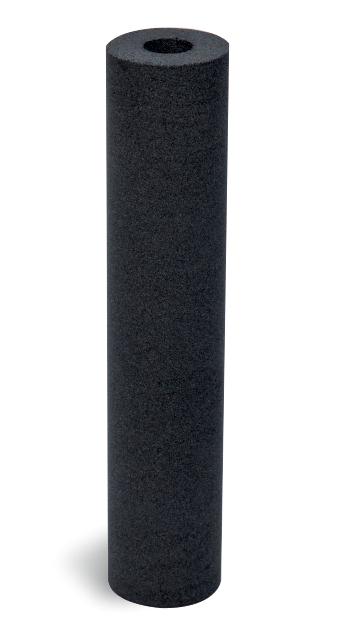
This Ranveth sintered activated carbon block filter, sized Ф40×195 mm, is built around a high-iodine coconut shell carbon matrix with an integrated food-grade ion exchange resin layer. It is designed to reduce chlorine, taste and odour, colour, and heavy metals such as lead and mercury, while the resin helps soften water and inhibit scale. The filter suits household reverse osmosis systems (as a pre- or post-carbon stage), direct drinking water dispensers, refrigerator water filters, and commercial coffee machines.
The performance of a carbon block depends less on any single material and more on how the media are combined and bonded. In this cartridge, the primary adsorption medium is high-iodine coconut shell activated carbon, selected for its large internal pore volume and consistent pore size distribution. Mixed into that carbon matrix is a food-grade ion exchange resin, which contributes ion exchange capacity for water softening and heavy metal reduction. The two media are not simply blended and compressed; they are sintered so that the carbon particles bond at contact points, creating a rigid, uniform microporous structure.
That structure is what drives the three parameters buyers usually care about. First, efficiency: the sintered matrix has a high density of open pores and a large accessible surface area, so chlorine and organic molecules contact the carbon quickly and adsorb at a high rate. The uniform pore network also avoids the channelling that can occur in loosely packed beds, which means water is forced through the media rather than bypassing it. Second, airflow resistance (or in water terms, pressure drop): a sintered block has a stable, predictable pressure drop because the pore structure is fixed during manufacturing. Initial flow is high, and the block does not compact or migrate under normal operating pressures. Third, service life: the high adsorption capacity of the coconut carbon, combined with the mechanical strength of the sintered bond, allows the filter to hold a substantial contaminant load before saturation. In typical use, the cartridge is rated for 6 to 12 months, depending on feed water quality and daily flow.
The layer build can be adjusted for specific applications. For example, the ratio of carbon to ion exchange resin can be modified, the carbon mesh size can be selected, and additional functional media can be incorporated. The end caps can be welded or otherwise configured to match the housing interface. All these choices are made at the sample stage so that the final cartridge matches the device's hydraulic and contaminant-reduction requirements.
| Item | Detail |
|---|---|
| Product name | Carbon block water filter / CTO filter for water purifiers and refrigerators |
| Core filtration media | High-iodine coconut shell activated carbon with food-grade ion exchange resin |
| Core performance | Softens water and inhibits scale; adsorbs chlorine (bleach) and off-tastes/odours; reduces colour; captures heavy metals such as lead and mercury |
| Precision and service life | Uniform microporous structure, high initial flow, high filtration precision, no black powder release; large saturation capacity for long service life |
| Standard size reference (outer diameter × length, mm) | Ф60×130 / Ф62×240 / Ф37.5×75 / Ф38×57 / Ф40×195 / Ф51×127 / Ф32×126 / Ф32×106 |
| Main end applications | Household RO purifiers (pre-CTO or post-T33), direct drinking water dispensers, side-by-side refrigerator water filters, commercial coffee machines |
| Customisation service | Full OEM/ODM support. Length, diameter, and inner/outer diameter ratios can be tooled to match equipment needs; end cap welding customisation available. |
| Quality certification | Company's 20,000 m² production base is ISO 9001 and IATF 16949 certified. Filter media meet stringent potable water safety and hygiene standards, backed by a national CNAS-accredited testing centre. |
The Ф40×195 format is a common footprint in compact water treatment systems where space is limited but performance cannot be compromised. In household reverse osmosis purifiers, this carbon block is typically used as a pre-filter (often called CTO) to protect the RO membrane from chlorine and particulates, or as a post-filter (T33) to polish taste before the water reaches the faucet. Because the block does not release carbon fines, it is also suitable for direct drinking water dispensers and for refrigerator water filters where a clean, particle-free output is essential. In commercial coffee machines, the cartridge reduces chlorine and scale-forming minerals, which helps maintain consistent extraction and protects boiler components. Other applications include beverage equipment, icemakers, and point-of-use filtration systems that require a reliable, repeatable carbon block.
Because every device has its own hydraulic and space constraints, we build cartridges to your specification rather than forcing a standard size. To quote accurately and to design the right media pairing, please send us the following:
With those details, our engineering team can propose a media combination, layer build, and end cap configuration, then produce samples for your validation.
Ranveth is backed by a manufacturer with 20 years of filtration experience and a focus on test-backed media selection. The company's own laboratory is CNAS-accredited (China National Accreditation Service for Conformity Assessment), which means we can issue test reports for filtration efficiency, contaminant capacity, and pressure drop without relying on external assumptions. That lab is directly connected to production: the manufacturing base covers 50,000 m², including six cleanrooms totalling 20,000 m², where carbon block cartridges are moulded, sintered, and assembled under controlled conditions. Quality management follows IATF 16949 (achieved in 2024) and ISO 9001, ISO 14001, and ISO 45001 systems, with IQC, IPQC, and OQC checks at each stage. Products comply with REACH and RoHS, and we can provide the corresponding compliance documents. For buyers who need consistency across batches, this combination of accredited testing and certified production is the foundation we build on.
We welcome the opportunity to discuss your project. To receive samples and a quotation, please use our contact page and include the device model, required size or drawing, target flow rate, operating conditions, and estimated quantity. Our team will respond with a tailored proposal and, where needed, a sample development plan.
This filter uses high-iodine coconut shell activated carbon combined with a food-grade ion exchange resin. The carbon provides a high surface area for adsorbing chlorine, tastes, odours, and organic compounds, while the resin contributes ion exchange capacity for water softening and heavy metal reduction. The two media are sintered into a uniform block, so the carbon and resin work together without channelling.
Sintering bonds the carbon particles at contact points, creating a rigid, uniform pore network. This structure gives a high accessible surface area for fast adsorption, a stable and predictable pressure drop, and good mechanical strength so the block does not compact or release fines. The high adsorption capacity of the coconut carbon, combined with the fixed pore structure, supports a typical service life of 6 to 12 months, depending on water quality and flow.
The high-iodine coconut shell carbon is selected for effective chlorine reduction, and the ion exchange resin assists in reducing heavy metals such as lead and mercury. Actual efficiency depends on feed water conditions and flow rate, so we recommend testing with your specific water. Our CNAS-accredited lab can provide performance data for the exact media combination you choose.
Yes, we support full OEM/ODM customisation. We can adjust the length, outer and inner diameter, carbon mesh size, carbon-to-resin ratio, and end cap design, including welded caps. Please send a drawing or sample of your current cartridge, along with flow and operating conditions, and our engineers will propose a build that fits your housing.
For standard sizes, the MOQ is typically 1,000–2,000 pieces, with lead times of 7–15 days for stock items. Custom sizes usually require an MOQ of 5,000 pieces, and production lead time is about 25–35 days after sample approval. These figures can vary with packaging and scheduling, so please confirm with our sales team for your specific requirement.
Under normal household or commercial use, the cartridge is rated for 6 to 12 months. Service life depends on the chlorine level, hardness, sediment load, and daily volume of water treated. Higher contaminant levels or higher flow rates will shorten the effective life. We recommend monitoring pressure drop or using a flow-based replacement schedule for critical applications.
Yes, we provide samples for evaluation. Standard sizes can be shipped within 3–5 working days, and custom samples typically take 10–15 working days. Each sample can be accompanied by a test report from our CNAS-accredited laboratory covering relevant performance parameters. Please contact us with your specifications to arrange samples.