
DE-DE▼

Dieses Produkt ist mit Geräten und Anwendungen der folgenden Marken kompatibel oder für sie geeignet; dient nur als Auswahlhilfe. Marken sind Eigentum ihrer jeweiligen Inhaber und bedeuten keine Partnerschaft oder Billigung.
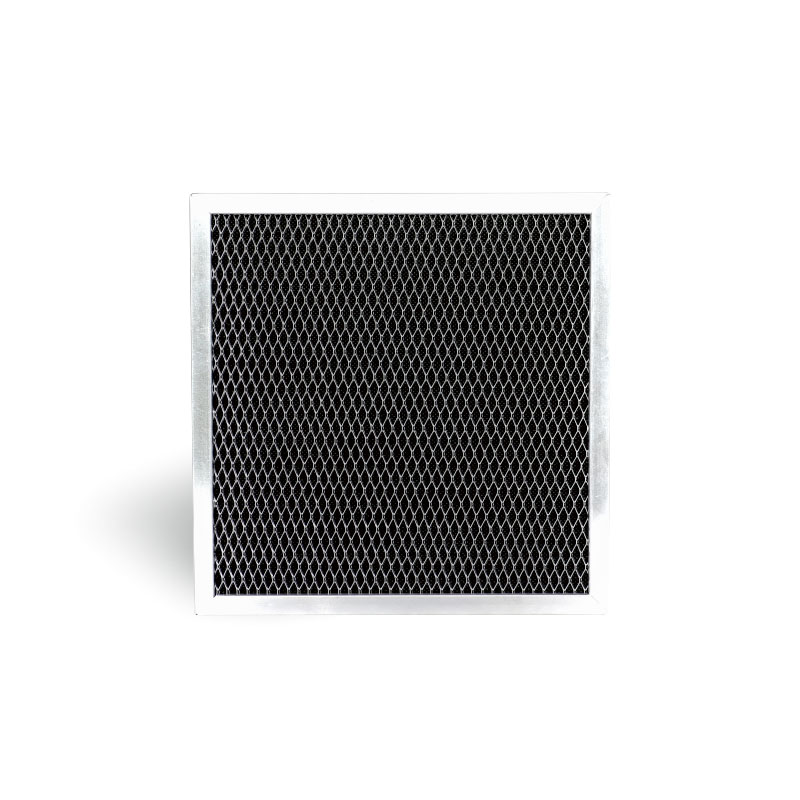
This is an American-style range hood filter from Ranveth that pairs a multi-layer corrugated aluminum foil with flame-retardant polyester fiber and a high-iodine-value activated carbon layer. It captures heavy cooking grease before it reaches the motor and blower, and adsorbs cooking odours in recirculating, ductless hoods. It is built for appliance makers, kitchen ventilation brands and commercial kitchen equipment suppliers who need a filter matched to their own hood dimensions and mounting clips.
Grease and odour are two different problems, and a single medium rarely handles both well. The build here separates them. The outermost stage is a three-dimensional labyrinth of corrugated aluminum foil: the foil is folded into wave forms and stacked so that the air path turns repeatedly, and grease droplets lose momentum and land on the metal rather than travelling on to the blower. Aluminum was chosen because it holds its shape under heat, resists corrosion and can be washed and reused.
Behind the foil sits flame-retardant polyester fiber. It acts as a finer polishing stage, catching the smaller aerosol fraction that passes the foil channels, and it gives the carbon layer a stable bed. The innermost functional layer is high-iodine-value activated carbon, included for recirculating hoods where air returns to the kitchen instead of going outdoors. The carbon handles the odour load; the foil and fiber handle the grease load.
Layer count and foil geometry are the two variables that set the balance between efficiency, airflow resistance and service life. More foil layers and tighter wave spacing raise grease capture but also raise pressure drop, which asks more of the fan. Fewer, more open layers keep resistance low and extend the interval between cleaning, at some cost in capture. Because the foil count is a custom parameter, we can tune this balance to the airflow your hood actually delivers instead of forcing your design around a fixed catalogue part. The assembly is tested to the UL 900 Class 1 / Class 2 flame-resistance safety standard, which matters in a grease-laden airstream.
| Item | Detail |
|---|---|
| Product name | American Range Hood Filter — activated carbon composite version |
| Core structure and materials | Multi-layer corrugated aluminum foil + flame-retardant polyester fiber + high-efficiency activated carbon layer |
| Core functions | Physical interception of heavy grease and protection of the motor and blower; strong adsorption of cooking odours |
| Fire safety rating | Meets the UL 900 Class 1 / Class 2 flame-resistance safety test certification standard |
| Typical end applications | American-style range hoods, ductless recirculating range hoods, kitchen exhaust fan systems, commercial catering fume purification equipment |
| Frame and clip customisation | High-strength aluminum frame; handle and plastic or metal clip styles selected to suit the customer's mounting slot design |
| Size and specification customisation | 100% tooled to the customer's equipment dimensions; length, width, thickness and aluminum foil layer count all available for flexible OEM/ODM production |
| Quality and certification systems | Produced in the company's 50,000 m² plant with a CNAS-accredited laboratory; certified to ISO 9001/14001 and IATF 16949 automotive quality systems |
The primary use is the American-style range hood, particularly ductless and recirculating models where the filter is the last treatment stage before air returns to the room. In those units the carbon layer carries most of the odour duty, so pairing it with effective grease removal upstream keeps the carbon from being blinded by oil.
The same construction suits kitchen exhaust fan systems in residential and light commercial settings, and commercial catering fume purification equipment where a replaceable or washable aluminum stage is preferred ahead of other treatment steps. Because frames, handles and clips are made to the customer's mounting slot, the filter can be designed as a drop-in part for existing hood platforms rather than a retrofit compromise.
To quote accurately we need the following from you:
Send these to our engineering team through the contact page and we will confirm feasibility, tooling and sample timing.
Media choices should be backed by measurement, not assertion. Our in-house laboratory holds CNAS accreditation and issues test reports covering filtration efficiency, dust holding capacity and resistance, so the foil and carbon pairing on your part can be documented rather than assumed.
Production runs in a 50,000 m² plant that includes six cleanrooms totalling 20,000 m². The quality system is certified to IATF 16949, obtained in 2024, and to ISO 9001, ISO 14001 and ISO 45001, with IQC, IPQC and OQC controls across the process. Products meet REACH and RoHS requirements and compliance documents can be supplied. With more than 20 years of filtration development and manufacturing and over 20 years of export to Europe, the United States, Japan and Korea, we have built more than 1,000 filtration solutions and run multiple automated lines capable of millions of pieces per month. The company is based in Zhongshan, Guangdong, China.
If you are evaluating a filter for a hood platform, tell us the hood model, the size or drawing, the airflow, the operating conditions and the quantity you have in mind. We will respond with a proposed layer build, sample timing and pricing. You can reach the team through the contact page.
It combines multi-layer corrugated aluminum foil, flame-retardant polyester fiber and a high-efficiency activated carbon layer inside an aluminum frame. The foil and fiber handle grease, while the carbon layer adsorbs cooking odours, which is why the build suits recirculating hoods.
More foil layers and tighter wave spacing increase grease capture but also raise pressure drop, so the fan has to work harder. Fewer, more open layers lower resistance and lengthen the cleaning interval. Because foil layer count is a custom parameter, we set it against the airflow your hood actually delivers.
Yes. Length, width, thickness and aluminum foil layer count are all made to your equipment dimensions under OEM/ODM production. Frame handles and plastic or metal clips are selected to suit your mounting slot design, and we can quote from a drawing, a sample or the hood model.
The construction is tested to the UL 900 Class 1 / Class 2 flame-resistance safety standard. This is relevant because the filter sits directly in a grease-laden airstream, and the aluminum foil also holds its shape under heat.
Send the device or hood model, dimensions or a drawing, airflow, operating conditions and quantity. Minimum order quantities are confirmed per specification, and standard and custom items are quoted separately once the build is defined.
We welcome sample evaluation. Sample availability and any tooling or sample charges depend on whether the part is a standard size or a new custom build, and this is confirmed with the quotation. Test reports from our CNAS-accredited laboratory can be provided with the sample.
Lead time depends on whether the part is standard or custom and on the quantity ordered. We confirm the schedule with the quotation after the layer build, frame and clip design are agreed, and tooling time is included where a new size is required.
The aluminum foil stage is washable and reusable, so the cleaning interval depends on cooking style and grease load; the activated carbon layer has a finite odour capacity and is replaced rather than washed. We recommend setting the interval from your own operating conditions, and our team can advise once we know the hood airflow and usage. Contact us through the inquiry page to discuss the right build for your application.