
DE-DE▼

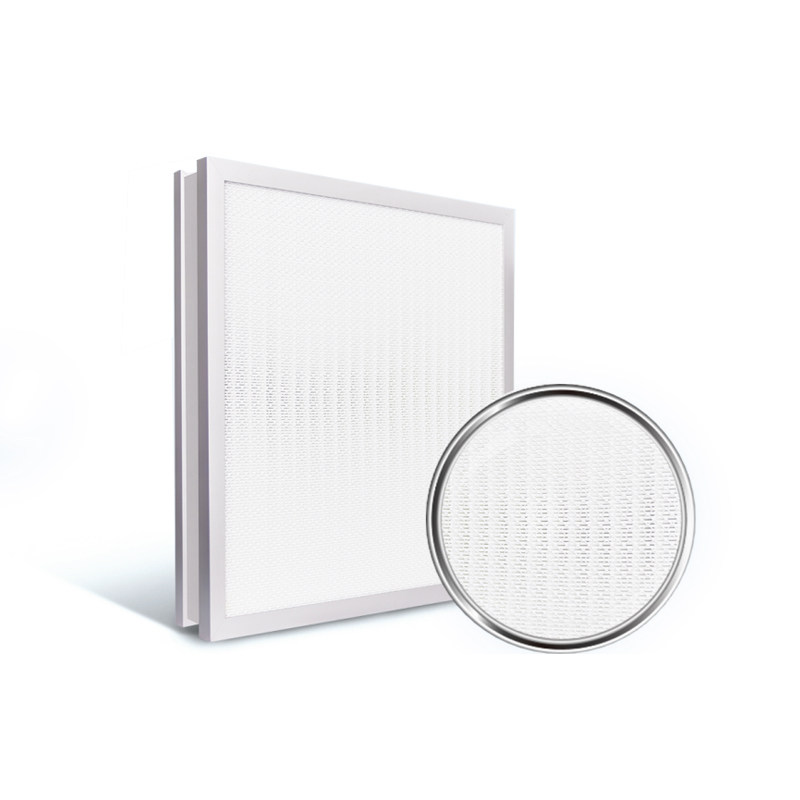
This Ranveth filter is a single- or double-flange medium efficiency panel filter built on an anodized aluminium frame and high-throughput ultra-fine glass fibre media, rated E11 or E12 under EN 1822. It removes fine particulate from supply air in commercial HVAC, cleanrooms, hospitals, pharmaceutical and electronics manufacturing, data centres and energy storage rooms. It is aimed at buyers who need a defined media-to-frame pairing with predictable resistance and service life.
The performance of this filter starts with how the media is matched to the frame. We use high-throughput ultra-fine glass fibre paper, a wet-laid nonwoven of sub-micron fibres that builds efficiency through depth rather than surface screening. The paper is folded into a pleat pack, and the pleat count and depth are chosen so that the media area behind each 592 mm face is large enough to keep face velocity low at the rated airflow. That is the mechanism that holds resistance down: 2000 m³/h through a 592 × 592 × 88 mm E11 element is only possible because the pleat area is generous relative to the face.
The frame is anodized aluminium alloy profile. Anodizing gives a thin oxide layer that resists corrosion in humid supply air and keeps the frame light enough for ceiling-grid and FFU installations. The single- and double-flange options are both leakage-control choices. A single flange suits standard duct connections and routine HVAC work. A double flange puts a sealing face on both the upstream and downstream sides, which is the better pairing when the filter sits in a cleanroom ceiling or a pharmaceutical suite where bypass leakage around the frame is as important as media efficiency. The media grade and the flange type are selected together, because a high-efficiency E12 pack in a frame that leaks simply moves the problem from the media to the seal line.
This pairing logic also governs service life. A pleat pack that is matched to the airflow runs at lower resistance for the same dust load, so it takes longer to reach the change-out point. If a buyer specifies an E12 filter for a duty that only needs E11, the tighter media will load faster and cost more in replacement. We would rather size the media grade to the actual protection target than overspecify it.
| Item | Detail |
|---|---|
| Product name | Single/Double Flange Medium & HEPA Filter |
| Filter class (EN 1822) | E11 (sub-high efficiency) / E12 (high efficiency) |
| Core media | High-throughput ultra-fine glass fibre filter paper |
| Frame material | Anodized aluminium alloy profile |
| Typical applications | Cleanrooms in pharmaceutical and electronics plants, hospital operating theatre purification, terminal HVAC systems, FFU (fan filter units) |
| Standard sizes and rated airflow (W × H × D) | 287 × 592 × 88 mm (E11 rated 1000 m³/h; E12 rated 500 m³/h) 592 × 592 × 88 mm (E11 rated 2000 m³/h; E12 rated 1000 m³/h) |
| Customisation (OEM/ODM) | In-house CNAS-accredited testing centre; ISO 9001 and IATF 16949 certified. Custom flange dimensions, non-standard airflows and special shapes are supported. |
The filter is specified where a defined particulate removal step is needed ahead of a tighter stage or as the final stage in a protected space. In pharmaceutical plants and electronics cleanrooms it is commonly the pre-filter that protects terminal HEPA units, which extends the life of the more expensive downstream filter. In hospitals it appears in operating theatre and critical-care ventilation, where the double-flange version is often chosen to control leakage at the ceiling interface. Commercial HVAC systems use the single-flange version in plant rooms and air-handling units, and fan filter units in data centres and energy storage rooms use the compact 287 × 592 × 88 mm size where ceiling space is limited.
Because the frame is aluminium and the media is glass fibre, the filter is suited to supply air that is dry and free of oil mist or corrosive chemical vapours. Buyers should tell us if the air stream carries solvent or acid vapour, because that changes the media and frame advice rather than the headline efficiency.
We build to drawing as well as to standard sizes. To quote accurately we need the following from you:
With those details we can confirm whether the standard 287 × 592 × 88 mm or 592 × 592 × 88 mm element fits, or propose a non-standard flange and pleat pack. Send them through the contact page and our engineers will respond with a specification proposal.
Media choices at Ranveth are test-backed before they reach a quotation. Our own laboratory is accredited by CNAS, and it issues reports on filter efficiency, dust holding capacity and resistance, so the E11 and E12 ratings on this filter trace to measured data rather than a catalogue claim.
Production runs in a 50,000 m² plant in Zhongshan, Guangdong, which includes six cleanrooms totalling 20,000 m². That cleanroom space matters for a glass-fibre filter, because handling and pleating in a controlled environment limits the chance of media damage before packing. The plant operates under IATF 16949, awarded in 2024, and under ISO 9001, ISO 14001 and ISO 45001 systems. Filters are checked through IQC, IPQC and OQC stages, and products meet REACH and RoHS requirements with compliance documents available on request.
Ranveth has more than 20 years of filtration development and manufacturing experience and has exported to Europe, the United States, Japan and South Korea for over 20 years. OEM and ODM work covers dimensions, structure, media grade, frame material, logo and packaging, with more than 1,000 filter solutions developed to date. Multiple automated lines support monthly output in the millions of pieces.
If you are evaluating this filter for a project, tell us the device or system model, the size or drawing, the airflow or water flow, the operating conditions and the quantity you expect. We will come back with a sample proposal and a quotation, and where the duty is unclear we will suggest the media grade and flange type that fit it. Start the conversation on our contact page.
It uses high-throughput ultra-fine glass fibre filter paper in a pleat pack, held in an anodized aluminium alloy profile frame. The media is rated E11 or E12 under EN 1822. The pleat geometry is matched to the frame size so that the rated airflow is reached at a controlled face velocity.
The single-flange version is intended for standard duct connections and routine HVAC installation. The double-flange version has a sealing face on both the upstream and downstream sides, which gives better leakage control in cleanroom ceilings, pharmaceutical suites and other pressure-critical installations. Both use the same glass fibre media and aluminium frame.
Yes. We support OEM and ODM production covering flange dimensions, non-standard airflows and special shapes. To quote, send the face dimensions and depth or a drawing, the required efficiency class, the rated airflow and the installation position. Standard sizes are 287 × 592 × 88 mm and 592 × 592 × 88 mm.
Send your device or system model, the size or drawing, the airflow, the operating conditions and the quantity through our contact page. We will confirm the suitable media grade and flange type and return a sample proposal with a quotation. Sample orders can be discussed separately from production volumes.
For this product, standard sizes typically start at 50–100 pieces. Custom sizes and flange configurations usually start at 100–200 pieces depending on complexity. We can negotiate for new customers and sample orders.
Standard sizes ship in 7–15 days. Custom orders usually take 25–35 days for bulk production. Multiple automated lines and stocked raw materials allow us to support urgent orders and long-term supply.
Replace when resistance reaches twice the initial value or 450 Pa, whichever comes first. In normal HVAC and cleanroom duty this typically falls within 6–12 months, but the actual interval depends on dust loading and running hours. We can advise on differential-pressure monitoring to set a change-out schedule.
Yes. Our CNAS-accredited laboratory issues reports on efficiency, dust holding capacity and resistance for the media and finished filters. These reports support the E11 and E12 ratings. Compliance documents for REACH and RoHS are also available on request.