
EL-GR▼

Το προϊόν αυτό είναι συμβατό ή κατάλληλο για εξοπλισμό και εφαρμογές των παρακάτω εμπορικών σημάτων, μόνο ως βοήθεια επιλογής. Τα εμπορικά σήματα ανήκουν στους αντίστοιχους κατόχους τους και δεν υποδηλώνουν συνεργασία ή έγκριση.
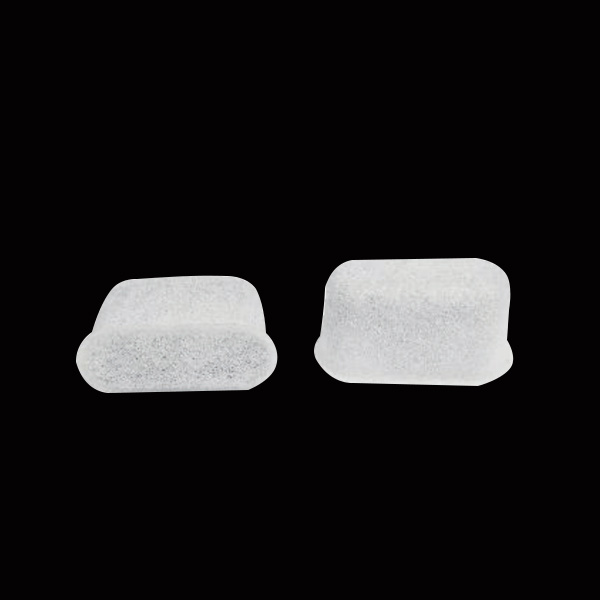
This is a drop-in replacement water filter cartridge for BREVILLE coffee machines, built around a paired bed of coconut-shell activated carbon and food-grade ion exchange resin. The carbon stage handles chlorine, odour and off-notes, while the resin stage targets the calcium and magnesium that scale heating elements and flatten extraction. It is made by Ranveth for coffee machine owners, service companies, and brands or traders who need a reliable compatible cartridge in volume.
Most of what a coffee filter can do is decided before assembly, in the choice of media and how the two media are arranged relative to each other. In this cartridge, the coconut-shell carbon is the front line. Coconut shell gives a hard, low-dust carbon with a well-developed microporous structure, which is the part of the pore spectrum that holds small organic molecules such as the chloramines and taste-and-odour compounds that carry through into the cup. The ion exchange resin sits downstream of it, and its job is different: it exchanges calcium and magnesium ions for softer ones, so the water that reaches the boiler and the brew head is less inclined to precipitate scale.
The order matters. If resin came first, it would see the full organic load and the chlorine in the incoming water, and ion exchange capacity would be spent on things the carbon is better at removing. Placing carbon first protects the resin bed and lets each medium work in the range where it is strongest. It also means the pressure drop across the cartridge stays predictable: the carbon does the bulk of the mechanical and adsorptive work, and the resin bed is a comparatively open path behind it. A well-matched pair keeps resistance low at the flows a coffee machine actually draws, rather than forcing the pump to work against a dense single medium.
Life follows the same logic. The rated life of roughly 250 litres, or about 2–3 months depending on local water quality and use frequency, is a whole-cartridge figure. In hard-water areas the resin is the limiting stage; in heavily chlorinated municipal supplies the carbon is. Because both stages are sized to the same service window, the buyer is not left with one medium exhausted while the other still has capacity. That is the practical value of pairing rather than stacking: efficiency, resistance and service life move together instead of trading against each other.
| Item | Detail |
|---|---|
| Product type | Coffee machine water purifying filter cartridge, compatible with BREVILLE |
| Filtration media | Quality coconut-shell activated carbon plus food-grade ion exchange resin |
| Micron rating | Fine microporous interception; retains larger particles such as sediment and rust |
| Filter life | Approximately 250 litres, or 2–3 months, depending on local water quality and usage frequency |
| Operating pressure | 20–120 psi (approximately 1.4–8.3 bar) |
| Operating temperature | 2 °C to 38 °C, cold water filtration only |
| Applications | Automatic coffee machines, semi-automatic espresso machines, commercial coffee machine water softening, OEM water filter cartridge custom builds |
| Quality and certification systems | Produced under ISO 9001/14001, IATF 16949 and medical supplies GMP standards; CNAS national testing accreditation |
The cartridge is specified for the water side of coffee equipment rather than for general drinking water. In automatic bean-to-cup machines it protects the boiler and the brew circuit from scale while keeping chlorine-derived notes out of the cup. In semi-automatic espresso machines it supports consistent extraction, because soft water and stable mineral content make shot-to-shot behaviour easier to control. Commercial operations use it as a softening stage ahead of coffee machines, where scaling risk is higher simply because the machine runs all day.
The other use is as a platform. Brands and traders building their own cartridge line can take this media pairing and layer build as a starting point, then adjust dimensions, media grade or packaging to their own machine fitment and market. Because the build is a two-stage bed rather than a single moulded block, changes to one stage do not automatically force a redesign of the other.
A custom cartridge is only as good as the brief behind it, so the more of the following you can share, the faster we can confirm feasibility and price.
Send these and our engineering team will respond with a proposed media pairing, layer build and a quotation route. If you are still at the early stage, say so and we will help narrow the specification.
Media choices are only worth making if they can be checked, so the first thing to note is that our own laboratory holds CNAS accreditation and can issue test reports covering filtration efficiency, dust holding capacity and resistance. Claims about a carbon–resin pairing are testable claims, and this is where they get tested.
Production sits on a 50,000 m² plant in Zhongshan, Guangdong, China, which includes six cleanrooms totalling 20,000 m² — relevant for a cartridge that goes into a machine handling drinking water. The quality system is certified to IATF 16949 (obtained in 2024) and to ISO 9001, ISO 14001 and ISO 45001. Products meet REACH and RoHS requirements and compliance documents can be supplied.
Ranveth draws on more than 20 years of filter product development and manufacturing, with continuous export to Europe, the United States, Japan and Korea over that period. OEM and ODM work covers dimensions, structure, media grade, logo and packaging, and more than 1,000 filtration solutions have been developed to date. Multiple automated lines support output in the millions of pieces per month, under IQC, IPQC and OQC control through the process.
If you are evaluating this cartridge for a machine line or a retail programme, we can start with samples so you can test fit and taste before committing. To quote accurately we need the device model, size or drawing, water flow, operating conditions and quantity. Send those details through the contact page and our team will follow up with sample arrangements and pricing.
It uses a two-stage bed: quality coconut-shell activated carbon followed by food-grade ion exchange resin. The carbon handles chlorine, odour and taste compounds, and the resin exchanges calcium and magnesium to reduce scaling. The order is deliberate — carbon first protects the resin and keeps pressure drop predictable.
Carbon does the bulk of the adsorptive and mechanical work, and the resin bed behind it is comparatively open, so resistance stays sensible at coffee-machine flows. Both stages are sized to the same service window, so one does not exhaust while the other still has capacity. That is why the whole-cartridge life figure is meaningful rather than a best-case number.
Rated life is approximately 250 litres, or about 2–3 months, depending on local water quality and how often the machine is used. Hard water will exhaust the resin stage sooner, and heavily chlorinated supplies will load the carbon faster. Replace on whichever comes first — the litre count or the calendar interval.
Yes. OEM and ODM work covers dimensions and structure, media grade and formulation tuned to a target market's water, logo printing, and retail packaging. More than 1,000 filtration solutions have been developed, and our engineering team can respond to a defined brief within about 7 working days.
Standard compatible cartridges start at 5,000 pieces, with stock or small-batch orders typically delivered in 15–20 days. OEM custom builds are recommended from 10,000 pieces, with a production cycle of roughly 25–30 days including tooling and packaging development. Monthly capacity runs into the millions of pieces.
Yes — we encourage testing before a purchase decision. Standard specifications can be sampled free of charge, with the customer covering international courier costs; customised samples are priced according to tooling and development cost and can be credited against a bulk order. Samples usually ship within 3–7 working days.
It is specified for cold water only, at 2 °C to 38 °C, and an operating pressure of 20–120 psi (approximately 1.4–8.3 bar). It is intended for coffee machine water circuits rather than general drinking-water installations. Share your inlet conditions and we will confirm suitability.
Cartridges are made in cleanrooms within a 50,000 m² plant, and our CNAS-accredited laboratory tests filtration efficiency, dust holding capacity and resistance. IQC, IPQC and OQC checks run through the process, under a system certified to ISO 9001, ISO 14001, ISO 45001 and IATF 16949. Tell us your target market and we will advise which reports and compliance documents apply — start with an inquiry through our contact page.