
EL-GR▼

Το προϊόν αυτό είναι συμβατό ή κατάλληλο για εξοπλισμό και εφαρμογές των παρακάτω εμπορικών σημάτων, μόνο ως βοήθεια επιλογής. Τα εμπορικά σήματα ανήκουν στους αντίστοιχους κατόχους τους και δεν υποδηλώνουν συνεργασία ή έγκριση.
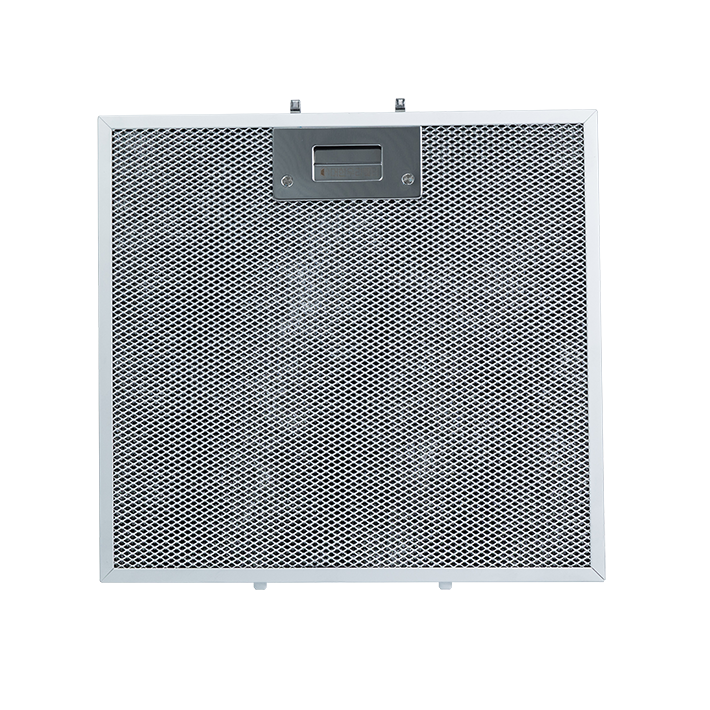
This European range hood filter combines aluminum foil micro-perforated mesh, flame-retardant polyester fiber, and an activated carbon layer to capture heavy grease and adsorb cooking odors. It is designed for recirculating range hoods in open kitchens, European-style wall-mounted or island hoods, and commercial kitchen exhaust systems. Ranveth builds this filter with a pairing of media and layer structure that balances oil capture, airflow resistance, and service life, and offers it as a fully customizable component for OEM and ODM programs.
The filter is built as a layered composite, and each layer is chosen for a specific job. The first stage is an aluminum foil micro-perforated mesh that intercepts larger grease droplets and flame-borne particles while allowing air to pass. Behind it, flame-retardant polyester fiber provides a finer barrier that traps smaller oil mists and helps distribute airflow evenly across the filter face. The final stage is a layer of high-quality granular or powdered activated carbon, which adsorbs cooking odors such as fried-food smell and spicy notes before air returns to the kitchen.
This pairing matters because grease and odor control pull in different directions. A denser grease layer improves capture but raises airflow resistance; a thicker carbon layer improves odor adsorption but can reduce airflow if the upstream media are not matched to it. Ranveth selects the mesh opening, fiber density, and carbon loading together so that the filter maintains a workable pressure drop while still meeting the intended oil removal and odor control targets. The aluminum foil mesh also contributes to flame resistance, and the complete filter is tested to UL 900 Class 1 / Class 2 fire safety standards.
The outer frame is made from high-strength aluminum alloy profiles or stainless steel, with optional clips and handles to suit different hood designs. Because the frame, media stack, and carbon layer are assembled as one unit, the filter can be removed for cleaning or replacement without tools in most hood models. For buyers, the practical result is a filter that can be tuned to a specific hood platform rather than chosen from a fixed catalog.
| Item | Detail |
|---|---|
| Product name | European Range Hood Filter (Activated Carbon Odor Control) |
| Core materials | Aluminum foil micro-perforated mesh + flame-retardant polyester fiber + high-quality granular/powdered activated carbon layer |
| Main function | Efficient separation and capture of heavy grease and oil; strong adsorption of cooking odors (e.g., cooking fumes, spicy smells) |
| Flame retardant certification | Complies with UL 900 Class 1 / Class 2 fire safety testing certification |
| Applications | Open-kitchen recirculating range hoods, commercial kitchen exhaust purification systems, European-style top-draft and side-draft range hoods |
| Outer frame options | High-strength aluminum alloy profiles, stainless steel frame (optional clips and handles available) |
| Customization and capacity | OEM/ODM flexible manufacturing supported; company holds IATF 16949 / ISO 9001 systems, with a national CNAS testing center safeguarding batch quality |
This filter is primarily used in recirculating range hoods where air is cleaned and returned to the kitchen rather than vented outside. That includes open-plan kitchens in apartments and houses, where odor control is as important as grease capture. It also fits European-style top-draft and side-draft hoods that use a rectangular or square filter cartridge behind the grease screen.
Commercial kitchen exhaust purification systems use the same layered approach when odor abatement is required, especially in settings where discharge air must be kept free of cooking smells. Because the filter is built to UL 900 fire safety standards, it is also suitable for hood designs that specify flame-resistant filtration components. The aluminum and stainless steel frame options allow the filter to match different hood interiors and cleaning routines.
To quote a custom filter, Ranveth needs the following information. The more detail you provide, the faster we can confirm feasibility and price.
If you are still at the design stage, our engineering team can propose a layer build and frame configuration based on your hood’s airflow and space. Send your requirements through the contact page and we will respond with a technical proposal and quotation.
Ranveth’s media choices are backed by test data. Our in-house laboratory is accredited by CNAS (China National Accreditation Service for Conformity Assessment) and can issue test reports for filtration efficiency, dust holding capacity, and resistance. That means the aluminum mesh, polyester fiber, and activated carbon pairing in this filter can be verified against the performance targets you set, rather than accepted on specification alone.
Manufacturing takes place in a 50,000 m² plant in Zhongshan, Guangdong, China, which includes six cleanrooms totaling 20,000 m². The company has held IATF 16949 automotive quality management certification since 2024 and also maintains ISO 9001, ISO 14001, and ISO 45001 systems. Products comply with REACH and RoHS environmental regulations, and compliance documents can be provided.
With more than 20 years of filtration product development and manufacturing experience, Ranveth has supplied European, American, Japanese, and Korean markets for over two decades. We support OEM/ODM customization of size, structure, filter media grade, frame material, logo, and packaging, and have developed more than 1,000 filtration solutions. Multiple automated production lines support monthly capacity in the millions of pieces, and quality control follows IQC, IPQC, and OQC throughout the process.
We encourage buyers to test this filter in the actual hood platform before committing to volume. Standard stock samples can be provided free of charge with freight paid by the customer; custom samples carry a sampling fee that is credited against a bulk order. To request samples or a quotation, please include your device or vehicle model, required size or drawing, airflow or water flow, operating conditions, and estimated quantity. Our team will reply with a clear proposal and lead time.
The filter uses a three-stage layered build: an aluminum foil micro-perforated mesh for coarse grease capture, a flame-retardant polyester fiber layer for finer oil mist, and a granular or powdered activated carbon layer for odor adsorption. The outer frame is high-strength aluminum alloy or stainless steel. This pairing is selected to balance oil removal, airflow resistance, and service life.
Grease filtration efficiency is typically 85%–95%, depending on the media configuration and operating conditions. Odor reduction depends on the activated carbon loading and the cooking style; the carbon layer is designed to adsorb cooking fumes and spicy smells in recirculating hoods. We can provide test data from our CNAS-accredited laboratory for specific configurations.
Yes. Ranveth supports full OEM/ODM customization, including length, width, thickness, aluminum mesh layer count, mesh opening, handle type (plastic clip, metal handle, push-type), frame process (spot welding, riveting, hemming), and surface treatment (polishing, anodizing). Our engineering team can assist with structure optimization and sample confirmation based on your drawing or physical sample.
Standard models typically have an MOQ of 500–1,000 pieces; custom models generally require 2,000–3,000 pieces, negotiable based on the overall order. Samples are usually available within 3–7 days, and bulk orders typically ship in 25–35 days, depending on quantity and customization complexity. Our Zhongshan production base supports stable capacity for replenishment orders.
Replacement interval depends on cooking frequency and grease load. In typical domestic use, the filter should be checked monthly and cleaned according to the hood manufacturer’s instructions; the activated carbon layer is usually replaced every 3–6 months when odor control performance declines. For commercial kitchens, more frequent replacement may be needed. We can advise based on your operating conditions.
The filter complies with UL 900 Class 1 / Class 2 fire safety testing certification. The materials also meet REACH and RoHS environmental regulations, and compliance documents can be provided. Ranveth holds ISO 9001, ISO 14001, ISO 45001, and IATF 16949 (since 2024) certifications, and our CNAS-accredited laboratory supports batch quality verification.
Yes. Standard stock samples can be provided free of charge, with the customer covering freight; custom samples carry a sampling fee that is credited against a bulk order. We encourage real-hood assembly and performance testing before ordering, and our CNAS laboratory can assist with test data if needed for your certification process.
Please provide the device or hood model, required size or drawing, airflow (m³/h) or target pressure drop, operating conditions such as cooking style and odor load, and estimated quantity. With these details, we can propose a layer build and frame configuration and return a quotation. Send your requirements via the contact page to start the discussion.