
EL-GR▼

Το προϊόν αυτό είναι συμβατό ή κατάλληλο για εξοπλισμό και εφαρμογές των παρακάτω εμπορικών σημάτων, μόνο ως βοήθεια επιλογής. Τα εμπορικά σήματα ανήκουν στους αντίστοιχους κατόχους τους και δεν υποδηλώνουν συνεργασία ή έγκριση.
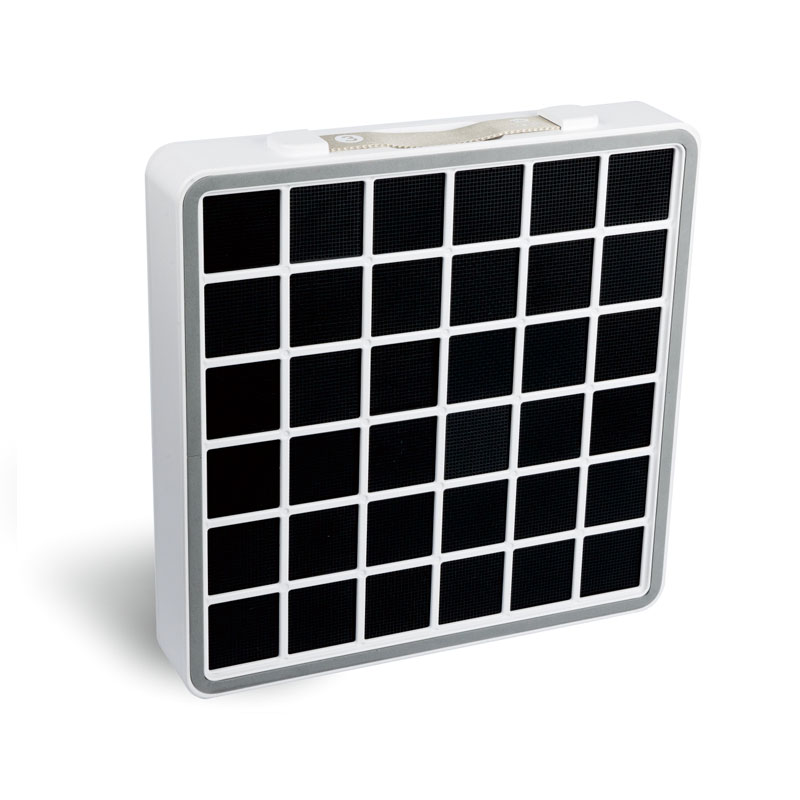
The Ranveth honeycomb activated carbon filter is a plate-type gas-phase filter built on a high-strength moisture-resistant plastic honeycomb framework and filled with high-iodine-value granular activated carbon. It adsorbs formaldehyde, benzene, ammonia, TVOC and persistent odours, and is made for air purifiers, fresh-air systems, automotive cabin filters and central air handling odour-control sections. Engineers choose it when they need strong gas removal with very low airflow resistance across the filter.
The performance of this filter comes from how the media and the structure are paired, not from carbon alone. The core is a high-iodine-value granular activated carbon, either as a straight carbon fill or combined with catalyst-modified carbon granules for aldehyde removal. High iodine value means a well-developed micropore network, which is where formaldehyde, benzene, ammonia and other volatile organic compounds are captured. The catalyst-modified granules are added when the target is formaldehyde specifically, because they support breakdown rather than storage alone.
That media is held in a plastic honeycomb framework made of high-strength, moisture-resistant engineering plastic. The honeycomb gives a very high void ratio, so air passes through open channels instead of being forced through a dense felt or foam. The result is a low pressure drop at a given face velocity, which lets the fan run at lower speed or move more air for the same power. The plastic walls also resist moisture, mould and corrosion, so the filter does not collapse or soften in humid return-air streams. The pairing works because the carbon provides the surface area and the honeycomb provides the geometry: the carbon does the adsorbing, and the structure decides how easily air reaches it and how long the carbon stays in place.
| Item | Detail |
|---|---|
| Product name | Honeycomb Activated Carbon Filter – Plastic Honeycomb Type |
| Framework material | High-strength, moisture-resistant engineering plastic honeycomb framework |
| Core fill material | High-iodine-value granular activated carbon, or a combination of carbon and catalyst-modified aldehyde-removal granules |
| Core purification performance | Strong adsorption of formaldehyde (HCHO), benzene, ammonia, TVOC and other volatile harmful gases and persistent odours |
| Physical structure advantages | Very high porosity, smooth air passage, very low operating airflow resistance, moisture-proof and mould-resistant, corrosion-resistant and non-collapsing |
| Main end applications | Household and commercial air purifiers, fresh-air ventilation systems, automotive air-conditioning filters, central air-conditioning return-air odour-control systems |
| Size and specification customisation | 100% OEM flexible custom manufacturing. External frame length and width, thickness, honeycomb pore size and activated carbon fill weight can all be tooled precisely to drawing requirements. |
| Quality certification system | Produced in a 50,000 m² plant; the company holds ISO 9001, ISO 14001 and IATF 16949 international automotive quality management system certification. |
Because the honeycomb keeps resistance low, the filter fits systems where airflow budget is tight. Typical installations include household and commercial air purifiers, fresh-air ventilation units, automotive air-conditioning filters and central air-conditioning return-air odour-control sections. In each case the buyer is usually balancing three things: how much gas-phase media can be carried, how much pressure drop the fan can tolerate, and how long the filter will last between changes. The plastic honeycomb format addresses all three at once, and it can be specified in different thicknesses and pore sizes to match the available space.
Custom builds are quoted from a short set of inputs. Send the device or vehicle model, or a drawing with the frame length, width and thickness. Tell us the expected airflow and the operating conditions, such as temperature, humidity and the target gases. State the quantity you plan to order and whether you need a sample first. With those inputs, Ranveth can propose the honeycomb pore size, carbon type and fill weight, and confirm a tooling route. Because the plant already runs more than 1,000 filtration solutions, most requests map onto an existing platform rather than starting from zero.
The first reason is testing. Ranveth's own laboratory is CNAS-accredited and can issue reports on filtration efficiency, dust holding capacity and resistance. That matters for a carbon filter because media choices should be backed by data, not by a data sheet alone.
The second is scale and process control. The production base covers 50,000 m², including six cleanrooms totalling 20,000 m². The company holds IATF 16949 automotive quality certification, obtained in 2024, as well as ISO 9001, ISO 14001 and ISO 45001. Products comply with REACH and RoHS, and compliance documents can be supplied. With more than 20 years of filtration development and manufacturing experience, Ranveth has supplied customers in Europe, the United States, Japan and South Korea for over two decades. Quality control runs through IQC, IPQC and OQC, and multiple automated lines support monthly output in the millions of pieces. The company is based in Zhongshan, Guangdong, China.
To move forward, send the device or vehicle model, the size or drawing, the airflow or water flow the filter will see, the operating conditions, and the quantity you have in mind. If you need a sample for evaluation, say so and include the target performance. Our team will reply with a proposed build and a quote. Contact Ranveth to start the conversation.
It uses high-iodine-value granular activated carbon, either on its own or combined with catalyst-modified carbon granules for aldehyde removal. The media is held in a high-strength moisture-resistant plastic honeycomb framework. This pairing gives strong gas adsorption with very low airflow resistance.
The honeycomb has a very high void ratio, so air moves through open channels rather than a dense mat. That keeps pressure drop low at a given face velocity and lets the carbon surface be reached easily. In practice, the filter removes formaldehyde, benzene, ammonia and TVOC while adding little load to the fan.
Yes. Ranveth supports 100% OEM custom manufacturing. Frame length and width, thickness, honeycomb pore size and activated carbon fill weight can all be tooled to your drawing or device model. Send the model or drawing and we will confirm the build.
The high-iodine-value carbon used in this filter achieves over 85% removal efficiency for common TVOC pollutants such as toluene, benzene and xylene. Efficiency depends on the application, airflow and gas concentration. Specific technical parameters can be customised to your application.
In a standard household air-conditioning application running about 8 hours a day, the effective service life is 6 to 12 months. Actual life depends on TVOC concentration, temperature, humidity and airflow. Ranveth's CNAS-accredited testing centre can provide life-test reports based on your operating conditions to help set a replacement interval.
Standard models typically have an MOQ of 1,000–2,000 pieces; custom models are negotiated based on specification complexity, and long-term customers can receive flexible MOQ terms. Standard lead time is 25–35 days, and repeat orders are 15–20 days. Capacity from the 50,000 m² plant supports large volumes.
Yes. Standard samples ship in 3–5 working days; custom samples take 7–15 working days depending on design complexity. Samples come with a test report from the CNAS-accredited lab. For B2B customers with clear intent, sample costs can be credited against the formal order. Send your device model, drawing, airflow and quantity to <a href="/en/contact">request a quote</a>.