
EN▼

Compatible with or suitable for equipment and applications from these brands, for reference only. Trademarks belong to their respective owners; no affiliation or endorsement implied.
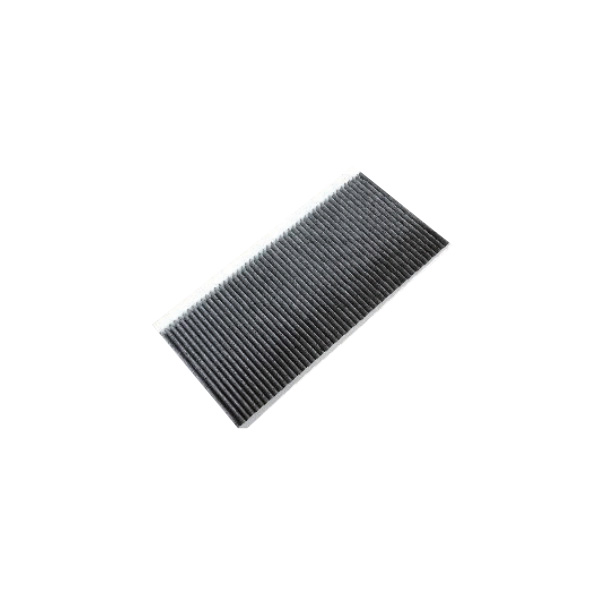
Ranveth automotive cabin air filters for odor removal combine a high-efficiency HEPA media layer with high-iodine coconut-shell granular activated carbon, so particles and gases are handled in one pleated element. They are built for passenger cars, coaches, heavy trucks and construction machinery, and are aimed at OEM and aftermarket buyers who need a defined media stack, low airflow resistance and a long service life. Ranveth supplies them as fully customised cabin filters for specific air ducts and housings.
The performance of a cabin filter is decided less by any single material than by how the layers are paired. In this element the pairing is a dual-effect composite: a high-precision HEPA filter medium on the particle side and high-iodine coconut-shell granular activated carbon on the gas side. The HEPA layer intercepts PM2.5 particulate and dust; the carbon layer targets ammonia, sulfur compounds and exhaust VOCs. Working together, they cover two different contaminant families without asking either layer to do the other's job.
That division of labour shapes the three properties buyers ask about most. Efficiency comes from the HEPA medium, whose fibre structure is selected to capture fine particulate rather than merely hold back visible dust. Airflow resistance comes from how the media is pleated and how much open area the pleat pack presents to the duct: the pleating process is designed for low operating resistance, so ventilation stays free and the blower does not have to work harder as the filter loads. Service life comes from the carbon loading and the dust-holding capacity of the pleat pack together, because a filter that keeps collecting particulate without choking will keep the gas layer available for odour duty.
The media choices behind these layers are validated in our own CNAS-accredited laboratory, where filter efficiency, dust-holding capacity and resistance can be tested and reported. That matters when a buyer is comparing samples: the pairing is not chosen by appearance but by measured behaviour across the three parameters above.
| Item | Detail |
|---|---|
| Product name | Automotive cabin air filter (odor removal) |
| Core structure and media | Dual-effect composite: high-precision HEPA filter medium plus high-iodine coconut-shell granular activated carbon |
| Core purification performance | High-efficiency interception of PM2.5 particulate and dust, plus targeted adsorption of ammonia, sulfur compounds and exhaust VOCs |
| Physical and flow characteristics | Good airflow characteristics, low operating resistance, high dust-holding capacity and long service life |
| Main applications | Air conditioning and ventilation systems of passenger cars (sedans, SUVs, MPVs), commercial coaches, heavy trucks and construction machinery |
| Size customisation | 100% OEM/ODM customisation for all vehicle models; any length, width, thickness and pleat count can be produced to the duct requirements of a given original equipment vehicle |
| Quality and certification | Produced in a 50,000 m² plant under the IATF 16949 automotive quality management system, with factory quality backed by a national CNAS testing centre |
This filter is specified wherever cabin air passes through a compact element before reaching the occupants: the HVAC and ventilation systems of passenger cars such as sedans, SUVs and MPVs, the larger ducts of commercial coaches, and the cabs of heavy trucks and construction machinery. In each case the duty is the same — hold back particulate and reduce the odours that enter with outside air, including exhaust fumes in traffic and on site.
Because the media stack is fixed but the housing is not, the same build is adapted across vehicle platforms by changing dimensions, thickness and pleat count rather than by changing the media concept. That keeps behaviour consistent from one model to the next while still matching each original duct.
To quote and sample accurately, we need the parameters that define fit and duty. Please send:
With these in hand we can confirm the media pairing, propose the pleat layout and return a drawing for approval before tooling or production.
The first reason is test-backed media selection. Our self-built laboratory holds CNAS (China National Accreditation Service for Conformity Assessment) accreditation and can issue reports on filtration efficiency, dust-holding capacity and resistance, so the pairing described above can be verified rather than assumed.
The second is manufacturing scale and environment. Our production base covers 50,000 m², including six cleanrooms totalling 20,000 m², which keeps filter media away from cross-contamination during converting and assembly.
The third is automotive-grade systems. We were certified to IATF 16949 in 2024 and also hold ISO 9001, ISO 14001 and ISO 45001, with IQC, IPQC and OQC controls running through the process.
Finally, we have more than 20 years of filter development and manufacturing experience, have developed over 1,000 filtration solutions, and have exported to Europe, the United States, Japan and Korea for more than 20 years. Our products meet REACH and RoHS requirements and compliance documents can be supplied. The company is based in Zhongshan, Guangdong, China.
If you are evaluating a cabin filter for a specific vehicle platform, send the model, dimensions or drawing, airflow data, operating conditions and quantity. We will respond with a media recommendation, a sample plan and pricing. You can reach the team through our contact page.
It uses a dual-effect composite: a high-precision HEPA filter medium for particulate and a high-iodine coconut-shell granular activated carbon layer for gases. The HEPA layer intercepts PM2.5 and dust, while the carbon targets ammonia, sulfur compounds and exhaust VOCs. The pairing is what allows one pleated element to handle both particle and odor duty.
The HEPA medium is selected for high-efficiency interception of PM2.5 particulate and dust, and the coconut-shell carbon is chosen for its high iodine value to adsorb ammonia, sulfur compounds and exhaust VOCs. Efficiency, resistance and dust-holding capacity can be tested and reported by our CNAS-accredited laboratory. Ask us for the test data relevant to your specification.
Yes. We support 100% OEM/ODM customisation for all vehicle models, and can produce any length, width, thickness and pleat count to match the air duct requirements of a given original equipment vehicle. Send the model or an existing sample and we will match it and confirm a drawing.
Yes. Send the vehicle or device model, dimensions or drawing, airflow or duct data, operating conditions and expected quantity, and we will return a media recommendation, sample plan and quotation. Samples are prepared against the confirmed specification so the evaluation reflects production build.
MOQ depends on whether the size is standard or custom, since custom builds involve tooling and media selection. Please state your model, dimensions and annual volume in your inquiry and we will confirm the MOQ for that configuration. Quantities can be discussed together with the sample stage.
Lead time is confirmed per order once the drawing and media specification are approved, as it depends on tooling status and quantity. Sharing your target delivery date with the inquiry lets us plan production accordingly. We will state the schedule clearly in the quotation.
Replacement depends on local air quality and duty cycle; in dusty or heavy-traffic environments the interval should be shortened. Because this element combines a HEPA layer with carbon, it should be changed once airflow drops noticeably or odour control fades. We can adjust media weight and carbon loading to suit the service interval your market expects.
Send the vehicle or device model, size or drawing, airflow or water flow data where relevant, operating conditions and quantity through our contact page. We will review the parameters and reply with a proposed build, sample plan and quote. You can reach us at <a href="/en/contact">/en/contact</a>.