
FR-FR▼

Ce produit est compatible avec les équipements et applications des marques suivantes, ou adapté à ceux-ci, à titre indicatif pour le choix. Les marques commerciales appartiennent à leurs propriétaires respectifs ; aucune affiliation ni approbation n'est sous-entendue.
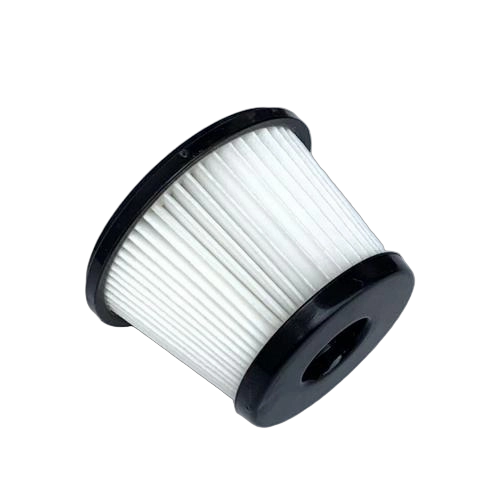
This cone-shaped HEPA filter element is a replacement and OEM filter for handheld vacuum cleaners and robot vacuums, built to capture PM2.5, dust mites, pollen and hair from the airstream before it leaves the dust cup. It pairs a high-precision PTFE membrane, composite PP meltblown or antibacterial filter paper with a pleated conical structure that keeps airflow resistance low and protects motor suction. Ranveth supplies it as a custom-fit part for appliance makers and aftermarket brands, with dimensions and frame options matched to your device.
The performance of a vacuum filter comes from how its layers are matched, not from any single material. In this element, the upstream layer is chosen for dust holding and structural support, while the downstream membrane does the fine-particle work. Ranveth builds the element around three media options: high-precision PTFE microporous membrane, composite PP meltblown, and antibacterial treated filter paper. Each option is selected according to the particle size you need to capture, the airflow your motor delivers and the service life you want to offer.
A PTFE membrane gives the element a washable surface: captured dust sits on the membrane and can be rinsed away, which supports a reusable filter programme. Composite PP meltblown provides high dust capacity at low resistance and suits disposable elements where the priority is filtration efficiency and stable suction. Antibacterial filter paper adds a treatment that helps control microbial growth on the media, which is relevant for mattress vacuum cleaners and other household devices used in close contact with fabrics.
The conical pleat geometry increases effective filter area inside a compact dust cup. More area at the same footprint means lower face velocity, and lower face velocity means lower pressure drop, so the motor does not have to work against a restrictive filter. That balance between efficiency, airflow resistance and service life is what the layer build is designed to hold: a membrane that captures fine particles, a support layer that keeps the pleats open, and an outer frame that seals the element to the housing so air cannot bypass the media.
| Item | Detail |
|---|---|
| Product name | Vacuum cleaner filter element / robot vacuum filter |
| Core filter media | High-precision PTFE microporous membrane / composite PP meltblown / antibacterial treated filter paper |
| Core purification function | Captures PM2.5 particles, dust mites, pollen and hair from the dust cup; helps prevent secondary exhaust pollution |
| Physical fluid characteristics | High-porosity breathable design, very low operating airflow resistance, high dust holding capacity; helps prevent motor overheating and supports battery runtime |
| Main end applications | Handheld cordless vacuum cleaners, smart robot vacuums, mattress mite removers, wet-dry vacuums, car mini vacuums |
| Frame and size customisation | 100% built to the device air path and dust cup dimensions; eco-friendly injection-moulded frame and rubber sealing ring edging for airtight closure |
| Company certification system | 50,000 m² production base and CNAS-accredited testing centre; ISO 9001, ISO 14001 and IATF 16949 quality management systems |
This conical element is used in handheld cordless vacuum cleaners, where the filter sits in the dust cup and must stay compact while handling high airflow. It is also used in smart robot vacuums, mattress mite removers, wet-dry vacuums and car mini vacuums. In each case the housing, pleat count and seal are matched to the device so the filter drops in without modification.
For appliance brands, the element can be developed as an OEM part with a specific media grade, frame material and sealing ring. For aftermarket and replacement-filter brands, Ranveth builds to your sample or drawing so the part fits the installed base you serve. The same layer logic applies across these applications: a pre-filter layer for coarse dust, a membrane or meltblown layer for fine particles, and a frame that holds the seal.
To quote a custom cone filter, send the device model or vehicle model, the size or a drawing of the current filter, and the airflow or water flow the device operates at. Tell us the operating conditions — typical dust load, whether the filter will be washed, and the expected replacement interval — and the quantity you plan to order. If you have a sample of the existing filter, send it and we will match the media, pleat count, frame and seal.
Our team reviews the drawing or sample against the media options and proposes a layer build. Where the fit depends on the dust cup geometry, we confirm the sealing ring and frame before tooling. You can start the conversation through our contact page.
Ranveth makes filter media choices against measured data. Our in-house laboratory is CNAS-accredited and can issue reports on filtration efficiency, dust holding capacity and resistance, so the media pairing in your filter is backed by test results rather than assumption.
The production base covers 50,000 m², including 6 cleanrooms with a combined area of 20,000 m², which supports clean assembly of filter elements. The company holds IATF 16949 automotive quality management certification, obtained in 2024, and operates ISO 9001, ISO 14001 and ISO 45001 systems. Products meet REACH and RoHS requirements, and compliance documents can be provided. With more than 20 years of filter development and manufacturing, Ranveth has supplied European, American, Japanese and Korean markets for over two decades and has developed more than 1,000 filter solutions. The company is located in Zhongshan, Guangdong, China.
If you are evaluating a cone filter for a handheld vacuum, robot vacuum or mattress cleaner, send the device model, size or drawing, airflow figure, operating conditions and order quantity. We will reply with a media recommendation, sample plan and quotation. Use the contact page to reach our team.
The element is built around one of three media options: high-precision PTFE microporous membrane, composite PP meltblown, or antibacterial treated filter paper. The chosen medium is paired with a support layer and a moulded frame with a rubber sealing ring, so the pleats stay open and air does not bypass the filter. The pairing is selected to match your device airflow and the particle size you need to capture.
The conical HEPA filter can reach H11 to H13 efficiency, with filtration efficiency of ≥99.95% for 0.3 μm particles. It captures dust, pollen, mites and PM2.5. The pleated conical design increases effective filter area and reduces airflow resistance. We can match the media grade to your target efficiency and report the test data from our CNAS-accredited laboratory.
We build to your device: send the model, a drawing or a sample of the existing filter, and we match the cone dimensions, pleat count, frame and sealing ring. The goal is a drop-in fit with an airtight seal. Custom sizes and structures are part of our OEM/ODM service, and we confirm fit before tooling.
Yes. Standard in-stock samples are available free of charge, with the customer covering courier cost. Custom samples carry a development fee that is refunded against the mass-production order. To quote, send the device model, size or drawing, airflow, operating conditions and quantity through our contact page.
Standard specification products typically have an MOQ of 3,000 pieces, while custom tooling projects generally start at 5,000 pieces depending on the specification. Standard lead time is 25–35 days after order confirmation. For peak-season or large-volume orders, confirm the production schedule in advance.
In normal household use, we recommend replacement every 3–6 months depending on usage frequency and dust load. We offer two options: a disposable HEPA element with higher filtration precision, and a washable element made with special composite media that can be cleaned 10–30 times. Our CNAS laboratory can provide life test reports for the option you choose.
Yes. We customise cone dimensions, pleat count, media grade (H11/H12/H13), end-cap material (PU, plastic or rubber) and sealing ring specification to your drawing or sample. Packaging can be colour box, blister, neutral or branded with your logo. With over 1,000 filter solutions developed, we can support a custom build from sample to mass production.