
HU-HU▼

Ez a termék a következő márkák berendezéseivel és alkalmazásaival kompatibilis, illetve azokhoz alkalmas, kizárólag választási referenciaként. A védjegyek a mindenkori tulajdonosaik tulajdonát képezik; nem jelentenek együttműködést vagy jóváhagyást.
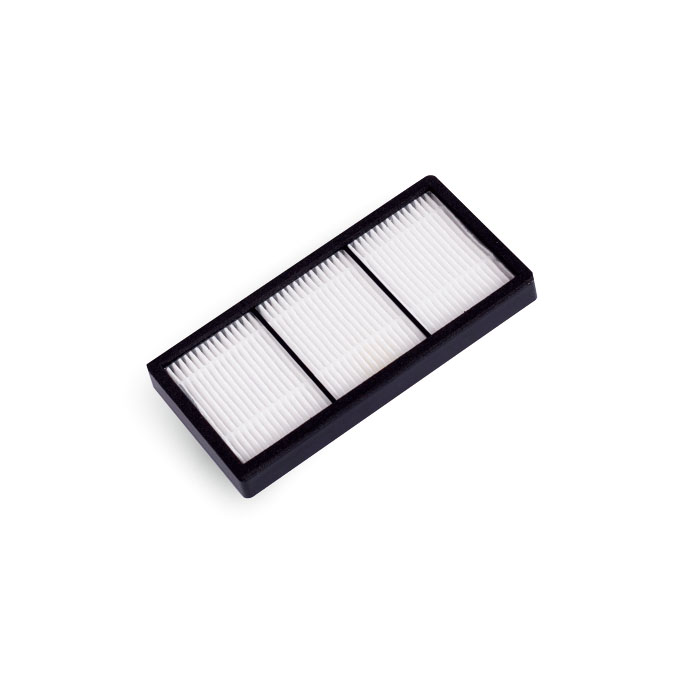
This is a washable dust box HEPA filter for robot vacuums and handheld vacuums, built by Ranveth around a paired media stack: a high-precision PTFE microporous membrane over composite PP (polypropylene meltblown) and other moisture-resistant, antibacterial filter media. It captures PM2.5, fine dust, dust mites, pollen and pet dander inside the dust box so exhaust air does not carry them back into the room. It is made for vacuum OEMs, appliance brands and aftermarket suppliers who need a filter matched to a specific dust box rather than a generic drop-in.
The performance of this filter comes from how the layers are chosen together, not from any single material. A PTFE microporous membrane carries the fine-particle work: its pores are small and uniform, so it holds PM2.5, dust mites, pollen and pet dander while keeping a high porosity structure. Behind it, composite PP meltblown adds depth, spreading dust through the layer instead of letting it cake on one face, and the construction uses moisture-resistant, antibacterial media suited to a part that may be washed.
That pairing is what sets the three properties buyers ask about. Efficiency: the membrane decides how much fine dust is stopped at the surface. Airflow resistance: the high-porosity, breathable design keeps resistance low, so the motor does not lose suction and battery runtime is not drained by the filter. Service life: because the depth layer holds what the membrane passes, the filter keeps working between cleaning cycles, and the PTFE-faced version can be washed rather than discarded each time.
Think of it as a division of labour. The membrane is the fine barrier; the PP layer is the dust holder; the frame is what makes the pair fit a real dust box. Ranveth builds the stack to the host device, so the pairing can be tuned: a tighter membrane where fine capture matters most, a more open build where suction and runtime are the priority.
| Item | Detail |
|---|---|
| Product name | Robot vacuum cleaner / handheld vacuum filter (dust box HEPA filter) |
| Core filter media | High-precision PTFE (polytetrafluoroethylene microporous membrane) / composite PP (polypropylene meltblown) and other moisture-resistant, antibacterial media |
| Core purification function | Strong interception of PM2.5, fine dust, dust mites, pollen and pet dander inside the vacuum, preventing secondary pollution from exhaust air |
| Physical and flow characteristics | High-porosity breathable design with very low operating airflow resistance; does not drain motor suction and supports device battery runtime |
| Main end applications | Smart robot vacuums, handheld cordless vacuums, bed mite-removal devices, small in-car vacuums, floor washers |
| Frame and size customisation | 100% customised to the device dust box dimensions; eco-friendly injection-moulded frames, overmoulded edge sealing, and volume OEM production of washable media (PTFE-coated version) |
| Company certification systems | 50,000 m² modern production base and a CNAS-accredited testing centre; ISO 9001, ISO 14001 and IATF 16949 quality management systems |
The filter is designed for dust boxes and vacuum bodies where exhaust air passes back into the room. Typical hosts are smart robot vacuums, handheld cordless vacuums, bed mite-removal devices, small in-car vacuums and floor washers. In each case the job is the same: hold fine dust, mites, pollen and pet dander inside the box, and let air leave the machine without carrying them back out.
Because the frame is injection-moulded to the host dust box, the same media pairing can be carried into different product families. A robot vacuum with a shallow dust box may take a thinner stack; a handheld vacuum with a higher airflow may take a more open one. The washable PTFE-coated version suits products where the user is expected to rinse the filter and refit it, while the standard build suits sealed, replace-only cartridges. Ranveth supplies both as OEM parts, including overmoulded edge sealing where the dust box needs a tight perimeter.
Custom builds start from the device, not from a catalogue. Send the following and the engineering team can match media grade, layer order, frame geometry and sealing to the host:
Frame material (eco-friendly injection-moulded PP or ABS-type options), overmoulded edge sealing, colour, logo and packaging can all be specified. If you have a target efficiency band, say so; the media pairing will be tuned to it rather than defaulted.
Media choices here are test-backed. Ranveth's own laboratory is CNAS-accredited and can issue reports on filtration efficiency, dust holding capacity and airflow resistance, so a layer build is confirmed by measurement before it goes to tooling.
Production sits in a 50,000 m² plant in Zhongshan, Guangdong, China, which includes six cleanrooms totalling 20,000 m². Cleanroom assembly matters for a filter that will sit in a dust box and be judged on what it does not release.
The quality systems behind the part are IATF 16949 (achieved in 2024) and ISO 9001, ISO 14001 and ISO 45001. Products meet REACH and RoHS requirements and compliance documents can be supplied.
Ranveth has more than 20 years of filter development and manufacturing experience, exporting to Europe, the United States, Japan and South Korea for over two decades, and has developed more than 1,000 filtration solutions. OEM and ODM work covers size, structure, media grade, frame material, logo and packaging. Multiple automated lines support monthly output in the millions of pieces, with IQC, IPQC and OQC checks through the process.
To move a dust box filter from drawing to sample, send the device model, size or drawing, airflow figure, operating conditions and quantity. The team will confirm a media pairing, propose a frame and sealing approach, and quote samples and volume pricing against that specification. Contact Ranveth to start the conversation.
It pairs a high-precision PTFE microporous membrane with composite PP (polypropylene meltblown) and other moisture-resistant, antibacterial media. The membrane handles fine-particle capture while the PP layer holds dust in depth. The exact layer order and grade are set for each host device.
The PTFE membrane sets how much PM2.5, fine dust, mites, pollen and pet dander is stopped at the surface. The high-porosity PP layer keeps airflow resistance low so motor suction and battery runtime are not drained. Tuning the pair balances capture against suction for the host vacuum.
Yes. Ranveth builds 100% to the device dust box dimensions, with eco-friendly injection-moulded frames and overmoulded edge sealing where needed. Send the model, a size drawing or a physical sample, and the frame, media grade and sealing are matched to it.
Send the device or vehicle model, size or drawing, airflow figure, operating conditions and quantity. The team confirms a media pairing and frame approach, then quotes samples and volume pricing. Sample lead times depend on whether tooling is required for the frame.
MOQ depends on the specification and whether the frame is a standard or new mould. Share your first-order and annual volumes with the inquiry, and the team will confirm the MOQ for that build. No MOQ is quoted until the specification is fixed.
Lead time depends on whether the frame tooling already exists and on order volume. Once the media pairing, frame and sealing are confirmed, Ranveth provides a schedule with the quotation. Production runs on multiple automated lines with monthly output in the millions of pieces.
The PTFE-coated washable version is designed to be rinsed and refitted, while the standard build is a replace-only cartridge. Replacement or wash interval depends on dust load and how often the vacuum runs, so set it from your own field data. The moisture-resistant media is chosen to tolerate repeated washing.
Yes. Products meet REACH and RoHS requirements and compliance documents can be supplied. The plant holds IATF 16949, ISO 9001, ISO 14001 and ISO 45001 certification. Please send your market requirements with the inquiry so the right documents are prepared.