
HU-HU▼

Ez a termék a következő márkák berendezéseivel és alkalmazásaival kompatibilis, illetve azokhoz alkalmas, kizárólag választási referenciaként. A védjegyek a mindenkori tulajdonosaik tulajdonát képezik; nem jelentenek együttműködést vagy jóváhagyást.
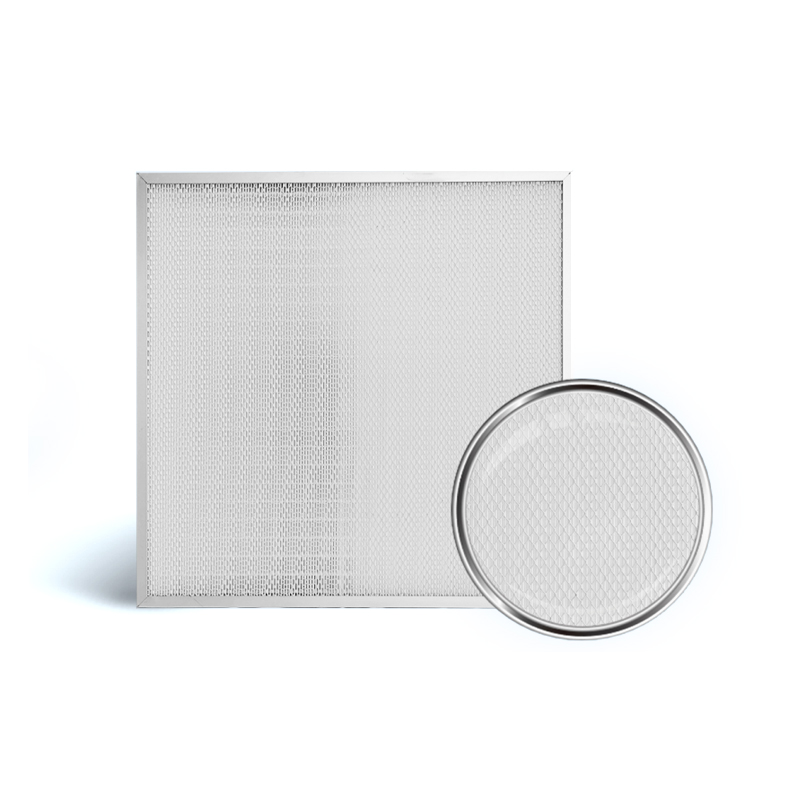
Ranveth panel high-efficiency filters are pleated panel filters built for terminal filtration in cleanrooms, FFU fan filter units, laminar flow hoods and clean transfer windows. They capture fine airborne particles at H13 and H14 efficiency grades, with filtration efficiency of 99.99% or higher for particles at 0.3 μm, and selected models reach ULPA U15/U16 level. They are intended for buyers in semiconductor and microelectronics manufacturing, pharmaceutical and food processing, medical and cleanroom facilities, automotive and machinery plants, energy storage, data centres and commercial ventilation systems who need a defined media-and-frame build rather than a generic panel.
The performance of a panel high-efficiency filter is set long before assembly, at the point where media and layer structure are paired. In the Ranveth range, the filter media options include glass fibre and PTFE, and the pleat pack is held by a separator chosen for the duty: hot melt adhesive, aluminium foil or paper separators. The frame can be aluminium alloy, galvanised steel, stainless steel, MDF or plastic. Each combination moves three things at once — efficiency, airflow resistance and service life — and the build is chosen so that those three stay in balance for the application.
A denser or finer medium raises particle capture but also raises resistance, which the fan in an FFU or air handling unit must then overcome. Separator choice affects how evenly air distributes across the pleat pack and how the pack holds its shape through pressure cycling. Frame material matters for weight, rigidity and compatibility with the mounting system in the ceiling grid or housing. Because the media and layer structure are specified together rather than independently, a buyer can target a filtration grade and an acceptable pressure drop at the same time, instead of accepting whatever falls out of a stock configuration.
Every unit is checked in the company's CNAS-accredited laboratory, where efficiency, dust holding capacity and resistance can be measured and reported. Efficiency testing, PAO/DOP scan leak testing and resistance testing are carried out on finished filters, so the pairing of media and structure is verified at the product level and not only on paper. That is the practical basis on which a specification is agreed: the build is selected for the duty, then confirmed by measurement.
| Item | Detail |
|---|---|
| Product name | Ranveth panel high-efficiency filter (pleated panel HEPA/ULPA filter) |
| Product category | High-efficiency filter |
| Efficiency grades | H13 and H14 available; filtration efficiency of 99.99% or higher for particles at 0.3 μm; selected models reach ULPA U15/U16 level |
| Filter media options | Glass fibre, PTFE |
| Frame material options | Aluminium alloy, galvanised steel, stainless steel, MDF, plastic |
| Separator options | Hot melt adhesive, aluminium foil, paper separator |
| Sealant | Selected according to the agreed build |
| Sizes and thickness | Made to customer drawing or operating condition; confirmed on sample |
| Typical installations | ISO Class 1–7 cleanrooms, FFU fan filter units, clean transfer windows, laminar flow hoods |
| Customisation | Size, frame material, media, sealant type, separator, logo and packaging to order (OEM/ODM) |
| Testing | Efficiency, PAO/DOP scan leak and resistance testing in the CNAS-accredited laboratory |
These filters are used where airborne particle control is part of the process rather than a comfort measure. In semiconductor and microelectronics work they serve wafer fabrication, lithography areas, chip packaging and microelectronics assembly, including ISO Class 1–7 cleanrooms and the terminal filtration stage of FFU units, clean transfer windows and laminar flow hoods. In medical and cleanroom settings they support controlled environments where the air supply must meet a stated grade. In pharmaceutical and food processing they are applied where process air is part of hygiene control. Automotive and machinery plants use them in paint and precision assembly areas, energy storage manufacturers use them in cell production environments, and AI compute and data centre operators apply them where equipment cooling air is filtered to protect hardware. Commercial air handling and ventilation systems use them as high-grade final filters, and energy and metal smelting operations use them in controlled sections of their facilities.
Because the media-and-layer pairing is set per application, the more precisely the duty is described, the more directly the build can be matched to it. To prepare a proposal, send:
If some of these are not yet fixed, describe the application and the engineers will propose a media and structure combination for review. Contact the team with your details and the enquiry will be routed to the appropriate engineer.
Media choices at Ranveth are test-backed. The company operates its own laboratory accredited by CNAS (China National Accreditation Service for Conformity Assessment), which can issue test reports covering filtration efficiency, dust holding capacity and resistance. That matters when a media and layer structure is being selected, because the pairing can be measured rather than assumed.
Production takes place in a 50,000 m² plant in Zhongshan, Guangdong, China, which includes six cleanrooms totalling 20,000 m². High-efficiency filters are assembled in cleanroom conditions to avoid cross-contamination. The quality system is certified to ISO 9001, ISO 14001 and ISO 45001, and IATF 16949 certification for the automotive quality management system was obtained in 2024. Products meet the REACH and RoHS environmental requirements, and compliance documents can be supplied.
The company has more than 20 years of experience in filter development and manufacturing and has exported to Europe, the United States, Japan and Korea for over 20 years. OEM and ODM work covers size, structure, media grade, frame material, logo and packaging, with more than 1,000 filter solutions developed to date. Multiple automated production lines support volume supply, and quality control runs through IQC, IPQC and OQC stages from incoming material to final release.
Samples and quotations are handled together so that the sample reflects the build being quoted. For standard specifications the minimum order quantity is generally 50–100 pieces; for custom specifications it depends on structural complexity and is usually 100–200 pieces, with flexibility for new customers and sample orders. Standard items ship in 7–15 days, and custom bulk orders usually take 25–35 days. To start, send the device or vehicle model, the size or drawing, the airflow or water flow, the operating conditions and the quantity you expect, and the team will respond with a proposal. Send your requirements through the contact page.
Ranveth panel high-efficiency filters can be built with glass fibre or PTFE media, held by hot melt adhesive, aluminium foil or paper separators, in an aluminium alloy, galvanised steel, stainless steel, MDF or plastic frame. The combination is selected for the duty so that efficiency, airflow resistance and service life stay in balance. The final build is confirmed on the sample.
H13 and H14 grades are available, with filtration efficiency of 99.99% or higher for particles at 0.3 μm, and selected models reach ULPA U15/U16 level. Efficiency is measured in the company's CNAS-accredited laboratory. The grade you need is agreed against the cleanliness class of your installation.
Yes. Sizes are made to your drawing or operating condition, and frame material, media, sealant type and separator can all be specified. OEM and ODM service covers logo and packaging as well, and the engineering team can support the step from drawing to sample to volume production. Send your drawing or the dimensions you need to begin.
Samples are prepared together with the quotation so that the sample represents the build being priced. To quote accurately we need the device or installation model, the size or drawing, the airflow and the operating conditions. Send these through the contact page and the enquiry is routed to an engineer.
Standard specifications generally start at 50–100 pieces. Custom specifications depend on structural complexity and usually start at 100–200 pieces, with flexibility for new customers and sample orders. Tell us your first-order quantity and expected annual volume so the terms can be set accordingly.
Standard items ship in 7–15 days. Custom bulk orders usually take 25–35 days. Multiple automated production lines and material stocking support urgent orders and long-term supply, and the schedule is confirmed when the order is placed.
Service life is typically 1–3 years, depending on the cleanliness of the surrounding air, the operating face velocity, the pre-filtration stage and daily running hours. Replacement is recommended when the final resistance reaches twice the initial resistance or the design final resistance. A suitable pre-filter stage helps extend the life of the terminal filter.