
ID-ID▼

Produk ini kompatibel dengan atau cocok untuk peralatan dan aplikasi dari merek-merek berikut, hanya sebagai referensi pemilihan. Merek dagang dimiliki oleh masing-masing pemiliknya; tidak menyiratkan kemitraan atau dukungan.
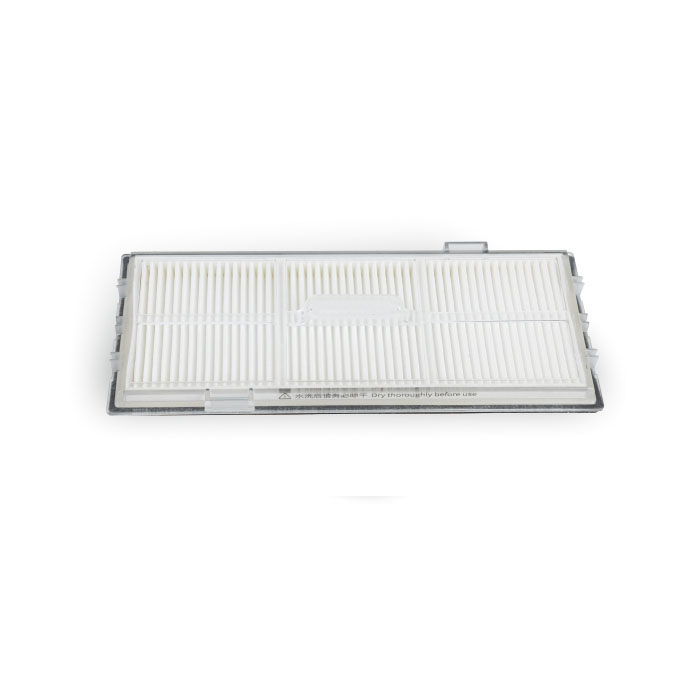
Ranveth's washable dust box filter is a removable filter element for robot vacuums and handheld vacuums, built around a high-precision PTFE microporous membrane or composite PP meltblown media. It captures PM2.5, fine dust, dust mites, pollen and pet dander so that exhaust air does not return particles to the room. It is made for appliance brands and vacuum OEMs that need a low-resistance, washable filter sized to their own dust box.
A filter's behaviour comes from how its layers are paired, not from any single sheet of material. In this element the working layer is a high-precision PTFE microporous membrane, used on its own or combined with composite PP meltblown media. The membrane carries the fine-particle capture; the PP layer behind it supports the structure and holds dust in the depth of the web. Pairing the two gives a high-porosity, breathable stack: a high share of open pore volume for air to pass through, while the pore size that particles meet stays small.
That pairing is what sets the three properties buyers ask about. Efficiency depends on the membrane's microporous structure, which is why PM2.5, fine dust, dust mites, pollen and pet dander are intercepted rather than carried back out with the exhaust. Airflow resistance depends on the openness of the same stack, so running resistance stays low and does not drain motor suction or battery runtime. Service life depends on how the layers behave under repeated cleaning: PTFE membrane versions are washable, and the removable construction lets the user clear dust and hair before refitting the element.
The media are also chosen for moisture and microbial resistance, so a filter that is washed and returned to a dust box does not have to be a dry-only component. The housing follows the same logic. Ranveth supplies an eco-friendly injection-moulded frame with an edge over-mould seal so the element sits in the dust box with a closed perimeter, and both frame and media are built to the customer's dust box dimensions rather than to a catalogue size.
| Item | Detail |
|---|---|
| Product name | Robot vacuum filter / handheld vacuum filter element (washable dust box filter, removable) |
| Core filtration media | High-precision PTFE (polytetrafluoroethylene) microporous membrane / composite PP (polypropylene meltblown) and other moisture-resistant, antimicrobial media |
| Filtration function | Captures PM2.5, fine dust, dust mites, pollen and pet dander inside the vacuum; prevents secondary contamination through the exhaust |
| Fluid and airflow behaviour | High-porosity breathable design with very low operating airflow resistance; does not waste motor suction and supports battery runtime |
| Typical end applications | Robot vacuums, handheld cordless vacuums, bed mite-removal units, compact car vacuums, floor washers |
| Frame and size | Fully customised to the device dust box; eco-friendly injection-moulded frame with over-moulded edge seal; volume production of washable PTFE-coated versions |
| Company systems | 50,000 m² production base and a CNAS-accredited testing centre; ISO 9001, ISO 14001 and IATF 16949 management systems |
The element is specified for robot vacuums first, where dust box volume is small and every millimetre of filter area has to earn its place. The same media pairing suits handheld cordless vacuums, where low resistance protects suction and runtime; bed mite-removal units, where fine dust and mite allergens are the target; compact car vacuums; and floor washers that need a moisture-tolerant element.
Because the frame is tooled to the dust box, the filter can be matched to a new appliance platform or to an existing one that is being refreshed. Washable PTFE versions are available for volume production, which suits programmes where the end user is expected to rinse and reuse the element rather than replace it every few weeks.
A custom element starts from four pieces of information. Send the device or vehicle model, or a drawing or sample of the dust box; the size or drawing of the filter seat; the airflow the appliance is designed for, or for wet applications the water flow; and the operating conditions, including whether the element will be washed and reused and what dust load it will see. Add the quantity you expect per order and per year, and any packaging or branding requirements.
With those details Ranveth can propose a media pairing, a frame and seal arrangement, and a sample for fit testing. Our team has developed more than 1,000 filtration solutions and offers OEM/ODM customisation of size, structure, media grade, frame material, logo and packaging.
The first reason is evidence. Ranveth's own laboratory is CNAS-accredited and can issue test reports on filtration efficiency, dust holding capacity and resistance, so the media pairing proposed for a project is backed by measurement rather than by a data sheet alone.
The second is capacity and control. Production runs in a 50,000 m² plant that includes six cleanrooms totalling 20,000 m², with multiple automated lines and monthly output that can reach several million pieces. Quality control covers IQC, IPQC and OQC across the whole process.
The third is systems. Ranveth has held ISO 9001, ISO 14001 and ISO 45001 certification and added IATF 16949 automotive quality management certification in 2024. Products meet REACH and RoHS requirements and compliance documents can be supplied.
Finally, experience. More than 20 years of filter development and manufacturing, with continuous exports to Europe, the United States, Japan and Korea for over 20 years, means the team has already met the entry requirements of the markets these appliances sell into. Ranveth is based in Zhongshan, Guangdong, China.
To move a project forward, send the device model, the size or a drawing of the dust box, the airflow or water flow figure, the operating conditions, and your expected quantity. We will reply with a proposed media and frame configuration, sample options and a quotation. Start here: contact Ranveth.
It uses a high-precision PTFE microporous membrane, alone or paired with composite PP meltblown media, plus moisture-resistant antimicrobial media options. The membrane provides fine-particle capture while the PP layer supports structure and dust holding. The pairing keeps porosity high so airflow resistance stays low.
The microporous membrane is designed to intercept PM2.5, fine dust, dust mites, pollen and pet dander, preventing secondary contamination through the exhaust. Efficiency figures for a specific build are measured in Ranveth's CNAS-accredited laboratory. Send your target efficiency and we will propose a matching media grade.
Yes. The frame is injection-moulded to your dust box dimensions with an over-moulded edge seal, and washable PTFE versions are available for volume production. Under correct washing, the composite media has been verified in the CNAS laboratory to hold over 90% of initial filtration efficiency after more than 50 washes. Send a drawing or sample to start.
Send the device or vehicle model, the filter size or a drawing, the airflow or water flow, the operating conditions and your expected quantity. We will propose a media and frame configuration and quote against it. Sample timing is confirmed once the specification is agreed.
Standard specifications typically start at 5,000–10,000 pieces; custom builds are agreed according to complexity. Stock standard orders usually ship in 7–15 days, while custom orders including tooling generally run 30–45 days after confirmation. Larger programmes rely on the 50,000 m² plant and automated lines.
Washable PTFE versions are designed for repeated rinsing and reuse, which lowers consumable replacement frequency for the end user. Replace the element when airflow resistance rises noticeably or the media is damaged. Actual interval depends on dust load and appliance use; we can advise once the operating conditions are known.
Yes. Size, structure, media grade, frame material, logo and packaging can all be customised under OEM/ODM. Ranveth has developed more than 1,000 filtration solutions, so packaging can be planned alongside the element. Share your requirements with the inquiry.
Ranveth holds ISO 9001, ISO 14001 and ISO 45001 certification and added IATF 16949 in 2024. Products meet REACH and RoHS requirements and compliance documents can be provided. Testing is carried out in the company's CNAS-accredited laboratory. Contact us to discuss the documents your market needs.