
KO-KR▼

본 제품은 아래 브랜드의 장비 및 응용 분야와 호환되거나 이에 적합하며, 선정 시 참고용으로만 제공됩니다. 상표는 각 소유자에게 귀속되며 파트너십이나 보증을 의미하지 않습니다.
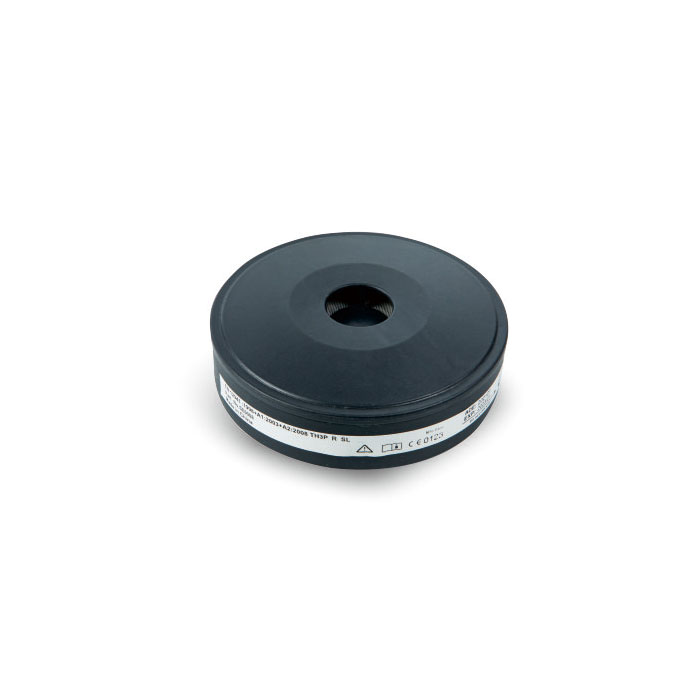
Ranveth Gas Filter Box is a ventilator and respirator cartridge that pairs a high-precision PTFE membrane with glass fibre and activated carbon to remove PM0.3 particles at ≥99.99% efficiency while adsorbing VOCs. It is built for clinical ventilator and anaesthesia circuits, industrial respirators, and high-spec fresh-air or oxygen equipment. The design logic is simple: match each medium to the job it does best, then stack them so airflow stays low-resistance and service life stays predictable.
Every Ranveth gas filter box starts with the media stack, not the housing. The core is a high-precision PTFE microporous membrane. PTFE gives a very fine pore structure at a relatively low pressure drop, which is why it can hold ≥99.99% removal efficiency for PM0.3 particles without turning the circuit into a bottleneck. Behind the membrane, a layer of top-grade glass fibre supports the fine filtration duty and adds depth loading capacity, so the filter does not blind off the moment it meets a dust or aerosol load.
The third functional layer is a composite activated carbon adsorption medium. This is where the box earns the “gas filter” part of its name: the carbon layer adsorbs and neutralises VOCs and odorous gases that pass through the particle filter. Because the carbon sits behind the particle media, the membrane protects it from coarse contamination, and the carbon protects the patient or user from volatile carry-over. The result is dual-action filtration in one cartridge: particles first, gases second, with each layer doing the job it was selected for.
Pairing also drives airflow resistance and service life. A membrane-only cartridge may filter well but load quickly; a carbon-only cartridge may adsorb gases but pass fine aerosols. By combining them in a defined order, Ranveth keeps resistance within the intended operating window for ventilator and respirator blowers, and extends usable life because each layer protects the next. The same pairing logic lets us offer HEPA H13/H14 through ULPA U15 and above, plus washable options, without changing the basic architecture.
| Item | Detail |
|---|---|
| Product name | High-efficiency HEPA filter / ventilator filter cartridge (HEPA Ventilator Filter / Respirator Cartridge) |
| Core media composition | High-precision PTFE (microporous polytetrafluoroethylene) membrane / top-grade glass fibre / composite activated carbon adsorption material |
| Core filtration performance | Dual action: precise removal of PM0.3 particles (efficiency ≥ 99.99%) plus efficient adsorption and neutralisation of harmful VOCs |
| Efficiency grades | Configurable from HEPA H13/H14 to ULPA U15 and above; washable filter options available |
| Main applications | Clinical ventilator and anaesthesia circuit systems, industrial gas masks / positive-pressure respirators, high-spec fresh-air purification and oxygen generation equipment |
| Dimensional customisation | Tooling and production fully to customer drawings; non-toxic medical-grade ABS/PC injection-moulded housing and medical silicone ultrasonic-welded sealing ring to ensure no leakage |
| Certification | Filtration efficiency verified by the company’s CNAS-accredited testing centre; company holds Medical Supplies GMP certification, IATF 16949, ISO 14001 and ISO 45001 system certificates |
The clinical use case is the breathing circuit. Ranveth gas filter boxes are specified for ventilator and anaesthesia machine circuits where both particle and gas control matter, and for oxygen generation equipment that needs clean, low-resistance air. In these settings the cartridge sits between the device and the patient, so the sealing ring and housing material matter as much as the media: the medical silicone ultrasonic-welded seal is there to prevent leakage at the connection.
Industrial use follows the same logic. Positive-pressure respirators and gas masks benefit from the combined particle and VOC layer when the environment carries both aerosols and volatile organic compounds. High-spec fresh-air purification is the third setting: where a compact cartridge must deliver HEPA-class particle removal and odour control without excessive pressure drop. Because the housing is injection-moulded to drawing, the same media stack can be packaged for different device interfaces, from clinical circuits to industrial mask fittings.
Custom builds are quoted from a short technical brief. Send the device or vehicle model the cartridge is intended for, and a size drawing or interface sketch if you have one. Tell us the airflow or water flow the system expects, and the operating conditions: temperature, humidity, expected contaminant load, and whether the environment carries VOCs as well as particles. State the quantity you plan to order, and whether you need a standard HEPA grade or an ULPA configuration, or a washable variant. If you already have a target efficiency or pressure-drop window, include it. With those inputs we can pair media and propose a layer build rather than simply quoting a stock part.
For projects that need a new housing, we tool to your drawing and can supply non-toxic medical-grade ABS/PC shells and medical silicone ultrasonic-welded sealing rings. Logo, packaging and documentation can be customised as part of an OEM/ODM programme. If you are still at the specification stage, send the device parameters and we will propose a media combination and a test plan.
The first reason is test-backed media selection. Ranveth’s own laboratory is CNAS-accredited and can issue test reports for filtration efficiency, dust holding capacity and resistance. When we propose a PTFE and carbon pairing, it is because the combination has been measured, not assumed. That matters in ventilator circuits, where a small change in resistance or efficiency is a clinical variable.
The second is manufacturing scale and cleanliness. The production base covers 50,000 m², including six cleanrooms totalling 20,000 m².The company holds IATF 16949 (achieved in 2024) and ISO 9001, ISO 14001 and ISO 45001 system certificates, and products meet REACH and RoHS requirements with compliance documents available.
Third is experience in custom filtration. Ranveth has more than 20 years of filter R&D and manufacturing experience and has developed over 1,000 filtration solutions, with more than 20 years of continuous export to Europe, the United States, Japan and South Korea. Multiple automated production lines support monthly output in the millions of pieces, and quality control runs through IQC, IPQC and OQC. The company is based in Zhongshan, Guangdong, China.
To request samples and a quote, send the device or vehicle model, the size or drawing, the expected airflow or water flow, the operating conditions, and the quantity you intend to order. If you have a target efficiency grade or a pressure-drop limit, include that as well. We will review the brief and respond with a proposed media pairing, sample plan and quotation. You can reach the team through the contact page; technical questions are welcome at any stage, including before a drawing exists.
It combines a high-precision PTFE microporous membrane, top-grade glass fibre and a composite activated carbon adsorption layer. The PTFE and glass fibre handle PM0.3 particle removal at ≥99.99% efficiency, while the carbon layer adsorbs and neutralises VOCs. The layers are ordered so the particle media protects the carbon and the carbon handles gases that pass the membrane.
The core configuration is rated at ≥99.99% removal efficiency for PM0.3 particles. The platform is configurable from HEPA H13/H14 to ULPA U15 and above, and washable options are available. Efficiency is verified at the company’s CNAS-accredited testing centre.
Yes. Ranveth produces fully to customer drawings, including injection-moulded non-toxic medical-grade ABS/PC housings and medical silicone ultrasonic-welded sealing rings to prevent leakage. Send the device model and a size drawing or interface sketch, and the media stack can be packaged for your specific fitting.
Pairing a fine PTFE membrane with glass fibre and carbon keeps resistance within the intended operating window while protecting each layer from the next layer’s load. The membrane stops particles before they reach the carbon, and the carbon handles VOCs, so the cartridge does not blind off prematurely. This is why the layer order is fixed rather than arbitrary.
Yes. Send the device or vehicle model, size or drawing, airflow or water flow, operating conditions and intended quantity. The team will respond with a proposed media pairing, sample plan and quotation. You can start through the contact page at any stage.
For this product, standard specifications typically start at 1,000 pcs, and customised configurations are evaluated separately depending on tooling and media configuration. Standard samples can be sent within 3–5 working days, custom samples involving tooling generally take 15–30 days, and batch lead time is usually 25–35 days after order confirmation.
Replacement depends on the duty: single-use clinical ventilator cartridges are changed after each patient, reusable types typically every 24–72 hours, and home ventilator use is usually every 1–3 months. Ranveth can provide life test data and replacement guidance based on your device parameters and target market regulations.
Yes. It is used in clinical ventilator and anaesthesia circuits, oxygen generation equipment, industrial gas masks and positive-pressure respirators, and high-spec fresh-air purification. The same media stack can be housed for different interfaces, so specify the device model when inquiring.