
MS-MY▼

Produk ini serasi dengan atau sesuai untuk peralatan dan aplikasi daripada jenama berikut, hanya sebagai rujukan pemilihan. Tanda dagangan dimiliki oleh pemilik masing-masing; tidak menunjukkan perkongsian atau sokongan.
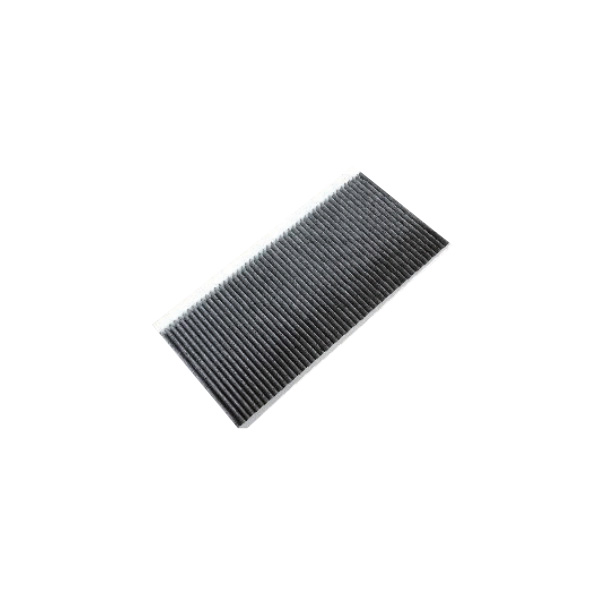
This is a Ranveth automotive cabin air filter built on a dual-layer composite: a high-precision HEPA filtration layer paired with high-iodine-value coconut-shell granular activated carbon. It captures PM2.5 particles and dust from the air entering the cabin and adsorbs ammonia, sulphides and exhaust VOCs that cause odour. It is made for passenger cars, coaches, heavy trucks and construction machinery, and for buyers who specify cabin filtration for OEM or aftermarket programmes.
The behaviour of a cabin filter is decided less by any single material than by how the layers are matched to each other. In this Ranveth element, the HEPA layer handles the particle side of the job and the carbon layer handles the gas and odour side. The two are combined so that each does its own work without one blocking the other.
The HEPA layer is a high-precision medium selected for efficient interception of PM2.5 and dust. Its pore structure is what determines whether fine particles are held in the medium or pass through, and it is the first barrier the incoming air meets. The carbon layer is high-iodine-value coconut-shell granular activated carbon, chosen because the iodine value reflects how much adsorption surface is available. That surface is what targets ammonia, sulphides and the VOCs associated with traffic exhaust.
The pairing matters in both directions. A dense particle layer protects the carbon from being blinded by dust, while a well-formed carbon bed must not add more resistance than the system can tolerate. The pleated construction is what makes the combination workable: pleating exposes a large media area inside a compact panel, which keeps airflow resistance low and raises dust-holding capacity. The result is a filter that supports cabin ventilation without loading the blower, and that holds its service life because it stores dust across a wide pleated surface rather than on a small flat one.
For a buyer, the practical reading is simple. Ask what the media pair is, ask how the pleat pack is dimensioned, and ask for resistance and capacity data measured on that build. Those three answers describe the efficiency, the airflow behaviour and the life of the element more reliably than a headline efficiency figure alone.
| Item | Detail |
|---|---|
| Product name | Automotive cabin air filter / car air filter element |
| Core structure | Dual-effect composite: high-precision HEPA filtration medium plus high-iodine-value coconut-shell granular activated carbon |
| Core filtration performance | Efficient interception of PM2.5 particles and dust; targeted adsorption of ammonia, sulphides and exhaust VOCs |
| Physical and airflow characteristics | Good airflow behaviour, low operating resistance, high dust-holding capacity and long service life |
| Main applications | Cabin ventilation systems of passenger cars (sedans, SUVs, MPVs and similar), commercial coaches, heavy trucks and construction machinery |
| Size customisation | Full OEM/ODM flexibility for all vehicle models; any length and width, thickness and pleat count can be customised to the original air duct requirements |
| Quality and certification | 50,000 m² plant; IATF 16949 automotive quality management system; national-level CNAS testing centre supporting automotive-grade release quality |
The element is specified for the cabin ventilation system, the path that draws outside air through the HVAC case and into the passenger compartment. In passenger cars — sedans, SUVs and MPVs — it addresses the everyday load of traffic dust, pollen-season particles and exhaust odour in dense city driving.
In commercial coaches and heavy trucks, the same media pairing is applied where cabin air is shared by a driver over long duty cycles and where the filter sees sustained particulate loading. Construction machinery is a further fit: the cabin is often worked in dust-heavy environments, and a pleated element with high dust-holding capacity is what keeps resistance from climbing too quickly between services.
Because the panel is built to the vehicle's duct, the same construction can be supplied across a wide range of models rather than being tied to one platform. That makes it suitable for buyers assembling a catalogue that covers many vehicles from a single media and process discipline.
Custom builds start from the vehicle and the duct, not from a catalogue number. To quote accurately, we need the following:
If you already have a sample element, sending it is often the fastest route. We can measure it, match the pleat geometry and propose the media pairing for your target efficiency.
The first reason is evidence. Our in-house laboratory holds CNAS (China National Accreditation Service for Conformity Assessment) accreditation and can issue test reports covering filtration efficiency, dust-holding capacity and resistance. Because the media pairing is the heart of this product, having the pairing measured rather than assumed is what lets a buyer specify with confidence.
The second is production scale and control. The manufacturing base covers 50,000 m², including 6 cleanrooms totalling 20,000 m², so filter production is not exposed to secondary contamination. The company was certified to the IATF 16949 automotive quality management system in 2024 and also holds ISO 9001, ISO 14001 and ISO 45001 certification.
Third is compliance and experience. Products meet REACH and RoHS requirements and supporting documents can be supplied. Ranveth draws on more than 20 years of filtration product development and manufacturing, with continuous exports to Europe, the United States, Japan and South Korea for over 20 years, and more than 1,000 filtration solutions developed to date. OEM/ODM support covers size, structure, media grade, frame material, logo and packaging. The plant is in Zhongshan, Guangdong, China.
If you are evaluating a cabin filter for a vehicle programme, the most useful next step is a sample tested in your own duct. Tell us the vehicle or device model, the size or drawing, the airflow the system needs to deliver, the operating conditions and the quantity you expect. With those details we can propose a media pairing and layer build, confirm sample and production timing, and prepare a quotation.
Contact us to start the conversation.
It uses a dual-effect composite structure: a high-precision HEPA filtration medium for PM2.5 particles and dust, paired with high-iodine-value coconut-shell granular activated carbon for ammonia, sulphides and exhaust VOCs. The two layers are combined in a pleated panel so that each supports the other's performance.
The HEPA layer intercepts fine particles first, which keeps dust away from the carbon bed; the carbon layer then adsorbs odour and gas without adding excessive resistance. Pleating exposes a large media area in a compact panel, which keeps operating resistance low and gives the element a high dust-holding capacity and a longer service life. The balance between the two layers is what determines all three outcomes.
Yes. We support full OEM/ODM customisation for all vehicle models. Any length and width, thickness and pleat count can be produced to match the original air duct requirements, and frame material, logo and packaging can also be customised. Send a drawing or a sample element and we will match the geometry.
Yes. Send the vehicle or device model, the size or drawing, the airflow requirement, the operating conditions and the expected quantity, and we will propose a build and prepare a quotation. Sample timing is confirmed against the specification once those details are clear.
MOQ depends on whether the item is a standard or a custom build, and on the tooling and material requirements of the specific model. Share your target volume and vehicle application and we will confirm the MOQ for that configuration in the quotation.
Lead time is set per order once the specification, quantity and tooling route are agreed. Because the plant runs multiple automated production lines with monthly capacity in the millions of pieces, volume orders can be scheduled without displacing the agreed delivery window.
Under normal use we recommend replacement every 15,000–20,000 km or once a year. In heavily polluted or dusty environments, shorten the interval to about 10,000 km. Dust-holding capacity and antibacterial durability have been verified in the CNAS laboratory, and detailed life test data can be provided as a purchasing reference.
Production runs through IQC, IPQC and OQC checks, in a plant of 50,000 m² that includes 6 cleanrooms totalling 20,000 m². The CNAS-accredited laboratory issues reports on filtration efficiency, dust-holding capacity and resistance, and the company has held IATF 16949 certification since 2024 alongside ISO 9001, ISO 14001 and ISO 45001. For a specific programme, contact us with your requirements.