
MS-MY▼

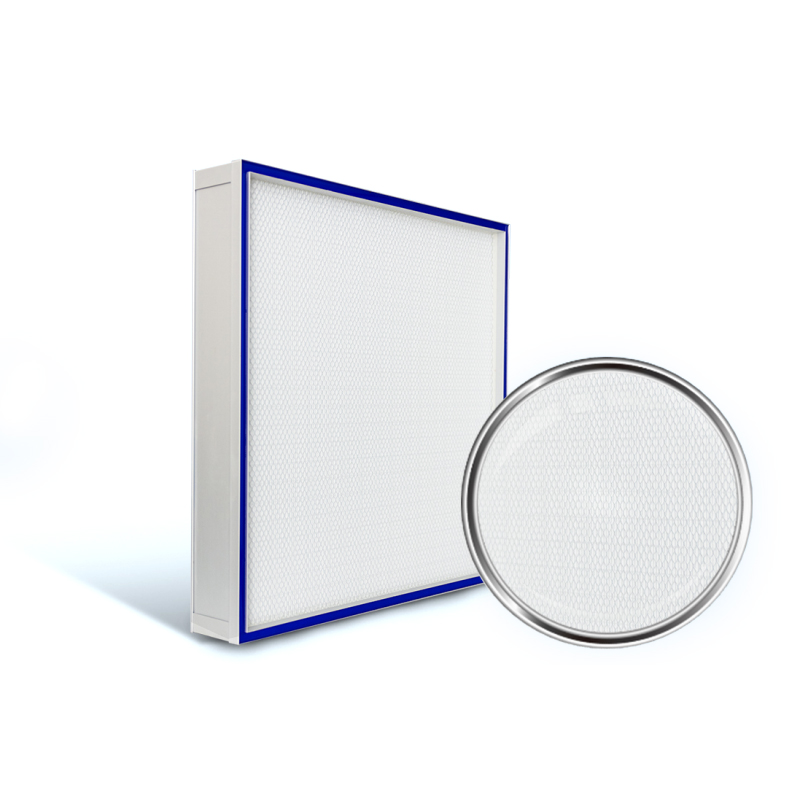
Ranveth high-efficiency gel seal filters are designed for critical cleanroom and containment applications where leak-free sealing is essential. They filter airborne particles at H12 through U15 efficiency using ultra-fine glass fibre media, and are intended for semiconductor fabs, pharmaceutical facilities, hospitals, and other controlled environments. The gel seal design ensures a continuous, reliable seal between the filter and the housing.
At the heart of every Ranveth gel seal filter is a high-throughput, moisture-resistant ultra-fine glass fibre medium. The media is selected for its consistent fibre diameter and uniform pore structure, which together determine the filter's particle capture efficiency and airflow resistance. The medium is pleated to maximise surface area within a compact frame, and the pleat geometry is optimised to balance pressure drop against dust-holding capacity.
The layer build pairs the glass fibre medium with an anodised aluminium frame and a polyurethane gel sealant. The gel is formulated to remain stable across temperature fluctuations and to resist compression set, so the seal stays effective throughout the filter's service life. This combination of medium and seal is what allows the filter to maintain H12–U15 efficiency without bypass leakage.
Two gel seal configurations are available: top gel seal (70 mm depth) and side gel seal (50 mm depth). Both use the same gel chemistry and frame construction, and the choice between them depends on the housing design and installation method. The pairing of medium and seal is validated through factory scan testing to ensure each filter meets its rated efficiency.
| Item | Detail |
|---|---|
| Product name | High-Efficiency Panel Filter (Gel Seal) / Gel Seal HEPA & ULPA Filter |
| Filter class (EN 1822) | H12 / H13 / H14 (HEPA) / U15 (ULPA) |
| Core filter material | High-throughput, moisture-resistant ultra-fine glass fibre |
| Frame and seal material | Anodised aluminium profile + polyurethane gel sealant |
| Installation type | Top gel seal / Side gel seal |
| Typical applications | Semiconductor wafer fab cleanrooms, biopharmaceutical GMP workshops, hospital Class 100 operating theatres, FFU units, high-standard paint lines |
| Standard sizes and rated airflow (W × H × D) | Side gel seal 50 mm depth: 610×610×50 mm (airflow 1000 m³/h); 1170×570×50 mm (airflow 1800 m³/h). Top gel seal 70 mm depth: 610×610×70 mm (airflow 750 m³/h); 1170×570×70 mm (airflow 1300 m³/h). Maximum supported airflow: 3600 m³/h. |
| Customisation (OEM/ODM) | Supported: non-standard dimensions, gel groove widths, and airflow requirements. Backed by a 50,000 m² plant and a CNAS-accredited testing centre; certified to ISO 9001 and IATF 16949. |
Ranveth gel seal filters are specified where reliable particle control is critical to product yield or patient safety. In semiconductor and microelectronics manufacturing, they protect wafer fabrication areas from particulate contamination. In biopharmaceutical production, they help maintain GMP-compliant cleanrooms for aseptic processing. Hospitals use them in Class 100 operating theatres and other high-risk areas.
Other common applications include fan filter units (FFUs), high-standard paint lines in automotive and machinery manufacturing, and cleanroom environments in energy and metal processing. The gel seal design is particularly valued in installations where the filter must be changed without introducing risk of bypass leakage.
To specify a custom gel seal filter, please provide the following information:
Our engineering team will review your requirements and propose a media and layer build that meets your efficiency and lifetime targets.
Ranveth backs its media and seal choices with in-house testing. Our CNAS-accredited laboratory can issue test reports for filtration efficiency, dust-holding capacity, and pressure drop, so you can verify performance before installation. This testing capability is central to how we develop and validate every filter design.
Manufacturing takes place in a 50,000 m² plant that includes six cleanrooms totalling 20,000 m², where filters are assembled under controlled conditions to prevent contamination. We are certified to IATF 16949 (2024) and hold ISO 9001, ISO 14001, and ISO 45001 certifications. Our quality system covers incoming inspection, in-process checks, and final inspection before shipment.
With more than 20 years of experience in filtration and exports to Europe, the US, Japan, and Korea, we support OEM/ODM projects with custom dimensions, frame materials, filter classes, and branding. Our location in Zhongshan, Guangdong, China, positions us to serve global customers efficiently.
To discuss your requirements or request a sample, please contact our team. We will ask for your device or vehicle model, required size or drawing, airflow or water flow, operating conditions, and quantity so we can provide an accurate quotation and lead time. Our engineers are available to assist with media selection and custom specifications.
It uses ultra-fine glass fibre media with high throughput and moisture resistance, paired with an anodised aluminium frame and polyurethane gel sealant. This combination is available in H12 to U15 efficiency classes.
The gel seal creates a continuous, compressible seal between the filter frame and the housing, eliminating bypass pathways. This is particularly important in high-cleanliness applications where even small leaks can compromise the environment.
Yes, we support OEM/ODM customisation, including non-standard dimensions, gel groove widths, and airflow requirements. Please provide your housing drawing and required specifications for a tailored proposal.
MOQ depends on the specification; standard sizes typically start at 10–50 units, while custom sizes are quoted individually. Lead time is generally 15–25 days for standard orders and 30–45 days for larger volumes.
Yes, we can provide paid samples, usually within 7–10 days, so you can verify fit and performance before placing a bulk order.
Under normal conditions with proper pre-filtration, the filter can last 3–5 years. Replacement is recommended when the pressure drop reaches twice the initial value or the design final resistance, typically 450–600 Pa.
Our CNAS-accredited laboratory tests filtration efficiency, dust-holding capacity, and pressure drop. We are certified to IATF 16949 and ISO 9001, and each filter undergoes factory scan testing before shipment.
Yes, our engineers can recommend the appropriate class (H12 to U15) based on your cleanroom requirements and operating conditions. Please contact us with your specifications for a consultation.