
NL-NL▼

Dit product is compatibel met of geschikt voor apparatuur en toepassingen van de volgende merken, uitsluitend als keuzereferentie. Handelsmerken zijn eigendom van hun respectieve eigenaren; er is geen sprake van partnerschap of goedkeuring.
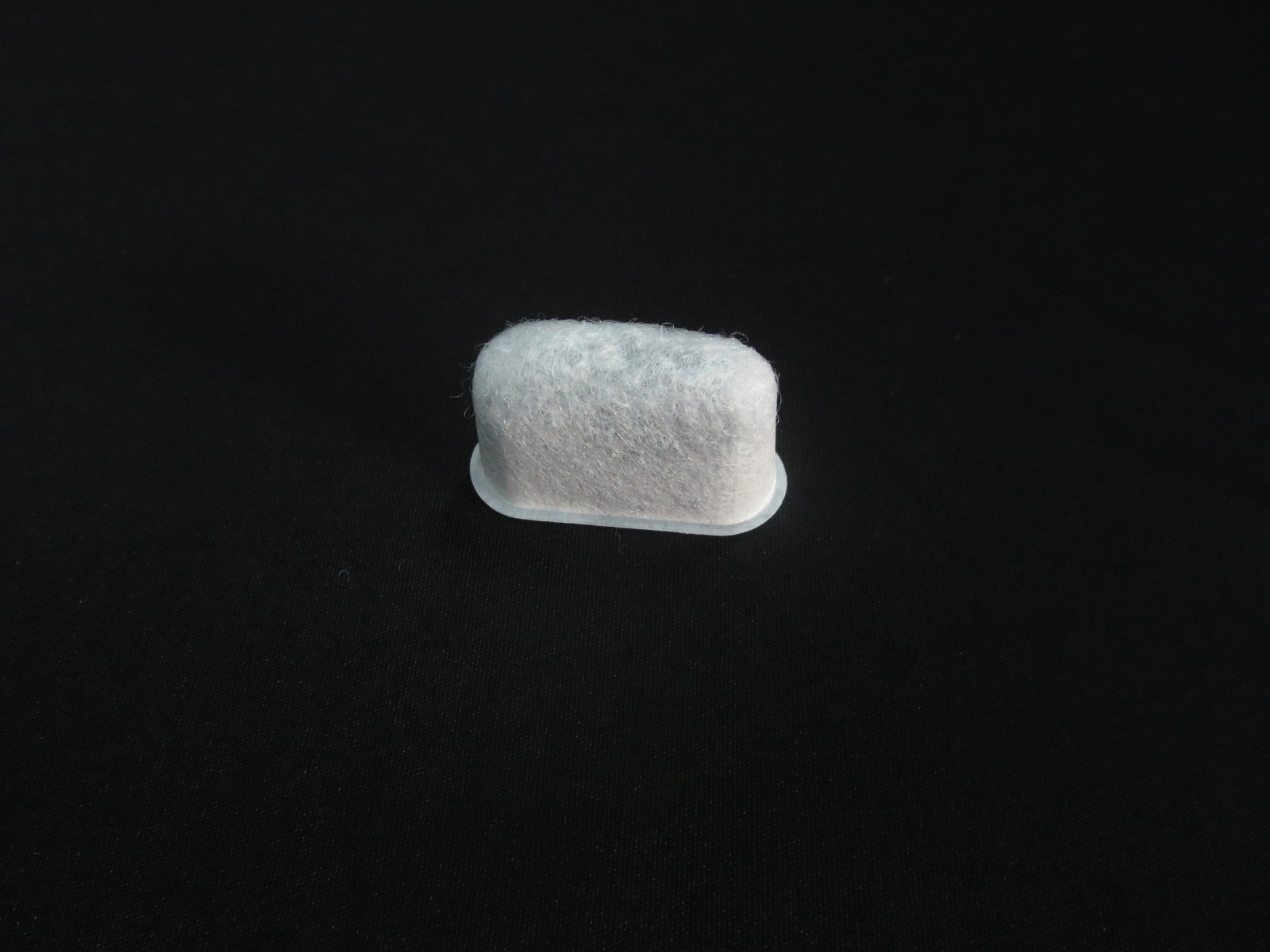
This is a drop-in water filter cartridge for Cuisinart coffee machines, built by Ranveth around two working media: coconut shell activated carbon for chlorine, odour and organic reduction, and food-grade ion exchange resin for hardness and scale control. It is aimed at coffee machine owners, service operators and private-label brands who want stable water quality in the cup and fewer scale problems in the boiler. The cartridge is available as a standard replacement part or as an OEM/ODM build to your own dimensions, media recipe and branding.
The performance of a coffee water filter comes mostly from how the media are chosen and arranged, not from the housing around them. In this cartridge the water passes through a coconut shell activated carbon stage first. Coconut shell carbon is chosen for its fine pore structure and low fines, which lets it take up free chlorine and the odour compounds that otherwise flatten aroma in the cup. The second stage is food-grade ion exchange resin, which exchanges hardness ions for softer ones and so reduces the calcium and magnesium load that forms scale on heating elements and valves.
Pairing the two matters because they solve different problems and interfere with each other if layered carelessly. Carbon ahead of the resin protects the resin from chlorine and organics that would otherwise consume its capacity early. The resin then works on the water that reaches it with a more predictable hardness profile, so its exchange capacity is used on scale ions rather than on contaminants the carbon could have handled. The build also sets the pressure drop the machine sees: the media are held in a fine microporous structure that intercepts sand, rust and other larger particles, keeping the flow path open and the resistance within the cartridge's 20–120 psi working range.
Service life follows the same logic. The rated capacity of about 250 litres, or roughly 2–3 months depending on local water quality and how often the machine runs, assumes both stages are being used as intended. Hard water uses the resin faster; heavily chlorinated water uses the carbon faster. That is why the media recipe is treated as a variable in OEM projects rather than a fixed formula: the ratio of carbon to resin can be adjusted to the water profile of the target market.
| Item | Detail |
|---|---|
| Product | Coffee machine water purifying filter, compatible with Cuisinart machines |
| Filtration media | Coconut shell activated carbon combined with food-grade ion exchange resin |
| Particle interception | Fine microporous structure that intercepts sand, rust and other large particles |
| Service life | Approximately 250 litres, or about 2–3 months, depending on local water quality and frequency of use |
| Operating pressure | 20–120 psi (approximately 1.4–8.3 bar) |
| Operating temperature | 2°C to 38°C, cold water filtration only |
| Typical applications | Automatic coffee machines, semi-automatic espresso machines, commercial coffee machine water softening, OEM water filter cartridge manufacturing |
| Quality systems | Produced under ISO 9001 and ISO 14001, IATF 16949, medical supplies GMP standard, with CNAS national-level testing |
The cartridge is used wherever a coffee machine draws on municipal water and the operator wants the cup to taste the same from one week to the next. In automatic coffee machines it protects the brewing circuit from scale and keeps chlorine out of the aroma. In semi-automatic espresso machines it does the same job on a smaller water volume, where hardness control has a direct effect on extraction and on the life of the heating element. Commercial coffee machine softening is the third main use: multi-group machines and high-volume sites go through water quickly, and a cartridge with predictable capacity makes it easier to set a replacement schedule.
The fourth use is OEM water filter cartridge manufacturing. Brands that already sell coffee machines, or that sell consumables into that market, use this build as a platform and change the interface, the media ratio or the packaging to suit their own product line. Because the cartridge is designed to the same dimensions and connection as the original part, it can replace it directly without modification to the machine.
Custom work starts from the machine, not the cartridge. Send us the device model you are targeting, and if the original part is available, its dimensions or a drawing. Tell us the water flow rate the machine needs and the pressure it runs at, so the media and the internal flow path can be matched rather than guessed. Operating conditions matter as much: the water temperature, the typical hardness and chlorine level in your market, and whether the cartridge will see intermittent domestic use or continuous commercial duty.
Finally, tell us the quantity you expect for the first order and for a year, and what you want customised — dimensions, connection, media formulation, housing colour, laser marking, logo printing, or retail and industrial packaging. With your inputs we can propose a media pairing and a layer build, then move to samples.
Ranveth is a filter manufacturer based in Zhongshan, Guangdong, China, with more than 20 years of filtration product development and manufacturing experience and more than 20 years of continuous export to Europe, the United States, Japan and South Korea. The company operates its own laboratory accredited by CNAS (China National Accreditation Service for Conformity Assessment), which issues test reports covering filtration efficiency, dust holding capacity and resistance. For a media-based product like this coffee cartridge, that laboratory is the reason the carbon and resin pairing can be discussed in numbers rather than adjectives.
The production base covers 50,000 m², including six cleanrooms with a combined area of 20,000 m², where cartridges are assembled and sealed. The quality system holds ISO 9001, ISO 14001 and ISO 45001 certifications, and in 2024 the company also obtained IATF 16949 automotive quality management system certification. Products meet REACH and RoHS environmental requirements, and compliance documents can be supplied. Quality control runs through IQC, IPQC and OQC. Across more than 1,000 filtration solutions developed to date, OEM and ODM projects can customise dimensions, structure, media grade, frame material, logo and packaging, supported by multiple automated production lines with monthly output in the millions of pieces.
If you are evaluating this cartridge for a coffee machine line or a private-label programme, the useful next step is a sample and a written quote against your own specification. Tell us the device or vehicle model you are working with, the size or drawing, the airflow or water flow the system requires, the operating conditions, and the quantity you have in mind. We will come back with a proposed build, sample timing and pricing. You can reach the team through our contact page.
It combines coconut shell activated carbon with food-grade ion exchange resin. The carbon stage takes up free chlorine, odour and organic compounds, while the resin exchanges hardness ions to reduce scale. A fine microporous structure intercepts sand, rust and other large particles.
Placing carbon ahead of the resin protects the resin from chlorine and organics, so its capacity is spent on hardness ions rather than on contaminants the carbon already handles. That pairing keeps the pressure drop within the 20–120 psi working range and supports the rated capacity of about 250 litres.
Yes. Dimensions, connection, media formulation, housing colour, laser marking, logo printing and packaging can all be customised. Send the device model and a size or drawing so we can confirm fit before sampling.
The rated life is approximately 250 litres, or about 2–3 months. The actual interval depends on local water quality and how often the machine is used; hard water consumes the resin faster, and heavily chlorinated water consumes the carbon faster.
Yes. Standard stock samples are available free of charge in small quantities, with the customer covering international courier costs. Customised samples are subject to a sample fee, which is credited against the order once production begins. Samples are usually dispatched within 3–5 working days.
The standard compatible version has an MOQ of 5,000 pieces, and stock or small batch orders are typically delivered in 15–20 days. OEM customised versions are recommended at 10,000 pieces or more, with a production cycle of about 25–30 days including tooling and packaging development.
We need the device model, the size or a drawing, the water flow and pressure the machine requires, the operating conditions such as temperature and water hardness, and your expected quantity. Share these through our <a href="/en/contact">contact page</a> and we will propose a build and pricing.