
SV-SE▼

Denna produkt är kompatibel med eller lämplig för utrustning och applikationer från följande varumärken, endast som urvalsreferens. Varumärkena tillhör respektive ägare och innebär inte partnerskap eller rekommendation.
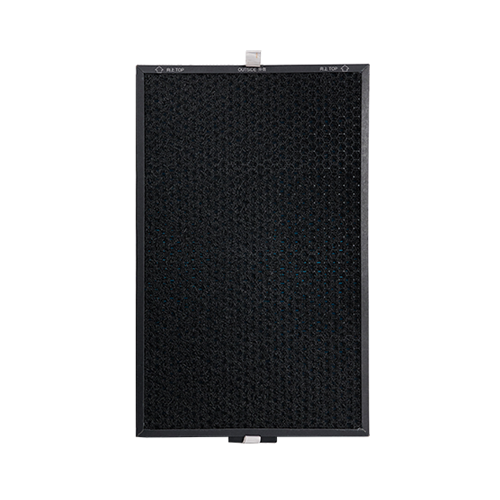
Ranveth flat activated carbon filter mesh is a plate-style adsorption filter built around high-performance activated carbon. It removes formaldehyde, benzene, ammonia and other volatile organic compounds from air, and is designed for air purifiers, fresh-air systems, vehicle cabin filters, central air handling units, vacuum cleaners and industrial exhaust pre-treatment. It is made by Ranveth in Zhongshan, Guangdong, China.
The performance of a flat carbon filter depends less on any single material than on how the carbon medium is held in place and how air is allowed to reach it. Ranveth approaches each build as a pairing problem: the carbon form is selected first, then the supporting structure is chosen to match the airflow and pressure profile of the device. The available carbon forms are honeycomb activated carbon in a sintered block, honeycomb activated carbon on a plastic honeycomb substrate, honeycomb activated carbon in a corrugated paper format, and cylindrical activated carbon filters.
In a sintered block, carbon particles are bonded into a rigid, open-cell structure. The block gives a high carbon loading in a thin profile and presents a large internal surface to the airstream, which suits applications where dwell time matters and the fan can overcome a moderate pressure drop. A plastic honeycomb carrier holds the carbon in a regular channel pattern; the open frontal area keeps resistance lower and the structure stays dimensionally stable in humid conditions. The corrugated paper format uses a folded carbon-bearing web to create a lighter, lower-cost plate for high-volume appliances. Cylindrical builds direct air through a radial or axial path and are used where the housing geometry calls for a round element.
The pairing logic continues at the layer level. A flat carbon mesh is not a single sheet of carbon cloth; it is a stack in which a pre-filter layer may catch coarse dust, the carbon layer performs the adsorption step, and a support layer keeps the medium flat under pressure. When the carbon layer is matched to the dust load and the airflow of the host device, the filter can reach its adsorption capacity before it blinds, and the pressure drop stays within the fan curve for longer. That is the practical meaning of efficiency, airflow resistance and service life in this product family: they are set by the pairing, not by the carbon alone.
Ranveth refines that pairing against the target gases. For formaldehyde, benzene and ammonia removal, the carbon grade and the residence time are adjusted together so that the gas has enough contact with the medium at the design airflow. Because the media choices are tested in the company's own laboratory, the layer build can be tuned before a custom sample is made, rather than after.
| Item | Detail |
|---|---|
| Core material | High-performance activated carbon |
| Structure options | Honeycomb activated carbon filter (sintered carbon block); honeycomb activated carbon filter (plastic honeycomb); honeycomb activated carbon filter (corrugated paper type); activated carbon filter (cylindrical type) |
| Purification performance | High-efficiency adsorption and removal of formaldehyde, benzene, ammonia and other volatile harmful gases (VOCs) |
| Application scope | Household and commercial air purifiers, fresh-air systems, vehicle air-conditioning filters, central air-conditioning circulation systems, vacuum cleaner filters and industrial exhaust treatment |
| Dimensions and specifications | Non-standard customisation based on the customer's specific equipment parameters and requirements |
The flat format is chosen when a device has a rectangular filter slot and needs odour and VOC control without a deep housing. In household and commercial air purifiers, the carbon plate sits behind or beside the particle filter and handles the gases that pass through. In fresh-air systems, it protects occupants from outdoor odours and traffic-related VOCs. Vehicle cabin filters use the same principle in a smaller envelope, and central air-conditioning circulation systems use plate carbon filters to reduce odour carryover between zones.
Vacuum cleaner filters use a carbon layer to control exhaust odour, and industrial exhaust treatment can use plate carbon filters as a pre-treatment stage before more specialised abatement. Across these uses, the common requirement is a flat element that fits an existing frame, keeps resistance within the fan's capability, and holds enough carbon to last a service interval. Ranveth builds to the device rather than asking the device to adapt to a catalogue size.
To quote a custom flat activated carbon filter, the most useful first message includes the device or vehicle model, the available filter slot dimensions or a drawing, and the airflow the device moves. Operating conditions matter as well: the target gases, their approximate concentration, temperature, humidity and duty cycle all influence which carbon form and layer build are appropriate. Quantity and annual volume help us propose a structure that is economical to produce, and any housing or frame constraints should be noted so the plate fits without modification.
If a drawing is not available, a photo of the filter slot with a ruler in frame is often enough to start. We can also work from a sample of the existing filter. The goal is to return a proposal that states the carbon form, the layer sequence and the expected fit, so the buyer can evaluate the build on its engineering merits.
Ranveth's laboratory is CNAS-accredited, which means the media choices behind each build can be backed by test reports for filtration efficiency, dust holding capacity and resistance. This matters for carbon filters because adsorption behaviour is not visible on the production line; it has to be measured.
The production base covers 50,000 m², including six cleanrooms totalling 20,000 m². Ranveth has held IATF 16949 certification since 2024 and operates ISO 9001, ISO 14001 and ISO 45001 systems. Products can be supplied with REACH and RoHS compliance documentation. With more than 20 years of filtration development and manufacturing experience, the company has built over 1,000 filtration solutions and exports to Europe, the United States, Japan and Korea. Quality control runs through IQC, IPQC and OQC, and multiple automated lines support monthly capacity in the millions of pieces.
If you are evaluating a flat activated carbon filter for a new device or replacing an existing supply, send us the device or vehicle model, the size or drawing, the airflow or water flow, the operating conditions and the quantity you expect. We will respond with a proposed media pairing, a sample plan and a quotation. You can reach the team through the contact page.
The filter uses high-performance activated carbon as the adsorption medium, supplied in one of four structures: sintered carbon block honeycomb, plastic honeycomb, corrugated paper type, or cylindrical. The layer build pairs the carbon layer with support and pre-filter layers so that the medium stays flat and the airflow path remains open. The exact combination is selected against the target gases and the device airflow.
Efficiency depends on contact between the gas and the carbon, while pressure drop depends on how openly the air can pass through the structure and its support layers. A sintered block gives high carbon loading and longer contact time, which suits VOC removal where the fan can handle moderate resistance. A plastic honeycomb carrier keeps resistance lower and is more dimensionally stable in humid conditions. Ranveth tunes the pairing so the filter reaches its adsorption capacity before dust blinds the medium.
Yes. Dimensions and specifications are non-standard customised according to the customer's equipment parameters and requirements. We can adjust the carbon form, the plate dimensions and the layer build to match the filter slot. Send the device model and a drawing or photo of the slot to start the fit check.
MOQ and lead time are confirmed with the quotation because they depend on the structure, size and order quantity. For this product, please refer to the figures agreed in your quotation rather than applying standard values from other filter types. Providing annual volume and target launch date helps us propose a workable schedule.
Yes. We can supply samples so your team can evaluate fit, airflow resistance and odour removal in the actual device. Sample policy and any tooling or sample charge are confirmed with the quotation and can be discussed against the expected order volume. Include the device model and operating conditions so the sample is built to the right pairing.
Service life depends on the carbon loading, the concentration of target gases, humidity, temperature and daily running hours. Because those conditions vary by application, we recommend confirming the replacement interval through testing or field data for your specific device. Ranveth can discuss the expected life of a proposed build during the quotation stage.
It is designed for high-efficiency adsorption and removal of formaldehyde, benzene, ammonia and other volatile harmful gases (VOCs). The carbon form and layer build are selected to match the gases present in your application. For mixed gas streams, tell us the main compounds and their approximate concentrations.
Please send the device or vehicle model, the size or drawing of the filter slot, the airflow the device moves, the operating conditions including target gases and humidity, and the quantity you expect. A photo of the slot with a ruler is acceptable if no drawing exists. With those details we can propose a media pairing and a quotation; you can start through the contact page.