
SV-SE▼

Denna produkt är kompatibel med eller lämplig för utrustning och applikationer från följande varumärken, endast som urvalsreferens. Varumärkena tillhör respektive ägare och innebär inte partnerskap eller rekommendation.
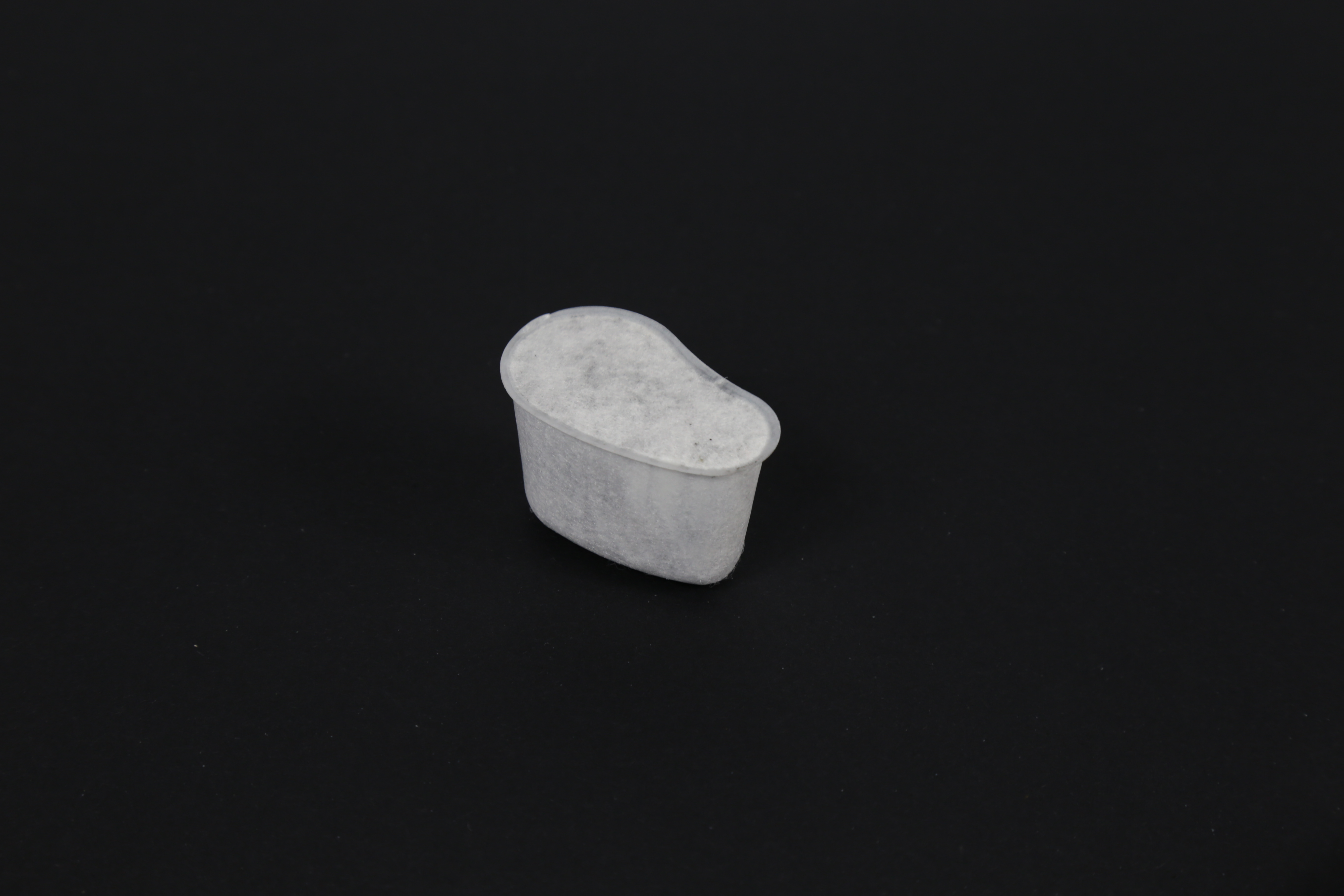
This is a coffee machine water filter cartridge compatible with KRUPS machines, built by Ranveth around a paired bed of coconut-shell activated carbon and food-grade ion exchange resin. It filters mains water before it reaches the boiler, reducing chlorine, hardness minerals, odours and larger suspended particles such as sediment and rust. It is made for households, cafés and OEM buyers running automatic, semi-automatic or commercial espresso equipment who want stable water quality and less scale on heating elements.
Inside the cartridge, the two media are not blended at random. The carbon and the resin are arranged so that each does the job it is best suited to, and the order in which water meets them determines much of the cartridge's behaviour.
The coconut-shell activated carbon is the first line of contact. Coconut shell produces a hard, fine-pored carbon with a high internal surface area, which is why it is used for drinking-water applications: it takes up free chlorine, chloramine by-products, taste and odour compounds and a range of organic residues. Removing chlorine early also protects the ion exchange resin downstream, since oxidising chlorine degrades resin over time. That ordering is one of the quiet reasons a paired cartridge lasts as long as it does.
The food-grade ion exchange resin follows. Its role is softening: calcium and magnesium ions, the minerals behind limescale, are exchanged for sodium or hydrogen ions held on the resin. Scale is what shortens the working life of a coffee machine's thermoblock or boiler, and scale control is the main reason buyers specify a resin stage at all. Because the resin sits behind the carbon, it meets water with the chlorine already stripped out and with coarse sediment held back, so its exchange capacity is spent on hardness rather than on interference.
Around the media, the cartridge uses fine microporous interception to hold back sand, rust and other large particulate before it can compact into the carbon bed. That layer is what keeps pressure drop predictable across the service interval: a bed that is not blinded by grit keeps its flow path open. The pairing also sets the trade-off every buyer should understand. More resin gives softer water and longer scale protection but a slightly higher resistance; more carbon improves taste and chlorine reduction. Ranveth tunes that ratio per project, and because the media choices are checked in the company's CNAS-accredited laboratory, the flow, pressure and reduction behaviour of a given build can be documented rather than assumed.
The result is a cartridge whose efficiency, airflow-equivalent resistance and service life are decided by the layer sequence, not by a single material. In practice, that means a stable flow rate at the stated operating pressure, a service life expressed in litres rather than guesswork, and a construction that behaves the same way in the first week and the last.
| Item | Detail |
|---|---|
| Filtration media | Coconut-shell activated carbon plus food-grade ion exchange resin |
| Micron rating | Fine microporous interception; retains sediment, rust and other large particulate |
| Service life | Approximately 250 litres or 2–3 months, depending on local water quality and usage frequency |
| Operating pressure | 20–120 psi (approximately 1.4–8.3 bar) |
| Operating temperature | 2°C–38°C, cold water filtration only |
| Applications | Automatic coffee machines, semi-automatic espresso machines, commercial coffee machine water softening, OEM water filter cartridge manufacturing |
| Quality systems | Production follows ISO 9001/14001, IATF 16949, medical supplies GMP standard and CNAS national-level testing certification |
The most common fitting is a domestic automatic bean-to-cup machine, where the cartridge sits in the water tank or on the inlet line and is changed every few months. Semi-automatic espresso machines benefit for a different reason: softer water changes extraction, and many users find the cup tastes cleaner when chlorine and hardness are controlled.
Commercial settings — small cafés, offices, staff kitchens — run far more litres per week, so the 250-litre nominal life is reached faster and replacement planning matters more than in a home. These buyers usually order in quantity and often ask for a formulation adjusted to their local water report.
OEM and ODM projects are the third use. Ranveth supplies the cartridge as a component for appliance makers and water-filter brands who need a KRUPS-compatible format with their own labelling, packaging and, where required, a media blend matched to a target market's water hardness.
Custom work moves quickly when the brief is specific. To quote accurately, we ask for:
With those details, we can propose a media ratio, confirm dimensions and return a sample and price.
Media choices here are test-backed. Ranveth's own laboratory holds CNAS (China National Accreditation Service for Conformity Assessment) accreditation and can issue reports on filtration efficiency, dust-holding capacity and resistance, so the carbon-to-resin ratio in your cartridge can be supported with measured data.
Production runs in a 50,000 m² plant in Zhongshan, Guangdong, which includes six cleanrooms totalling 20,000 m². Cleanroom assembly matters for a drinking-water cartridge because it limits secondary contamination during build.
The quality system is certified to IATF 16949, awarded in 2024, alongside ISO 9001, ISO 14001 and ISO 45001. Products meet REACH and RoHS requirements and compliance documents are available on request.
Ranveth has more than 20 years of filtration development and manufacturing experience and has supplied export markets in Europe, the United States, Japan and Korea for over two decades, with more than 1,000 filtration solutions developed to date. Multiple automated lines support monthly output in the millions of pieces, and quality control follows IQC, IPQC and OQC stages through the run.
If you are evaluating a KRUPS-compatible cartridge or planning an OEM build, send us the machine model, required dimensions, expected flow, water conditions and quantity. We will reply with a media recommendation, sample arrangement and pricing. Contact our team to start.
It pairs coconut-shell activated carbon with food-grade ion exchange resin. The carbon stage reduces chlorine, taste and odour compounds, and the resin stage exchanges calcium and magnesium ions to limit limescale. Fine microporous interception ahead of the media holds back sediment and rust.
Carbon sits first so chlorine is removed before it can degrade the resin, and coarse particulate is held back before it can blind the carbon bed. That keeps pressure drop predictable and lets the resin spend its capacity on hardness. The result is a stable flow at 20–120 psi and a nominal life of about 250 litres or 2–3 months.
Yes. Ranveth supports OEM/ODM work covering dimensions, structure, media grade and ratio, logo and packaging. For a coffee application, the usual starting point is the machine model, a drawing or sample, the available inlet pressure and a local water report. Media blends can then be adjusted to the target market's hardness.
Send the device model, size or drawing, flow or water volume requirement, operating conditions and quantity through the contact page. We will confirm the proposed build, arrange samples and return pricing. Where a drawing is not available, an existing cartridge sample is enough to begin.
Standard compatible cartridges start at 5,000 pieces, and stock or small pre-stocked orders are typically delivered within 15–20 days. OEM customised versions are recommended from 10,000 pieces, with mass production including tooling and packaging development taking about 25–30 days.
Standard orders run 30–45 days, and repeat orders 25–35 days, depending on quantity and the degree of customisation. Production is tracked through an ERP system, and peak-season schedules can be agreed in advance. Export experience across Europe, the US, Japan and Korea supports stable delivery planning.
Replace it at approximately 250 litres or every 2–3 months, whichever comes first. In commercial settings with high daily throughput the litre limit is reached sooner, so replacement should be planned by volume rather than by calendar alone. Harder water shortens practical life.
Production follows ISO 9001/14001, IATF 16949, medical supplies GMP standard and CNAS national-level testing certification. Media performance can be documented through the CNAS-accredited laboratory. Products also meet REACH and RoHS requirements, with compliance files available on request. To discuss your application, send an inquiry through our contact page.