
SV-SE▼

Denna produkt är kompatibel med eller lämplig för utrustning och applikationer från följande varumärken, endast som urvalsreferens. Varumärkena tillhör respektive ägare och innebär inte partnerskap eller rekommendation.
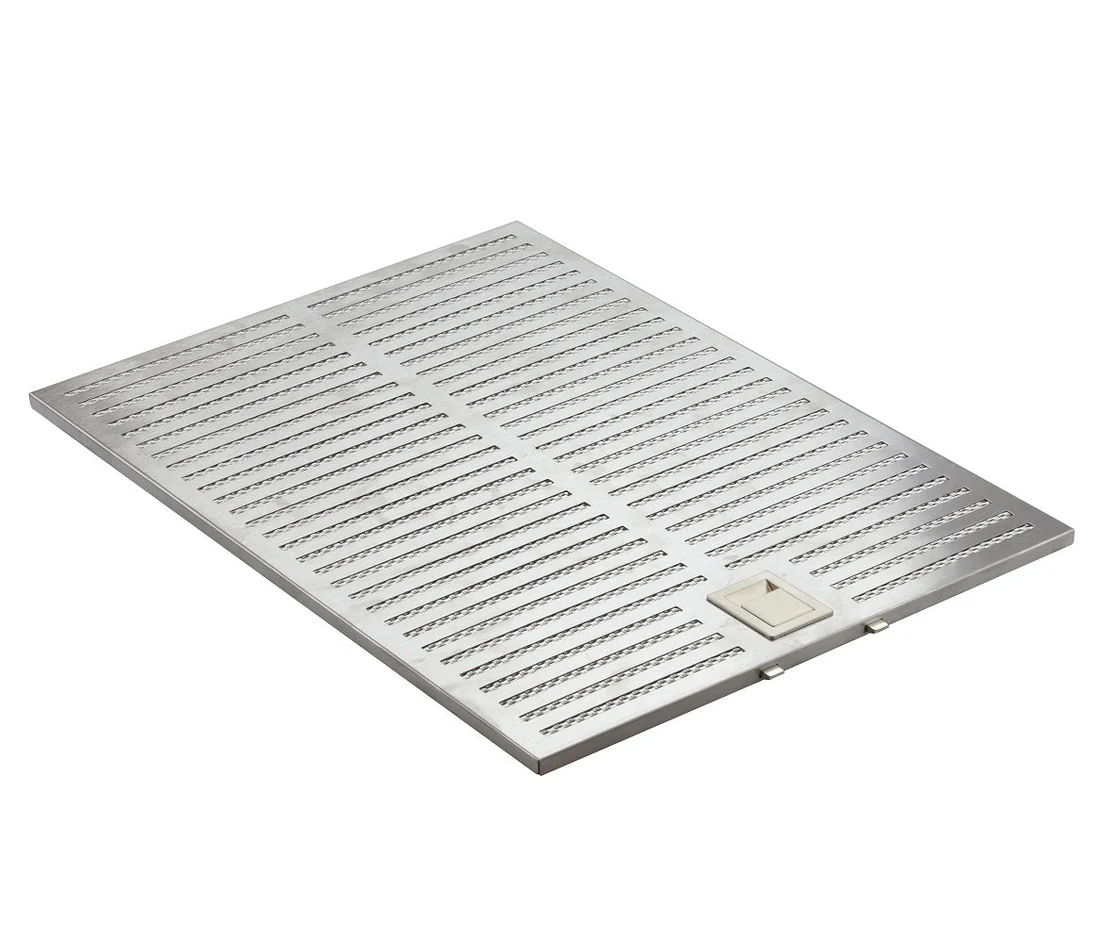
This is a stainless steel oil removal filter mesh designed for recirculating range hoods, combining a 304 stainless steel frame and front cover with an aluminium foil micro-perforated mesh, flame-retardant polyester fibre, and an activated carbon layer to capture heavy grease and adsorb cooking odours. It is built for open-kitchen recirculating hoods, commercial kitchen exhaust systems, and European-style top or side suction hoods. Ranveth supplies it as a fully customisable component, with UL 900 Class 1/Class 2 flame safety certification and OEM/ODM support.
The performance of this filter comes from how its layers are matched, not from any single material. The outermost layer is an aluminium foil micro-perforated mesh. Its openings are sized to intercept larger grease droplets while keeping the structure rigid enough to hold the following media in place. Behind it sits a layer of flame-retardant polyester fibre, which provides depth and surface area for finer oil mist to coalesce. The final stage is a layer of high-quality granular or powdered activated carbon, selected to adsorb cooking odours such as油烟味 and spicy notes that pass through the grease stages.
Because the grease load is removed progressively, the carbon layer is not blinded by oil, and the polyester layer does not have to carry the full odour burden. This pairing directly affects three things buyers care about: efficiency, airflow resistance, and service life. A well-matched stack captures more grease before it reaches the carbon, which keeps resistance lower over time and extends the useful life of the odour-adsorbing stage. The 304 stainless steel outer frame and front cover hold the media flat and square, so the layers stay aligned in the hood and do not channel air around the edges.
Ranveth treats media selection as an engineering decision. The aluminium foil mesh, polyester fibre, and activated carbon can be specified in different grades and thicknesses to suit the grease load and odour challenge of a given hood design. The flame-retardant polyester and the overall construction are intended to meet UL 900 Class 1 / Class 2 flame safety testing, which matters for recirculating appliances where the filter sits close to the cooking zone.
| Item | Detail |
|---|---|
| Product name | European-style range hood filter (activated carbon odour removal version) |
| Core materials | 304 stainless steel outer frame and front cover + aluminium foil micro-perforated mesh + flame-retardant polyester fibre + high-quality granular/powdered activated carbon layer |
| Primary function | High-efficiency separation and capture of heavy grease and oil; strong adsorption of cooking odours (e.g.,油烟味, spicy notes) |
| Flame safety standard | Compliant with UL 900 Class 1 / Class 2 flame safety testing certification |
| Applications | Open-kitchen recirculating range hoods, commercial kitchen exhaust purification systems, European-style top-suction/side-suction range hoods |
| Frame options | High-strength aluminium alloy profile, stainless steel frame (various clips and handles available) |
| Customisation and capacity | OEM/ODM flexible manufacturing; company holds IATF 16949 / ISO 9001 systems; national-level CNAS testing centre ensures batch quality |
This filter is specified for recirculating range hoods where ducting to the outside is not possible or not desired. In open-kitchen homes, it helps stop grease from settling on cabinets and reduces cooking odours that would otherwise spread into living areas. In commercial kitchens, it is used in exhaust purification systems that need a compact grease-and-odour stage. It also fits European-style top-suction and side-suction hoods that use a flat, replaceable filter panel.
Because the filter is built around a stainless steel frame with optional aluminium alloy profiles, it can be adapted to different hood footprints and mounting styles. Ranveth supplies it with a range of clips and handles so that the filter can be removed for cleaning or replacement without tools in many hood designs. The activated carbon layer is intended for odour control, not for heavy grease loading, so the filter is typically used after a primary grease stage or as a combined stage in recirculating hoods with moderate grease output.
To quote a custom filter accurately, Ranveth needs a small set of inputs. Please send the following:
With these details, our engineers can propose a media pairing and layer build that balances efficiency, resistance, and service life for your specific application. We can also advise on frame material, clip type, and packaging.
Ranveth’s media choices are test-backed. Our self-built laboratory is accredited by CNAS (China National Accreditation Service for Conformity Assessment) and can issue reports on filtration efficiency, dust holding capacity, and resistance. This means the aluminium foil mesh, polyester fibre, and activated carbon combinations we propose for your filter can be verified against measurable performance before production.
Manufacturing takes place in a 50,000 m² plant in Zhongshan, Guangdong, China, which includes six cleanrooms totalling 20,000 m². We have held IATF 16949 certification since 2024 and maintain ISO 9001, ISO 14001, and ISO 45001 systems. Products comply with REACH and RoHS environmental regulations, and compliance documents are available on request.
With over 20 years of filter development and manufacturing experience, we have exported to Europe, the US, Japan, and Korea for more than two decades. We support OEM/ODM customisation of size, structure, filter media grade, frame material, logo, and packaging, and have developed more than 1,000 filtration solutions. Multiple automated production lines give monthly capacity in the millions of pieces, with IQC, IPQC, and OQC controls throughout.
To discuss your filter requirements, please contact our team. Share your device or vehicle model, size or drawing, airflow or water flow, operating conditions, and quantity. We will respond with a proposal, sample options, and a quotation. Our approach is consultative: we help you match media and structure to your hood design so that the filter performs as expected in service.
It uses a 304 stainless steel outer frame and front cover, an aluminium foil micro-perforated mesh, flame-retardant polyester fibre, and a high-quality granular or powdered activated carbon layer. This pairing is designed to capture heavy grease and adsorb cooking odours. The media grades can be customised to your application.
The aluminium foil mesh intercepts larger grease droplets, the polyester fibre captures finer oil mist, and the activated carbon adsorbs odours. Because grease is removed progressively, the carbon is not blinded by oil, which helps keep resistance lower over time. The exact balance of efficiency and resistance depends on the media grades selected for your hood.
Yes, it is compliant with UL 900 Class 1 / Class 2 flame safety testing certification. The flame-retardant polyester fibre contributes to this performance. Certification documents can be provided with your order.
Yes, we support full customisation of size, structure, filter media grade, frame material (including high-strength aluminium alloy or stainless steel), logo, and packaging. Please send your hood model and a drawing or sample so we can match the fit. We also offer various clips and handles.
MOQ and lead time depend on the customisation and quantity. Our monthly capacity is in the millions of pieces across multiple automated lines. Please contact us with your estimated annual volume so we can confirm MOQ and schedule.
Replacement interval depends on cooking frequency, grease load, and whether the hood is recirculating. In typical open-kitchen use, the activated carbon layer may need replacement every 3–6 months, while the grease stage can be cleaned periodically. We can advise based on your operating conditions.
Yes, samples are available for evaluation. Please provide your device or vehicle model, size or drawing, and operating conditions so we can prepare a suitable sample. Contact us to discuss sample options and quotation.
Our CNAS-accredited laboratory can test filtration efficiency, dust holding capacity, and resistance. This allows us to verify media pairings before production. We can share test reports relevant to your specification.