
TH-TH▼

ผลิตภัณฑ์นี้ใช้ร่วมกับหรือเหมาะสำหรับอุปกรณ์และการใช้งานของแบรนด์ต่อไปนี้ เพื่อเป็นข้อมูลอ้างอิงในการเลือกเท่านั้น เครื่องหมายการค้าเป็นกรรมสิทธิ์ของเจ้าของแต่ละราย มิได้หมายถึงความร่วมมือหรือการรับรอง
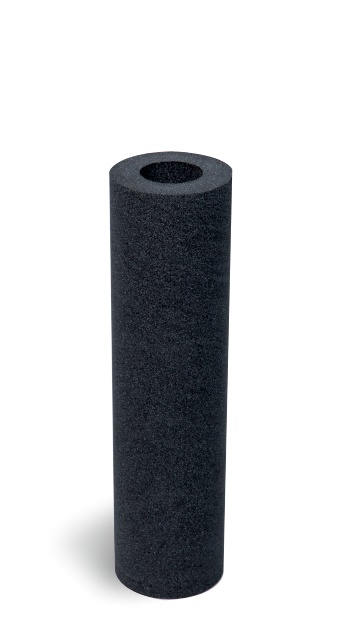
This Ф32×126 sintered activated carbon rod is a coconut-shell carbon block with built-in ion-exchange resin, made by Ranveth for point-of-use water purification. It reduces chlorine, off-tastes, colour and certain heavy metals while softening water, and is designed for reverse-osmosis pre-filters, water dispensers, refrigerator filters and commercial coffee machines. It suits appliance makers, filter brands and OEM buyers who need a compact carbon block with a repeatable layer build.
Media pairing is the first decision in a sintered carbon rod, because it sets the balance between adsorption capacity, flow resistance and service life. In this rod, high-iodine coconut-shell activated carbon provides the adsorption surface for chlorine, odour, colour and organic compounds, while food-grade ion-exchange resin is distributed through the carbon matrix to soften water and capture lead, mercury and similar heavy metals. The carbon and resin are not two separate stages pressed together; they are blended into one sintered body, so water meets both media in the same pass.
The layer build matters just as much. The carbon is sintered so that the micropore structure stays open and uniform. That uniformity gives a high initial flow at a given pressure drop and keeps the filtration rating consistent across the rod. It also means the rod does not shed black carbon fines into the downstream line, an important point for RO systems and for coffee equipment where a small amount of carbon dust would affect taste and appearance. A well-built sintered rod holds its shape in service, so the flow path does not collapse or channel as the carbon adsorbs.
Because the resin is part of the same matrix, the softening effect and the chlorine reduction happen together rather than in sequence. For a buyer, this simplifies the housing and the bill of materials: one cartridge does the work that might otherwise need a carbon stage and a separate softening stage. The pairing also supports a long service interval, since the carbon has a high saturation capacity and the resin is protected inside the block rather than exposed as loose beads.
| Item | Detail |
|---|---|
| Product name | Carbon block water filter / CTO filter for water purifiers and refrigerators |
| Core filtration media | High-iodine coconut-shell activated carbon with food-grade ion-exchange resin |
| Core performance | Softens water and inhibits scale; adsorbs chlorine (bleaching powder) and off-tastes; reduces colour and odour; captures harmful heavy metals such as lead and mercury |
| Precision and service life | Uniform micropore structure, high initial flow, high filtration precision, no black carbon fines; large saturation capacity and long service life |
| Common size references (outer diameter × length, mm) | Ф60×130 / Ф62×240 / Ф37.5×75 / Ф38×57 / Ф40×195 / Ф51×127 / Ф32×126 / Ф32×106 |
| Main end applications | Household RO purifier pre-filter (CTO) or post-filter (T33), direct-drinking water dispensers, built-in filters for side-by-side refrigerators, commercial coffee machines |
| Customisation | OEM/ODM supported. Length, diameter and inner/outer diameter ratios can be tooled to the device; end-cap welding is also available |
| Quality systems | 20,000 m² production base certified to ISO 9001 and IATF 16949; filter media meet strict drinking-water safety and hygiene standards; CNAS-accredited testing centre provides quality control |
The Ф32×126 size is compact, which makes it a practical choice where space inside the appliance is limited. Typical installations are household reverse-osmosis purifiers, where the rod serves as a pre-filter (CTO) ahead of the membrane or as a post-filter (T33) at the tap; direct-drinking water dispensers; and built-in water filters in side-by-side refrigerators. The same media pairing is also used in commercial coffee machines, where consistent water quality supports stable extraction and protects the boiler from scale.
The common size references in the specification sheet cover outer diameters from Ф32 to Ф62 mm and lengths from 57 to 240 mm, so buyers can match an existing housing without changing the manifold. If the required size is not on the list, the sintering process allows the length, diameter and inner/outer diameter ratio to be tooled to the device, and end caps can be welded to suit the connection.
To quote a custom sintered carbon rod accurately, we need the following information. The more detail you provide, the faster we can confirm media choice, tooling and price.
Send these details through the contact page and our engineers will review the media pairing and layer build against your target. If a standard size is close, we will say so; if tooling is needed, we will outline the steps.
Media choices are only as good as the evidence behind them. Ranveth operates a self-built laboratory accredited by CNAS (China National Accreditation Service for Conformity Assessment), which can issue test reports on filtration efficiency, dust holding capacity and resistance. That means the carbon and resin combination in this rod can be supported with measured data rather than assumption.
The production base covers 50,000 m², including six cleanrooms with a combined area of 20,000 m², so carbon rods are made in a controlled environment. The plant holds IATF 16949 (achieved in 2024) and ISO 9001, ISO 14001 and ISO 45001 systems. Products meet REACH and RoHS requirements and can be supplied with compliance documents. With more than 20 years of filtration development and manufacturing experience and exports to Europe, the US, Japan and Korea over that period, Ranveth has accumulated over 1,000 filtration solutions and supports OEM/ODM customisation of size, structure, media grade, end caps, logo and packaging. Quality control runs through IQC, IPQC and OQC, and the address is Zhongshan, Guangdong, China.
If you are evaluating a carbon block for a purifier, dispenser, refrigerator or coffee machine, we can discuss the right media pairing for your water conditions and housing. Please include the device model, required size or drawing, flow rate, operating conditions and quantity so we can respond with a specific proposal. To start the conversation, contact our team.
It combines high-iodine coconut-shell activated carbon with food-grade ion-exchange resin in a single sintered matrix. The carbon adsorbs chlorine, off-tastes, colour and organic compounds, while the resin softens water and captures heavy metals such as lead and mercury. Because both media are blended into one rod, they act in the same pass rather than as separate stages.
The carbon is sintered to keep a uniform micropore structure, which gives a high initial flow at a given pressure drop and a consistent filtration rating along the rod. A uniform build also prevents channeling and stops black carbon fines from reaching downstream equipment. The result is stable efficiency and a long service life rather than a trade-off between flow and filtration.
Yes. The sintering process supports OEM/ODM customisation of length, diameter and inner/outer diameter ratio, and end caps can be welded to suit the connection. If you send the housing drawing and target flow rate, our engineers can confirm whether a standard size fits or whether tooling is required.
Replacement depends on inlet water quality and daily throughput, so we recommend setting the interval from your own water test and flow data. The rod is designed with a large saturation capacity for a long service life, and we can discuss test-backed guidance for your application when you share the operating conditions.
Yes. Send the device model, required size or drawing, flow rate, operating conditions and quantity through the contact page, and we will respond with a sample and quote proposal. Having the full application detail helps us match the media pairing and avoid unnecessary tooling.
MOQ and lead time are set per product and per order, so they are confirmed in the quotation based on the size, customisation and quantity you request. Please include your first-order and annual volumes in the inquiry so we can give an accurate schedule. We do not apply MOQs from other product lines to this rod.
Ranveth's self-built laboratory is accredited by CNAS and can issue reports on filtration efficiency, dust holding capacity and resistance. Products meet REACH and RoHS requirements and can be supplied with compliance documents. Quality control follows IQC, IPQC and OQC through production.
Its compact size suits household reverse-osmosis purifiers as a pre-filter (CTO) or post-filter (T33), direct-drinking water dispensers, built-in refrigerator filters and commercial coffee machines. If your housing needs a different dimension, the same media pairing can be tooled to your drawing. Share your device model and we will confirm the fit.