
TH-TH▼

ผลิตภัณฑ์นี้ใช้ร่วมกับหรือเหมาะสำหรับอุปกรณ์และการใช้งานของแบรนด์ต่อไปนี้ เพื่อเป็นข้อมูลอ้างอิงในการเลือกเท่านั้น เครื่องหมายการค้าเป็นกรรมสิทธิ์ของเจ้าของแต่ละราย มิได้หมายถึงความร่วมมือหรือการรับรอง
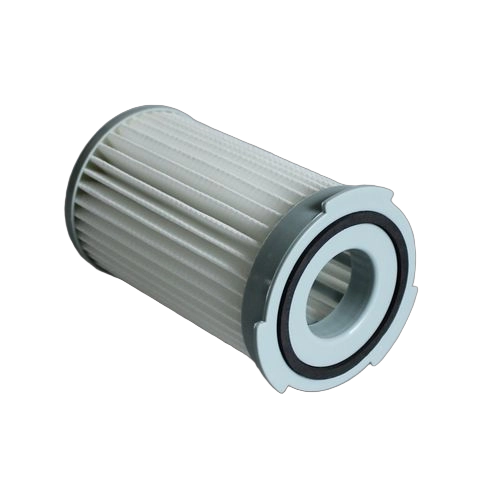
This washable HEPA filter is a cylindrical filter element for handheld and robot vacuum cleaners, designed to capture fine dust, PM2.5, dust mites, and pollen from the airstream. It pairs a PTFE membrane with composite PP meltblown media and optional antibacterial treatment to balance fine-particle capture with low airflow resistance. It is made by Ranveth for vacuum OEMs and aftermarket brands that need a durable, washable filter matched to their specific dock or bin geometry.
The filter is built around a layered media stack. A microporous PTFE membrane sits on the dirty-air side and provides the fine filtration layer; behind it, composite PP meltblown layers support the membrane, hold dust, and maintain pleat stability. An optional antibacterial treatment can be added to the filter paper to limit microbial growth on the media. Each layer is selected for its role in the stack: the membrane controls particle capture, the meltblown layers manage dust loading and pressure drop, and the pleat pattern keeps the media open under airflow.
This pairing matters because efficiency, resistance, and service life move together. A tighter membrane improves capture but can raise resistance if the support layers are not matched to the airflow of the vacuum. The media in this filter is specified for high porosity and low operating resistance, so the motor is not working against an unnecessary pressure drop and battery runtime is not sacrificed. High dust-holding capacity also means the filter can load with fine dust before airflow drops noticeably, which supports longer intervals between cleaning.
The cylindrical format is wound or pleated to fit the bin and airflow path of handheld vacuums and robot cleaners. The outer frame can be produced in environmentally friendly injection-molded plastic, and a rubber sealing ring can be added to the rim to maintain a tight seal and prevent dust bypass. Because the media and the frame are developed together, the filter can be tuned for a specific vacuum model rather than adapted from a generic blank.
| Item | Detail |
|---|---|
| Product name | Vacuum cleaner filter element (cylindrical / conical format) |
| Core filter media | High-precision PTFE microporous membrane / composite PP meltblown / antibacterial-treated filter paper |
| Core filtration function | Captures fine particles (PM2.5), dust mites, pollen, and hair from the dust cup; helps prevent secondary contamination from exhaust air |
| Physical and airflow properties | High-porosity, breathable design with very low operating resistance; high dust-holding capacity; helps prevent motor overheating and supports battery runtime |
| Main end applications | Handheld cordless vacuums, smart robot vacuums, mattress mite removers, wet-dry vacuums, car mini vacuums |
| Frame and dimensional customisation | 100% custom production to the device airflow path and dust cup dimensions; environmentally friendly injection-molded frame and rubber sealing ring edging for airtight, leak-free fit |
| Company certification systems | 50,000 m² modern production base and a CNAS-accredited testing centre; ISO 9001, ISO 14001, and IATF 16949 quality management systems |
This filter is used in handheld cordless vacuums, smart robot vacuums, mattress mite removers, wet-dry vacuums, and car mini vacuums. In each case, the filter sits in the exhaust path of the dust cup, where fine dust and allergens are captured before air returns to the room. The cylindrical shape is common in handheld vacuums where the filter fits inside a conical or round housing; the same media stack can be adapted to robot vacuum filter cartridges and mite remover filters. Because the filter is washable, it suits products where the end user is expected to rinse and reuse the filter rather than replace it after every cleaning session. The low-resistance media is particularly relevant for battery-powered devices, where airflow restrictions reduce suction and runtime.
To quote a custom filter, send the vacuum or robot model, the filter size or a drawing, and the target airflow or water flow if applicable. Operating conditions such as dust type, humidity, and expected wash frequency help us select the media grade and pleat geometry. Also include the required quantity, packaging needs, and any logo or branding requirements. If you have an existing sample, a dimensional sketch, or a 3D file, that is enough for our engineering team to evaluate the frame, seal, and media combination. For standard inquiries, a photo of the filter and the model number will help us identify the closest existing tooling.
Ranveth's media choices are backed by its own CNAS-accredited laboratory, which can issue test reports for filtration efficiency, dust-holding capacity, and resistance. That means the PTFE membrane and PP meltblown pairing can be validated against the airflow and efficiency targets of your device, not just specified on paper. Production takes place in a 50,000 m² plant that includes six cleanrooms totalling 20,000 m², which helps protect filter media from contamination during manufacturing. The company operates under ISO 9001, ISO 14001, and ISO 45001 systems and has held IATF 16949 automotive quality certification since 2024, with IQC, IPQC, and OQC controls covering incoming materials, in-process production, and outgoing inspection. Ranveth has more than 20 years of filter development and manufacturing experience and has supplied European, US, Japanese, and Korean markets for over two decades. Products can be supplied with REACH and RoHS compliance documentation, and OEM/ODM support covers dimensions, structure, media grade, frame material, logo, and packaging, with more than 1,000 filter solutions developed to date.
To discuss a washable HEPA filter for your vacuum platform, send your device or vehicle model, the filter size or drawing, the target airflow or water flow, operating conditions, and estimated quantity. Our team will review the media pairing and frame options and respond with a quotation and sample plan. Contact Ranveth to start the conversation.
It combines a microporous PTFE membrane with composite PP meltblown layers and optional antibacterial-treated filter paper. The PTFE layer provides fine-particle capture, while the meltblown layers support the membrane and manage dust loading and pressure drop. This layered build is what allows the filter to maintain low airflow resistance while capturing PM2.5 and dust mites.
The filter can be built to H11 to H13 efficiency grades, corresponding to 95% to 99.95% capture of 0.3 μm particles, depending on the media selected. It is designed for repeated washing and, with correct cleaning and complete drying, typically withstands 20 to 30 wash cycles with performance degradation kept within a reasonable range. All performance data are verified in Ranveth's CNAS-accredited testing centre to support batch consistency.
Yes. Ranveth produces the filter 100% to the device airflow path and dust cup dimensions, including diameter, height, pleat count, end-cap structure, and the rubber sealing ring. OEM and ODM support covers frame material, media grade, logo, and packaging. Send a sample, drawing, or 3D file and the engineering team can evaluate the tooling and media pairing for your model.
For this product, standard specifications typically start at 3,000 pieces, while custom tooling orders generally start at 5,000 pieces depending on the specification. Regular lead time is 25 to 35 days after order confirmation. Larger or seasonal orders should be scheduled in advance to secure production capacity.
Yes. Stock samples can be provided free of charge, with the customer covering international courier costs. Custom samples may incur a sampling fee depending on tooling complexity, which can be credited against mass production. Sample lead time is usually 3 to 7 days for stock items or 15 to 20 days for custom builds.
The washable design supports 20 to 30 wash cycles under correct cleaning and drying, so replacement frequency depends on dust load and user behaviour. In typical household use, rinsing according to the vacuum manufacturer's schedule and replacing after the wash-cycle limit helps maintain airflow and filtration efficiency. Because the media is low-resistance and high-capacity, the filter can hold a substantial dust load before airflow drops noticeably.
Ranveth can supply REACH and RoHS compliance documentation for the filter materials and adhesives, and the company's products have been exported to Europe, the US, Japan, and Korea for over 20 years. Specific certification needs can be discussed during the inquiry so that testing and documentation can be planned. This helps buyers meet import compliance requirements in target markets.
Yes. Ranveth offers OEM and ODM support that includes colour box printing, blister packaging, PE bags, instruction sheets, labels, and UPC/EAN barcodes, all designed to the customer's brand guidelines. Packaging structure can also be optimised to reduce transport costs and improve shelf presentation. Brand materials are kept confidential to protect intellectual property. To discuss a custom build, <a href="/en/contact">contact Ranveth</a> with your device model and requirements.