
VI-VN▼

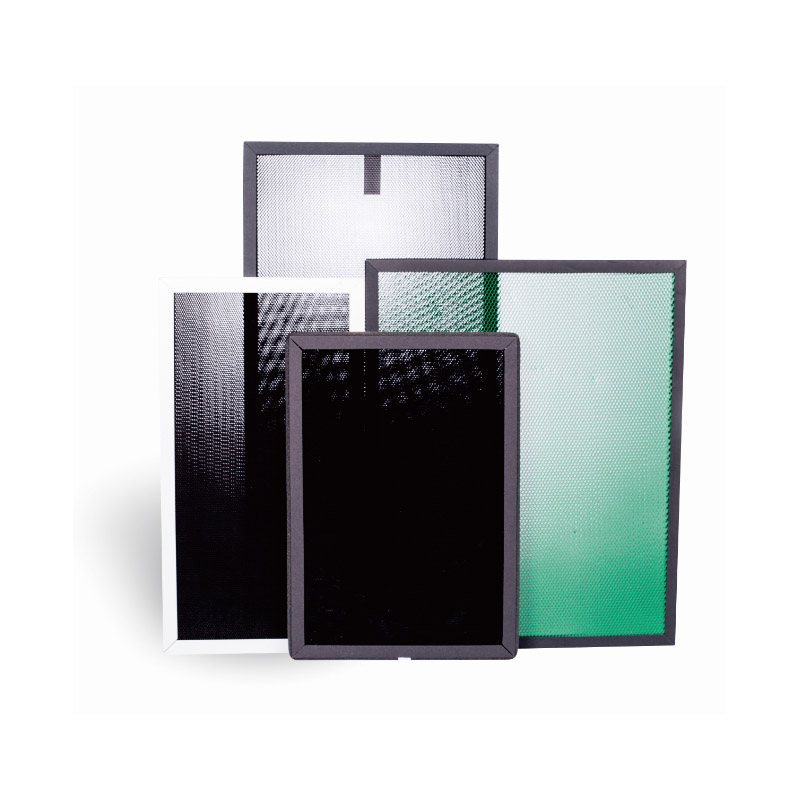
Ranveth's ozone removal filter is a catalytic filter built on an aluminum honeycomb carrier coated with a proprietary ozone-decomposition catalyst. It converts ozone in the airstream into oxygen, serving air purifiers, laser printers, copiers, ozone disinfection equipment, and medical exhaust outlets. It is designed for OEMs and equipment makers who need documented ozone control and a filter that fits their existing enclosure.
Every filter starts with the pairing of carrier and catalyst. The carrier is an aluminum honeycomb: a rigid, open-channel structure that presents a large geometric surface area to the airflow while keeping pressure drop low. The catalyst is a Ranveth-developed coating applied to those channels, protected by Chinese invention patent ZL200710026260.6. Because the catalysst sits directly on the aluminum substrate, ozone contacts the active surface as soon as it enters the channel, and the conversion to oxygen begins immediately.
The pairing matters more than either element alone. A denser honeycomb raises contact area but also resistance; a thinner coating lowers resistance but can shorten service life. Ranveth balances the two so that the finished filter meets the ozone limits below without imposing an avoidable load on the fan. The aluminum base also resists deformation under sustained airflow, which helps the filter hold its shape and its performance over its service interval.
For installation, the honeycomb can be cut to the required thickness and fitted with an aluminum alloy frame or sponge/EVA sealing gasket. Those options are chosen to match the host device's slot and to maintain airtightness at the edges, so the air actually passes through the catalyst rather than around it.
| Item | Detail |
|---|---|
| Product name | Ozone Removal Filter / ozone decomposition catalytic filter |
| Core structure and materials | Aluminum honeycomb carrier with a Ranveth-developed ozone-removal catalyst coating |
| Patent backing | Chinese invention patent, patent number ZL200710026260.6 |
| Ozone control standard | Treated indoor ozone concentration below the national standard of 0.16 mg/m³; meets the UL867 requirement of ≤0.1 mg/m³ |
| Typical end applications | High-voltage electrostatic air purifiers, large laser printers, commercial copiers, ozone disinfection equipment exhaust, medical device exhaust ports |
| Frame and size customisation | 100% customised to customer equipment dimensions; aluminum honeycomb cut in various thicknesses; optional aluminum alloy frame and sponge/EVA sealing strips for installation airtightness |
| Quality system | Backed by a 50,000 m² plant and a CNAS-accredited testing laboratory; ISO 9001/14001 and IATF 16949 quality management systems |
The filter is used wherever ozone is generated as a by-product or as a process gas and must be reduced before air reaches people or sensitive equipment. In high-voltage electrostatic air purifiers, it sits downstream of the ionization stage. In large laser printers and commercial copiers, it handles the ozone produced by the charging process. It is also used on ozone disinfection equipment exhaust and on medical device exhaust ports.
Because the honeycomb is cut to order, the same media pairing can be built into different device architectures, from compact printer cartridges to larger purifier panels. The filter is typically specified as a medium-efficiency stage and can be combined with other filtration stages where a full air-treatment train is required.
To quote accurately, Ranveth needs the following from your side:
With these inputs, the engineering team can propose a honeycomb thickness, catalyst loading, and frame configuration, and confirm whether the target ozone limit is achievable in your operating window.
Ranveth's media choices are test-backed. The company's own laboratory is CNAS-accredited and can issue reports on filtration efficiency, dust holding capacity, and resistance, so the catalyst and honeycomb pairing can be verified against your specification rather than taken on trust.
Production takes place in a 50,000 m² plant that includes six cleanrooms totalling 20,000 m². The quality system holds IATF 16949 (obtained in 2024) alongside ISO 9001, ISO 14001, and ISO 45001, and products meet REACH and RoHS requirements with compliance documents available. With more than 20 years of filter development and manufacturing experience, and more than 1,000 filtration solutions developed, Ranveth supports OEM/ODM work covering dimensions, structure, frame material, logo, and packaging. The company is located in Zhongshan, Guangdong, China.
If you are evaluating an ozone removal stage, send your device model, size or drawing, airflow or water flow data, operating conditions, and quantity to our contact team. We will review the application and respond with a sample proposal and a quotation.
It pairs an aluminum honeycomb carrier with a Ranveth-developed ozone-removal catalyst coating. The honeycomb gives a rigid, open structure with low airflow resistance, while the catalyst converts ozone to oxygen on contact. The catalyst technology is protected by Chinese invention patent ZL200710026260.6.
Under standard test conditions of 0.1 ppm ozone and 1.0 m/s face velocity, the filter achieves ozone removal efficiency of 95% or higher. In typical commercial air-conditioning and ventilation duty, service life is usually 12 to 18 months, depending on site ozone concentration, airflow, temperature, and humidity. Performance data can be supported by reports from our CNAS-accredited testing laboratory.
Yes. Outer frame dimensions are 100% customised to your equipment. We cut aluminum honeycomb in various thicknesses and can add an aluminum alloy frame or sponge/EVA sealing strips to maintain installation airtightness. Send your device model, drawing, and airflow data so we can propose the right build.
Standard sizes typically start at 500–1,000 pieces, while custom configurations are generally quoted from 1,000 pieces upward depending on size and options. Standard samples are usually free with freight paid by the customer; custom samples carry a development fee that can be credited against a bulk order. Standard stock ships in 7–10 days, custom samples take about 10–15 days, and bulk production is usually 25–35 days.
The aluminum honeycomb presents many open channels, so air passes through with relatively low resistance while still contacting the catalyst-coated walls. Because the honeycomb is rigid, it resists deformation under sustained airflow. We match honeycomb thickness and catalyst loading to your airflow and ozone load, and cut the panel to your slot dimensions so it seats correctly.
It is used in high-voltage electrostatic air purifiers, large laser printers, commercial copiers, ozone disinfection equipment exhaust, and medical device exhaust ports. It is typically specified as a medium-efficiency stage and can be combined with other filtration stages in a complete air-treatment train.
Replacement depends on the ozone load and operating conditions. In typical commercial ventilation duty, a service interval of 12 to 18 months is common. We recommend monitoring downstream ozone concentration and pressure drop; when either moves outside your target range, the filter should be replaced.
Please provide your device or equipment model, the required size or a drawing, the airflow rate and expected ozone concentration, operating temperature and humidity, frame and sealing preferences, and estimated annual quantity. With these details we can confirm feasibility against your ozone limit and send a sample proposal and quotation. You can reach us through <a href="/en/contact">our contact page</a>.