
VI-VN▼

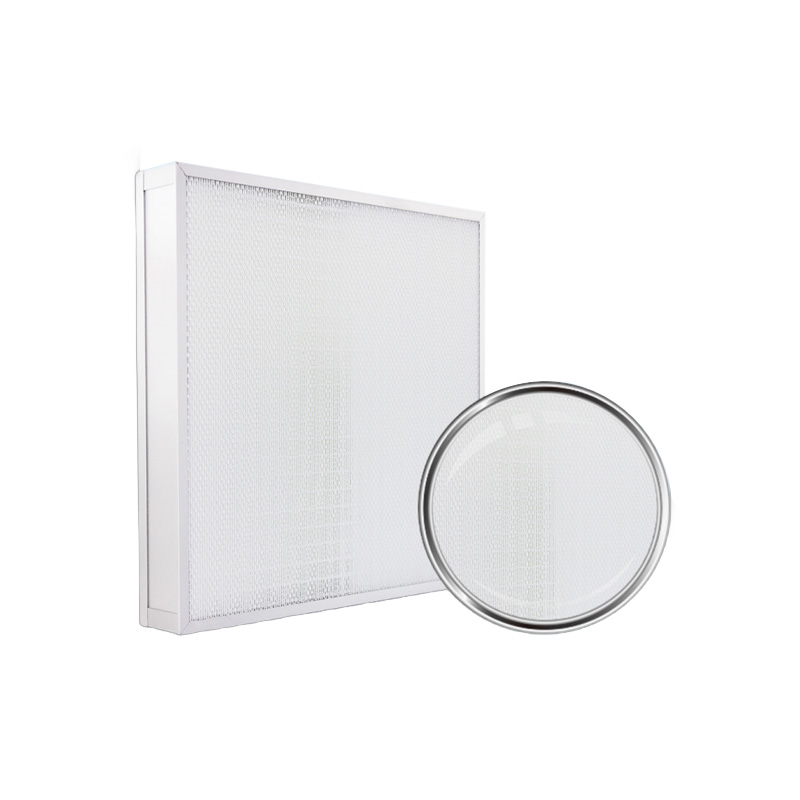
The Ranveth High Efficiency Filter (Mini-Pleat, Partitionless) is a panel filter that uses a closely pleated glass fibre or PTFE medium, held apart by hot-melt adhesive instead of aluminium separators, to remove particles down to the sub-micron range. It is rated from M6 to U16 and is built for cleanrooms, FFU units, pharmaceutical GMP areas, hospital operating theatres and high-end commercial HVAC systems. Engineers and buyers who need predictable efficiency, low airflow resistance and long service life in a thin frame choose this filter. Ranveth manufactures it in Zhongshan, Guangdong, China.
The performance of a partitionless HEPA filter comes from how the medium is folded and how the pleats are held. In the Ranveth design, the medium is pleated on automated lines to a controlled pitch, then locked in place with hot-melt adhesive beads that run across the pleat tips. These adhesive lines replace the corrugated aluminium separators used in older filter designs. The result is a filter with a high ratio of media surface to face area inside a 50 mm or 70 mm deep frame, so air passes through more square metres of media at a given face velocity.
That larger media area is the main reason the filter keeps resistance low. Lower resistance means the fan in an FFU or air-handling unit uses less energy to move the same volume of air, and the filter lasts longer before it reaches its final pressure drop. The choice of medium matters as much as the fold. Glass fibre media are selected for consistent efficiency and mechanical strength across the M6 to U16 range. PTFE media are available where the process requires a different chemical profile or where the buyer specifies them. The anode-oxidised aluminium or stainless steel frame holds the pleat pack square and protects the edges during transport and installation.
Every filter is scanned for leaks before it leaves the plant. The CNAS-accredited laboratory attached to the factory tests efficiency, dust holding capacity and resistance, so the media pairing used in each build is supported by measured data rather than by assumption. This is what allows Ranveth to offer filters across a wide efficiency band without changing the basic partitionless architecture.
| Item | Detail |
|---|---|
| Product type | High efficiency panel filter, partitionless (mini-pleat) |
| Core media | Selected glass fibre / PTFE |
| Frame material | Anode-oxidised aluminium profile / stainless steel |
| Separator | Hot-melt adhesive |
| Efficiency class | M6 – U16 (medium to ultra-high efficiency) |
| Typical applications | Microelectronics and semiconductor cleanrooms, pharmaceutical GMP workshops, hospital operating theatres, high-end commercial building HVAC systems, FFU units |
| Standard sizes and nominal airflow (W × H × D) | 305 × 610 × 50 mm (350 CMH); 610 × 610 × 50 mm (750 CMH); 1170 × 570 × 50 mm (1300 CMH); 1170 × 1170 × 70 mm (3600 CMH). More sizes available with 50 mm or 70 mm depth options. |
| Customisation | Non-standard sizes and OEM service are available, supported by the company’s 20,000 m² cleanroom workshop and CNAS national testing centre. |
The filter is specified where the particle count in the air must be controlled to a defined class. In semiconductor and microelectronics plants it is used in FFU fan filter units, clean booths, terminal supply outlets for Class 10 to Class 10000 cleanrooms, and in lithography, wafer fab and packaging and test workshops. Pharmaceutical factories use it in GMP workshops, and hospitals use it in operating theatres. It also appears in high-end commercial building HVAC systems where the owner wants high-efficiency filtration without a heavy pressure penalty. Other sectors in the Ranveth range include automotive and machinery manufacturing, energy and metal smelting, energy storage, AI computing and data centres, and food processing.
For a non-standard size or an OEM project, the more precise your inputs, the faster the quote. Please send:
With these details, Ranveth can propose a media and frame combination, confirm the efficiency class and provide a drawing for approval before production.
The first reason is testing. Ranveth’s own laboratory is accredited by CNAS (China National Accreditation Service for Conformity Assessment) and can issue reports on filtration efficiency, dust holding capacity and resistance. Media choices are therefore backed by measurement, not only by specification sheets.
The second is capacity. The production base covers 50,000 m², including six cleanrooms with a combined area of 20,000 m². That cleanroom space is used for the final assembly and inspection of high-efficiency filters, and it supports the custom and OEM work described above.
The third is systems. Ranveth holds IATF 16949 (achieved in 2024) and ISO 9001, ISO 14001 and ISO 45001 certifications. Products meet REACH and RoHS requirements, and compliance documents can be supplied. With more than 20 years of filter development and manufacturing experience, and more than 20 years of continuous export to Europe, the United States, Japan and South Korea, Ranveth has accumulated over 1,000 filtration solutions. Multiple automated production lines give a monthly capacity of several million pieces. Quality control runs through IQC, IPQC and OQC. The company is located in Zhongshan, Guangdong, China.
To discuss a sample or a quotation, please use the contact page and include the device or vehicle model, the size or drawing, the airflow or water flow, the operating conditions and the quantity you expect to order. Our team will respond with a proposal based on the media and frame combination that fits your requirement.
The standard build uses selected glass fibre medium with hot-melt adhesive as the pleat separator; PTFE medium is available where specified. The medium is paired with an anode-oxidised aluminium or stainless steel frame in a partitionless mini-pleat design. This combination supports efficiency classes from M6 to U16.
By replacing aluminium separators with hot-melt adhesive beads, the pleat pack holds more media in the same frame depth, which lowers face velocity through the medium. Lower resistance reduces the fan energy needed in an FFU or air-handling unit. The effect is measured in the CNAS-accredited laboratory and reported with each filter.
Yes. Ranveth offers non-standard sizes and OEM service, with frame options including anode-oxidised aluminium and stainless steel. Custom builds are supported by the 20,000 m² cleanroom workshop and the CNAS testing centre. Please provide a drawing or the required dimensions and airflow.
Standard sizes typically start at 50–100 pieces, while custom sizes usually start at 100–200 pieces depending on complexity; sample orders can be discussed. Standard products ship in 7–15 days, and custom orders typically take 25–35 days. Urgent schedules can be negotiated.
Under normal conditions with G4 pre-filters and F8 intermediate filters, service life is typically 3–5 years, depending on dust concentration, operating airflow and the final resistance set point. Ranveth can supply initial resistance, rated resistance and final resistance data plus performance curves for your conditions. This allows the replacement interval to be planned rather than guessed.
Yes, sample orders can be arranged, and the terms are flexible for new customers. Please share the size, efficiency class and airflow so the sample matches your application. A quotation for production quantities can be issued together with the sample offer.
Every filter is inspected 100%, covering appearance, dimensions, initial resistance, efficiency at rated airflow and a scan leak test. Each unit carries a unique number and a factory test report for traceability. The testing is performed in the CNAS-accredited laboratory.
Please send the device or vehicle model, the required size or a drawing, the rated airflow, the operating conditions and the expected quantity. The required efficiency class and final resistance target are also helpful. With these details, Ranveth can propose a media and frame combination and provide a drawing for approval. You can submit the information through the <a href="/en/contact">contact page</a>.