
VI-VN▼

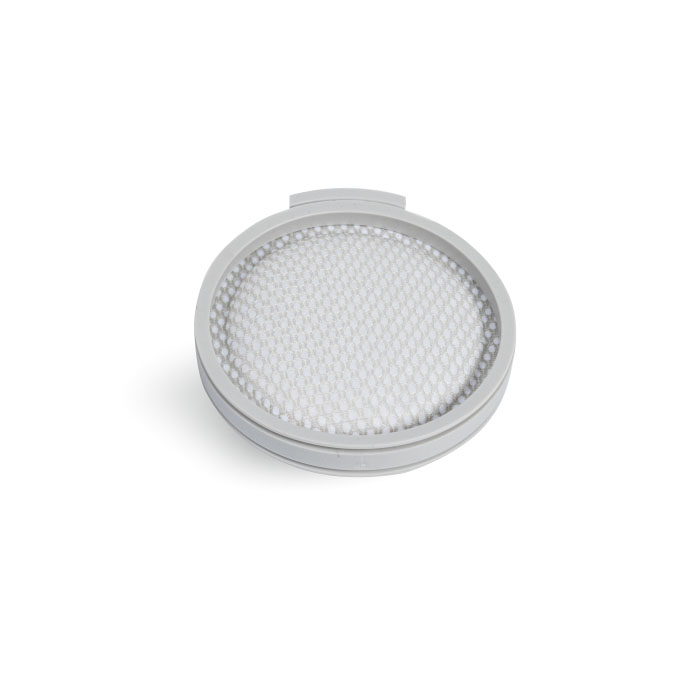
This is a washable disc-shaped filter for handheld and robot vacuum cleaners, built around a PTFE microporous membrane or composite PP media. It captures PM2.5, fine dust, dust mite allergens, pollen and pet dander from the airstream before it leaves the dust cup, and it is made for vacuum OEMs and aftermarket brands that need a repeatable, low-resistance filter in their own dimensions. Ranveth supplies it as a fully customisable component, with the media grade, frame and sealing edge specified to your device.
Filter performance in a disc format comes from how the layers are chosen and stacked, not from any single material. Ranveth pairs a high-precision PTFE microporous membrane with a composite PP meltblown support layer, and can add an antimicrobial treated filter paper where the application calls for it. The membrane does the fine interception; the PP layer gives mechanical support and depth loading; the treatment option addresses odour and microbial growth in the dust cup.
That pairing is what sets the three properties buyers ask about. Efficiency: the microporous structure intercepts PM2.5 and allergen-sized particles, so exhaust air does not carry dust back into the room. Airflow resistance: a high-porosity, breathable design keeps pressure drop low, so the motor does not lose suction and does not run hotter than intended. Service life: because the PTFE layer is washable, the filter can be cleaned and reused rather than replaced after every few cleaning cycles.
The layer build is fixed only after the media grade is matched to the device's airflow and dust load. A denser membrane raises efficiency but also raises resistance; a more open build protects suction but shifts the particle capture curve. Ranveth treats this as a specification decision, not a catalogue choice, and confirms it with bench data before tooling.
| Item | Detail |
|---|---|
| Product name | Vacuum cleaner filter cartridge / robot vacuum filter (disc shape) |
| Core filtration media | High-precision PTFE microporous membrane / composite PP meltblown / antimicrobial treated filter paper |
| Core purification function | Intercepts PM2.5, fine dust, dust mites, pollen and pet dander in the dust cup; prevents secondary exhaust pollution |
| Physical fluid characteristics | High-porosity breathable design with very low operating airflow resistance; preserves motor suction, limits motor overheating and supports battery runtime |
| Main end applications | Handheld cordless vacuums, smart robot vacuums, mite removers, wet-dry floor cleaners, compact car vacuums |
| Frame and dimensional customisation | 100% built to device dimensions; eco-friendly injection-moulded frames (cylindrical, flat, special shapes) and rubber sealing-ring edge treatment for 100% airtightness |
| Company certification | 50,000 m² production base and a CNAS-accredited testing centre; ISO 9001, ISO 14001 and IATF 16949 quality management systems |
The disc format suits appliances where the filter sits as a round or flat cartridge in the dust cup and is removed by hand for cleaning. Typical installations are handheld cordless vacuums, smart robot vacuums, mite removers, wet-dry floor cleaners and compact car vacuums. In each case the filter is the last barrier before exhaust, so its fit and seal matter as much as its media.
Ranveth builds the outer frame to the device's dimensions, including cylindrical, flat and special shapes, and finishes the edge with a rubber sealing ring so the filter seats with 100% airtightness. That edge treatment is what stops dust from bypassing the media and depositing on the motor or the room. Because the frame is injection moulded, colour and geometry can follow your existing part without a separate adapter.
To quote a custom disc filter, send the device or vehicle model, or a drawing or sample of the current filter with its diameter, thickness and centre-hole dimensions. Tell us the airflow the appliance runs at and the operating conditions — dust type, humidity, cleaning frequency and whether the filter will be washed. State the target efficiency if you have one, and the order quantity you expect for the first run and for a year. With those inputs Ranveth can propose a media pairing and layer build, confirm the frame and seal, and return a sample and a quotation. If you already have a test report or a competitor sample, include it; it shortens the matching step.
The first reason is test-backed media. Ranveth's own laboratory is accredited by CNAS, the China National Accreditation Service for Conformity Assessment, and issues reports on filtration efficiency, dust holding capacity and resistance. When we recommend a PTFE and PP pairing for your airflow, it is supported by measured data rather than a data sheet alone.
The second is manufacturing depth. The production base covers 50,000 m², including six cleanrooms totalling 20,000 m², so media handling and frame moulding stay in a controlled environment. Ranveth holds IATF 16949, the automotive quality management system, obtained in 2024, and operates ISO 9001, ISO 14001 and ISO 45001 systems. Products meet REACH and RoHS requirements and compliance documents are available.
The third is customisation experience: more than 20 years in filtration, over 1,000 filter solutions developed, and OEM/ODM support across size, structure, media grade, frame material, logo and packaging. Multiple automated lines support monthly output in the millions of pieces, with IQC, IPQC and OQC checks through the process. The company is based in Zhongshan, Guangdong, China, and has exported to Europe, the United States, Japan and Korea for more than 20 years.
Send your device model, filter size or drawing, airflow or water flow, operating conditions and quantity through our contact page. We will reply with a proposed media pairing, sample plan and quotation. For buyers who need to validate before tooling, we can discuss sample timing and the documentation you require.
It pairs a high-precision PTFE microporous membrane with a composite PP meltblown support layer, and an antimicrobial treated filter paper can be added. The membrane handles fine particle interception while the PP layer provides support and depth loading. The exact combination is fixed against your device's airflow and dust load.
A denser membrane raises particle capture but also raises pressure drop, while a more open build protects suction and shifts the capture curve. Ranveth selects the pairing so the filter intercepts PM2.5 and allergens without loading the motor. The trade-off is confirmed with bench data before tooling.
Yes. The PTFE layer is washable, so the filter can be cleaned and returned to service instead of being replaced after short intervals. Wash life depends on your cleaning routine and dust load, and Ranveth confirms it during sampling rather than quoting a universal cycle count.
Send the device model, or a drawing or sample showing diameter, thickness and centre-hole dimensions. Ranveth builds the injection-moulded frame to those dimensions in cylindrical, flat or special shapes, and finishes the edge with a rubber sealing ring for 100% airtightness. The result is a drop-in part rather than an adapter.
MOQ and lead time are set per project according to size, media grade and frame tooling, and are confirmed in the quotation. Because the filter is built to your dimensions, the first order includes a tooling and sample approval step. Repeat orders follow the agreed production schedule.
Yes. Sampling follows the drawing or sample review, and performance data can be issued from Ranveth's CNAS-accredited laboratory covering filtration efficiency, dust holding capacity and resistance. Sample timing and documentation are agreed with the quotation so your validation step is planned.
Replacement interval depends on dust load, cleaning frequency and whether the user washes the filter as instructed. Because the PTFE media is washable, many users extend the interval by cleaning rather than replacing. Ranveth can advise a service interval once the application and operating conditions are known.
We ask for the device or vehicle model, size or drawing, airflow or water flow, operating conditions, and quantity. Include any existing test report or sample if available. Send these through the contact page and we will return a proposed media pairing, sample plan and quotation.