ZH-TW▼
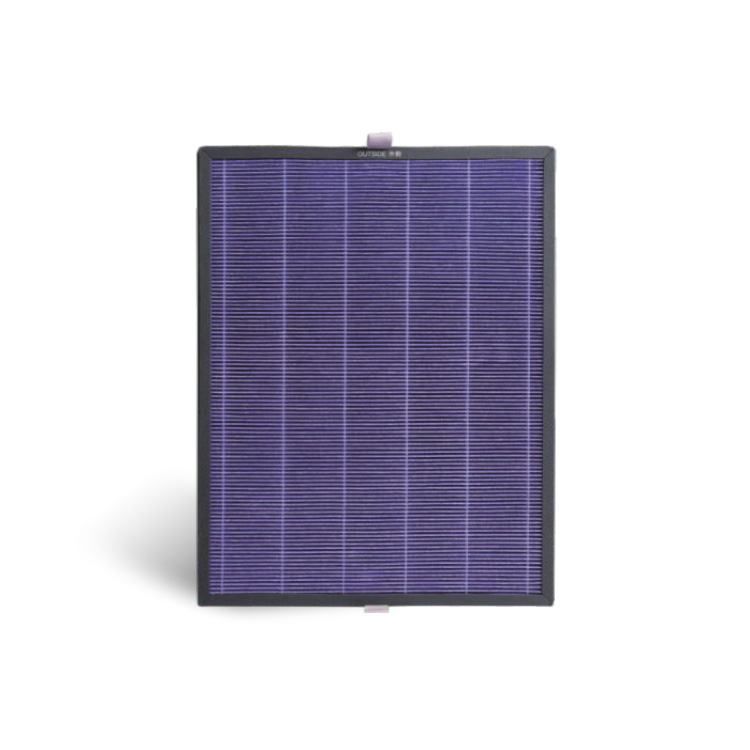
This is a flat panel HEPA and activated carbon composite filter from Ranveth, built to remove both fine particles and odours in one slim element. The particle layer captures PM2.5, pollen, dust mite matter and bacteria, while a honeycomb activated carbon layer adsorbs formaldehyde, TVOC and everyday odours. It is made for household and commercial air purifiers, desktop mini purifiers, humidifier-purifier combinations and dehumidifiers, and it is supplied as a fully custom OEM part matched to your device cavity.
The performance of this filter comes from how the two media are chosen and stacked, not from any single layer in isolation. For dust removal, the dust media can be polypropylene (PP), a PP+PET composite, or PTFE polytetrafluoroethylene; each has a different balance of efficiency, airflow resistance and dust holding behaviour. The odour layer uses quality honeycomb activated carbon or modified formaldehyde-reducing carbon granules, selected for its adsorption profile against gaseous pollutants.
Pairing matters because the two layers sit in the same airflow path. A denser particulate medium raises efficiency but also raises resistance in front of the carbon bed, which changes how long the carbon stays effective. A very open particulate layer protects airflow but lets more particles reach the carbon, where they can occupy adsorption sites. Ranveth selects the pairing against your device's fan curve and target CADR so that the finished panel delivers the dust and odour performance you specify without overloading the motor.
The MAX flat design is the structural side of the same argument. A thin panel frees space inside the housing for a larger face area, and a larger face area lowers face velocity for a given airflow. Lower face velocity means lower resistance and more even loading across the media, which supports a longer service interval. This is why the layer build and the flat format are developed together rather than specified separately.
| Item | Detail |
|---|---|
| Product name | Flat Panel HEPA and Activated Carbon Composite Filter |
| Physical structure | MAX flat design with very low airflow resistance and high use of available housing space |
| Dust removal media | PP (polypropylene), PP+PET composite, or PTFE (polytetrafluoroethylene) |
| Odour removal media | Quality honeycomb activated carbon or modified formaldehyde-reducing carbon granules |
| Filtration performance | Dust grade and CADR value depend on the selected media and on the fan parameters of the customer's device |
| Main end applications | Household and commercial air purifiers, desktop mini purifiers, humidifier-purifier combinations, dehumidifiers |
| Size and specification customisation | 100% OEM flexible customisation; any length, width and thickness plus frame sealing to suit the customer's device cavity |
| Quality certification system | ISO 9001, ISO 14001 and IATF 16949 certified; CNAS-accredited testing centre with strict control of resistance, efficiency and odour-removal decay at despatch |
The flat format suits products where depth is the tightest dimension. In household and commercial air purifiers it allows a broad filter face behind a slim front grille, so the unit can keep a low profile while still moving enough air for the stated CADR. In desktop mini purifiers, the low resistance of the panel lets a small fan produce useful clean air delivery without a heavy motor, and the carbon layer addresses the odours common in small rooms and offices.
In humidifier-purifier combinations and dehumidifiers, the same panel handles particles and odours while the appliance manages moisture. Because the dust and odour layers are combined in one part, the appliance needs one filter slot instead of two, which simplifies the housing, the replacement routine and the bill of materials. The media grade is chosen per project, so a unit aimed at fine particle removal and a unit aimed at odour control in the same chassis can run different builds of the same panel size.
Custom builds start from your device, not from a catalogue size. To quote accurately, send the following:
With these inputs, Ranveth proposes a media pairing and layer build, then confirms it against your fan curve before sampling.
Media choices here are test-backed. Ranveth's own laboratory is accredited by CNAS (China National Accreditation Service for Conformity Assessment) and can issue reports on filtration efficiency, dust holding capacity and resistance, so the pairing proposed for your project is supported by measured data rather than assumption.
The production base covers a 50,000 m² plant, including six cleanrooms with a combined area of 20,000 m². Ranveth holds IATF 16949 certification, obtained in 2024, together with ISO 9001, ISO 14001 and ISO 45001 system certification. Products meet REACH and RoHS environmental requirements and compliance documents can be supplied.
Ranveth has more than 20 years of filter product development and manufacturing experience and has exported continuously to Europe, the United States, Japan and Korea for over 20 years. OEM and ODM support covers size, structure, media grade, frame material, logo and packaging, with more than 1,000 filter solutions developed to date. Multiple automated production lines support monthly output in the millions of pieces, and quality control runs through IQC, IPQC and OQC. The company is located in Zhongshan, Guangdong, China.
If you are evaluating a flat panel HEPA and carbon composite filter for a new appliance or a replacement programme, send your device model, size or drawing, airflow or CADR target, operating conditions and quantity. Ranveth will respond with a proposed media pairing, a sample plan and a quotation. You can reach the team through the contact page.
The dust layer can be PP, a PP+PET composite or PTFE, and the odour layer uses honeycomb activated carbon or modified formaldehyde-reducing carbon granules. Ranveth selects the combination against your device's fan parameters and target CADR rather than offering one fixed build. The two layers share the same airflow path, so the pairing is chosen as a system.
The MAX flat structure uses very little depth, which lets the filter face area grow inside a slim housing. A larger face area lowers face velocity at a given airflow, so resistance drops and loading is spread more evenly across the media. In practice this supports a longer service interval than a thicker, smaller-face element in the same appliance.
Yes. Ranveth supports 100% OEM flexible customisation, and the panel can be made to any length, width and thickness required by the customer's device cavity, including frame sealing. Send a cavity drawing or the appliance model and the team will confirm a build. Media grade, structure, frame material, logo and packaging can also be customised.
Samples are available so you can test fit and performance in your own appliance, and the quotation is built from your model, size or drawing, airflow target, operating conditions and quantity. Ranveth reviews the proposed media pairing with you before sampling. Start through the <a href="/en/contact">contact page</a> with your requirements.
MOQ depends on the build, since a custom size with a specific media pairing and frame sealing differs from a repeat of an existing specification. Share your expected order quantity and annual volume with the inquiry, and Ranveth will state the MOQ for that configuration. Quantities for sample evaluation are handled separately from production orders.
Lead time is confirmed with the quotation, because it depends on the media selected, the customisation level and the order quantity. The sequence is normally: requirements review, media pairing proposal, sample approval, then production scheduling. Providing your target launch date at inquiry stage lets Ranveth align the sample and production plan with it.
Replacement interval depends on ambient dust and odour load, run hours per day and the media pairing chosen, so Ranveth sets an expected interval with you during the custom build. The flat panel's low resistance and even loading support a longer interval, but the schedule should be confirmed against your appliance's actual duty cycle. This is why operating conditions are part of the inquiry.
Dust grade and CADR depend on the selected media and on the fan parameters of the customer's device, so they are confirmed per project rather than quoted as a single figure. Ranveth's CNAS-accredited laboratory can issue reports on filtration efficiency, dust holding capacity and resistance for the proposed build. Ask for the relevant test report with your quotation request via the <a href="/en/contact">contact page</a>.