ZH-TW▼
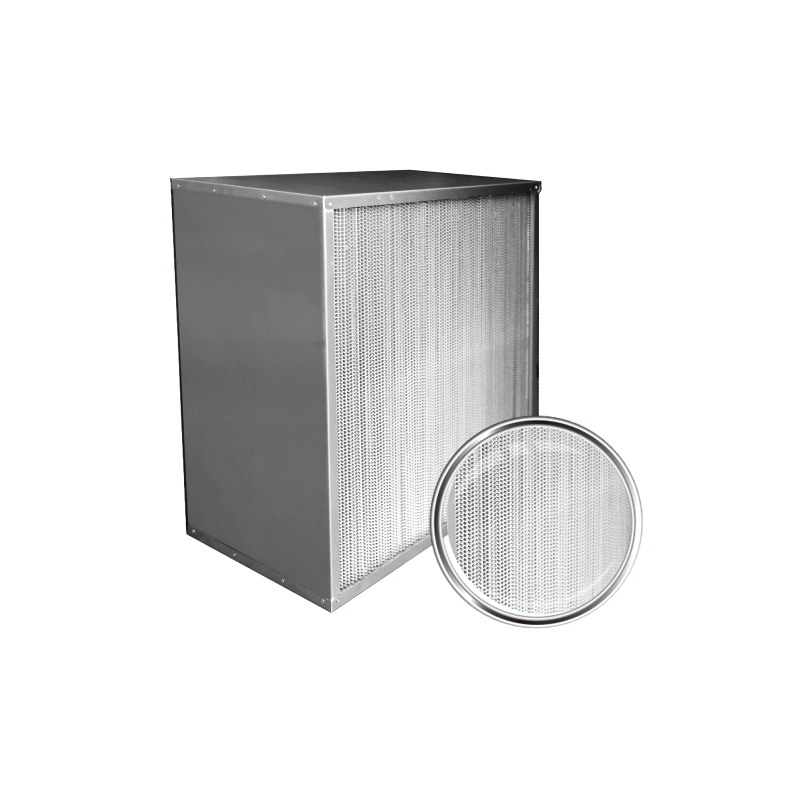
The Ranveth separator pleated rigid box filter is a medium-efficiency air filter built around a corrugated separator and a deep-pleat media pack, offered in G4, M5, M6, F7, F8 and F9 grades with either non-woven fiber or high-precision glass fiber media. It captures particles in commercial air handling units, cleanroom pre-filtration stages, coating workshops and high-airflow exhaust plenums, and it is aimed at HVAC engineers, cleanroom contractors, OEM equipment builders and industrial maintenance buyers who need a stable, high-volume filter with predictable resistance. Ranveth builds the range in Zhongshan, Guangdong, China, and supports custom sizes and non-standard frames.
The useful way to read this filter is layer by layer, because the grade and service behaviour come from how the layers are paired rather than from any single material.
The first decision is the media itself. Non-woven fiber is the general-purpose choice for G4 to M6 work, where the load is coarse dust and the priority is holding a lot of it without a sharp rise in pressure drop. High-precision glass fiber is used for the finer F7 to F9 grades, where the target is sub-micron capture and the pleat pack has to stay open and undistorted under airflow. Both media are formed into deep pleats, and the depth is what gives the filter its large effective area: more media in the same face size means lower face velocity at a given airflow, which in turn lowers resistance and raises dust-holding capacity.
The second decision is the support structure. A pleat pack alone will collapse or balloon under load, so corrugated separators are inserted between the pleats to hold the spacing. This is the defining feature of the box design: each pleat is mechanically supported along its depth, so the pack resists deformation and rupture during handling, installation and long service at high airflow. The pack is then set into a rigid box frame, in aluminum or galvanized steel, which keeps the filter square and lets it seat cleanly in a holding frame or AHU track.
The third element is the rated operating velocity. This range is rated at 2.5 m/s, which is a deliberately high figure: the separator-supported pack is intended for ventilation systems moving large air volumes, where a lighter pleat design would deflect or shed pleats. The practical consequence for a buyer is that efficiency, resistance and service life move together. Choosing a higher grade raises capture but also raises initial resistance; choosing a deeper pleat pack lowers resistance but takes more space in the duct. The separator allows that trade-off to be made without the pack losing its shape.
| Item | Detail |
|---|---|
| Product name | Separator pleated rigid box filter |
| Efficiency grades | G4 / M5 / M6 / F7 / F8 / F9 |
| Core media | Non-woven fiber or high-precision glass fiber |
| Frame and support | Aluminum or galvanized steel frame with corrugated separators |
| Rated operating air velocity | 2.5 m/s, for high-airflow ventilation systems |
| Typical applications | Pre-filtration for Class 100 cleanrooms in pharmaceutical and electronics plants; intake sections of commercial AHU systems; dust removal in coating shops; industrial high-velocity exhaust outlets |
| Standard size references (W × H × D) | 24×24×21 in (594 × 594 × 534 mm); 24×20×21 in (594 × 492 × 534 mm); 24×24×15 in (594 × 594 × 381 mm); 12×24×21 in (289 × 594 × 534 mm) |
| Customisation (OEM/ODM) | Custom sizes and non-standard frames supported; produced in a 50,000 m² plant with a CNAS-accredited testing laboratory, under ISO 9001/14001/45001 and IATF 16949 systems |
The most common duty is pre-filtration ahead of a final-stage filter. In pharmaceutical plants and electronics plants running Class 100 cleanrooms, a separator box filter in F7 to F9 takes the bulk of the particulate load and protects the terminal HEPA stage behind it, which is where the economics of the product sit: a filter that holds more dust before reaching its final resistance extends the replacement interval of the more expensive filter downstream.
In commercial buildings the same filter sits in the intake section of air handling units, where the 2.5 m/s rating and the rigid box construction suit large-volume ventilation. Coating workshops use it for dust removal in paint and surface lines, where the media choice is usually driven by the solvent and dust profile of the process. Industrial high-velocity exhaust outlets are the fourth regular duty, and this is where the separator structure earns its place, because exhaust plenums are exactly the environment that distorts an unsupported pleat pack.
The range also appears in semiconductor and microelectronics facilities, medical and cleanroom projects, pharmaceutical and food processing plants, automotive and machinery manufacturing, AI computing and data centers, energy storage facilities, and energy and metal smelting operations. In each case the grade is selected against the particle size the process is sensitive to, not simply against the highest available number.
Custom builds are a normal part of this product line, and the more context you send, the faster a workable proposal comes back. To quote accurately we need:
Frame material, media grade, separator type, labeling and packaging can all be specified. Send the details through the contact page and we will confirm what is feasible before any commitment.
The media choices in this filter are backed by measurement rather than assumption. Ranveth's own laboratory is accredited by CNAS (China National Accreditation Service for Conformity Assessment) and can issue test reports covering filtration efficiency, dust-holding capacity and resistance, which is what allows a buyer to compare grades on the same basis instead of on datasheet wording alone.
Production sits in a 50,000 m² plant in Zhongshan, Guangdong, China, of which 20,000 m² is made up of six cleanrooms. The quality system holds ISO 9001, ISO 14001 and ISO 45001 certification, and IATF 16949 was added in 2024. Products meet the REACH and RoHS environmental requirements and compliance documentation can be supplied.
Ranveth has more than 20 years of filtration product development and manufacturing experience and has exported to Europe, the United States, Japan and South Korea for over 20 years. More than 1,000 filtration solutions have been developed to date, and OEM/ODM work covers dimensions, structure, media grade, frame material, logo and packaging. Multiple automated production lines support monthly output in the millions of pieces, with IQC, IPQC and OQC checks across the process.
If you are evaluating this filter for a project, we can supply samples with test data and quote against your actual dimensions and airflow. To move quickly, tell us the equipment or system model, the size or drawing, the airflow, the operating conditions and the quantity you expect. Use the contact page to send them, and we will respond with a proposal and the relevant documentation.
The filter is available with non-woven fiber media for the G4 to M6 grades and high-precision glass fiber media for the F7 to F9 grades. The media is formed into deep pleats and held apart by corrugated separators inside an aluminum or galvanized steel box frame. The combination is chosen so that the pleat pack keeps its shape at the rated 2.5 m/s air velocity.
The corrugated separators hold the pleats at a fixed spacing along their full depth, so the pack resists deformation and rupture under airflow. That keeps the effective media area stable, which keeps resistance predictable and lets the filter hold more dust before reaching its final pressure drop. In practice, a stable pack means the replacement interval is set by dust load rather than by pleat collapse.
Yes. Custom sizes and non-standard frames are supported, along with a choice of media grade, frame material, separator type, labeling and packaging. Send the face dimensions and depth, or a drawing if the installation is not a standard track, together with the airflow the filter must handle. We will confirm what is feasible before quoting.
Samples are available, and custom sample development typically takes 7 to 15 days. Sample reports from the CNAS-accredited laboratory cover efficiency, initial resistance and dust-holding capacity, so the figures can be checked against your specification. Quotations are prepared against your dimensions, airflow and quantity.
Standard sizes typically start at 50 to 100 pieces. Custom specifications are confirmed case by case depending on size and material, and can be discussed flexibly. If you share your first order and expected annual volume, we can advise on the most practical arrangement.
Standard items are generally shipped within 15 to 20 days. Custom products typically take 25 to 35 days. For large orders we confirm an exact delivery date against the production schedule, and capacity is sufficient to support ongoing supply for brand owners and distributors.
Replacement is driven by the final resistance you set for the installation and by the dust load in the airstream, not by a fixed calendar period. Because the deep pleat pack holds a large dust load, the interval is usually longer than with a shallow-pleat filter of the same face size. Monitor pressure drop across the filter and replace when it reaches your defined limit.
Choose the grade against the particle size your process is sensitive to. G4 to M6 with non-woven media suits coarse dust and general ventilation, while F7 to F9 with glass fiber suits pre-filtration ahead of a final HEPA stage in cleanrooms and similar spaces. Sharing your airflow and operating conditions lets us recommend a grade and pleat depth that fit the 2.5 m/s rating. Contact us with your details to start.